
As Nation Moved to Civil War, the North had the Financial Edge

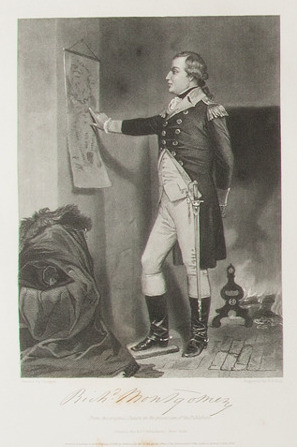
Richard Montgomery was an Irish soldier who served in the British Army before joining the Continental Army.

By Jim O’Neal

Richard Montgomery (1738-75) was a little-known hero-soldier born in Dublin, Ireland, who became a captain in the British Army in 1756. Later, he became a major general in the Continental Army after the Continental Congress elected George Washington as Commander in Chief of the Continental Army in June 1775. This position was created specifically to coordinate the military efforts of the 13 Colonies in the revolt against Great Britain.

Montgomery was killed in a failed attack on Quebec City led by General Benedict Arnold (before he defected). Montgomery was mourned in both Britain and America as his remains were interned at St. Paul’s Chapel in New York City.

A remarkably diverse group of schools, battleships and cities named in his honor remain yet today. Montgomery, Ala., is the capital and second-largest city in the state; it’s where Rosa Parks refused to give up her bus seat to a white passenger on Dec. 1, 1955, sparking the famous Montgomery bus boycott. Martin Luther King Jr. used Montgomery to great advantage in organizing the civil rights movement.

Montgomery was also the first capital of the Provisional Congress of the Confederate States when the first meeting was convened in February 1861. The first seven states that seceded from the United States had hastily selected representatives to visit the new Confederate capital. They arrived to find the hotels dirty, dusty roads, and noisy lobbyists overflowing in the statehouse. Montgomery was not prepared to host any large group, especially a large political convention.

Especially notable was that most of the South’s most talented men had already either joined the Army, the Cabinet or were headed for diplomatic assignments. By default, the least-talented legislators were given the responsibility of writing a Constitution, installing the new president (Jefferson Davis), and then authorizing a military force of up to 400,000 men. This conscription was for three years or the duration of the war. Like the North, virtually everyone was confident it would be a short, decisive battle.

Jefferson Davis was a well-known name, having distinguished himself in the Mexican War and serving as Secretary of War for President Franklin Pierce. Like many others, he downplayed the role of slavery in the war, seeing the battle as a long-overdue effort to overturn the exploitive economic system that was central to the North. In his view, the evidence was obvious. The North and South were like two different countries: one a growing industrial power and the other stuck in an agricultural system that had not evolved from 1800 when 80 percent of its labor force was on farms and plantations. The South now had only 18 percent of the industrial capacity and trending down.

That mediocre group of lawmakers at the first Confederate meeting was also tasked with the challenge of determining how to finance a war against a formidable enemy with vastly superior advantages in nearly every important aspect. Even new migrants were attracted to the North’s ever-expanding opportunities, as slave states fell further behind in manufacturing, canals, railroads and even conventional roads, all while the banking system became weaker.

Cotton production was a genuine bright spot for the South (at least for plantation owners), but ironically, it generated even more money for the North with its vast network of credit, warehousing, manufacturing and shipping companies. The North manufactured a dominant share of boots, shoes, cloth, pig iron and almost all the firearms … an ominous fact for people determined to fight a war. The South was forced to import foodstuffs in several regions. Southern politicians had spoken often of the need to build railroads and manufacturing, but these were rhetorical, empty words. Cotton had become the powerful narcotic that lulled them into complacency. Senator James Hammond of South Carolina summed it up neatly in his “Cotton is King” speech on March 4, 1858: “Who can doubt, that has looked at recent events, that cotton is supreme?”

Southerners sincerely believed that cotton would rescue them from the war and “after a few punches in the nose,” the North would gladly surrender.

One of those men was Christopher G. Memminger, who was selected as Confederate States Secretary of the Treasury and responsible for rounding up gold and silver to finance the needs of the Confederate States of America (CSA). A lawyer and member of the South Carolina legislature, he was also an expert on banking law. His first priority was for the Treasury to get cash and he started in New Orleans, the financial center of the South, by raiding the mint and customs house.

He assumed there would be at least enough gold to coin money and commissioned a design for a gold coin with the goddess of liberty seated, bearing a shield and a staff flanked by bales of cotton, sugar cane and tobacco. Before any denominations were finalized, it was discovered there was not enough gold available and the mint was closed in June.

This was followed by another nasty surprise: All the banks in the South possessed only $26 million in gold, silver and coins from Spain and France. No problem. Memminger estimated that cotton exports of $200 million would be enough to secure hundreds of millions in loans. Oops. President Lincoln had anticipated this and blockaded all the ports after Fort Sumter in April 1861. No cotton, no credit, no guns.

In God we trust. All others pay cash.

One small consolation was that his counterpart in the North, Salmon P. Chase, was also having trouble raising cash and had to resort to the dreaded income tax. However, both sides managed to keep killing each other for four long years, leaving a legacy of hate.
Intelligent Collector blogger JIM O’NEAL is an avid collector and history buff. He is president and CEO of Frito-Lay International [retired] and earlier served as chair and CEO of PepsiCo Restaurants International [KFC Pizza Hut and Taco Bell].
Telegram Pushed War-Weary America into World War I

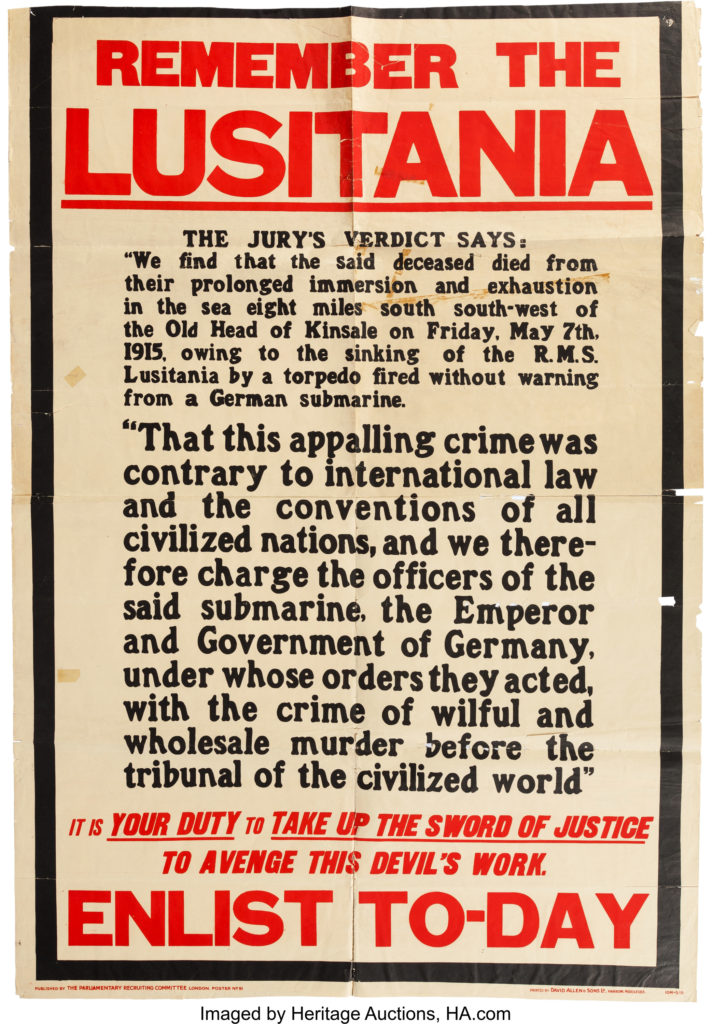
A British recruiting poster issued in the wake of the sinking of the ocean liner Lusitania by a German U-boat in 1915 was offered in a December 2016 auction.

By Jim O’Neal

World War I officially began in Europe on July 28, 1914, but the strong isolationist sentiment in the United States prevented our involvement for nearly three years. The U.S. economy was booming and the tragic events in Europe were broadly viewed as a “foreign affair,” 3,000 miles across the Atlantic Ocean and something to be avoided. Further, it had only been 51 years since our Civil War had ended, with General Robert E. Lee surrendering to Ulysses S. Grant at Appomattox. The United States had not fully recovered from a military readiness standpoint and another war would be hard to sustain. The rebuilding of the South simply added to the problem.

Then there were the American bankers, who would make massive loans to Great Britain and France that would produce a nice, steady stream of profits. They were more than content to stay on the sidelines as long as their capital seemed secure. Show me a war and I will bet there are always groups profiting from making the bullets and bombs that create jobs. Other industries like steel or food production generally end up on the positive side of the export equation. Twenty-five years later, gearing up for World War II would help the country break the grip of the Great Depression. (Our military budget is currently over $700 billion … and growing.)

Another important factor were the immigrants in the United States, whose support was dependent on their country of origin. Most had left behind family and friends who would end up in harm’s way if America escalated the war. Naturally, there were also the permanent peaceniks like the Quakers and other religious groups who were simply pacifists by virtue of their beliefs. Two million socialists could be lumped into this group, as well as numerous women’s organizations.

The 8 million German-Americans had little loyalty to Germany, and were surprisingly neutral in addition to being strongly against any war, especially if it involved Germany. Their primary concern if the United States entered the war revolved around the reprisals against them as questions about their allegiance to America were already at a simmering level. This apprehension had been growing since the sinking of the British passenger ship Lusitania and German U-boats sank six American merchant ships, including the Housatonic – all without any warning.

On Nov. 7, 1916, President Woodrow Wilson was re-elected on an anti-war platform and a campaign slogan of “He kept us out of war” (note the past tense). He had defeated Supreme Court Justice Charles Evans Hughes Sr. by dominating the Southern vote and in the run-up to the election knew it would be a competitive battle. With a war raging in Europe, Wilson was concerned that if he lost, he would be a lame-duck president for four long months. He devised a clever plan that involved making Hughes the Secretary of State and then he and Vice President Thomas R. Marshall would immediately resign and Hughes would become president, as the rules of succession applied at that time.

Wilson was the first sitting Democratic president to win re-election since Andrew Jackson in 1832. Six months later, we would be in World War I due to a quirk of fate or a German blunder: the Zimmermann Telegram.

In January 1917, a coded message was sent from German Foreign Secretary Arthur Zimmermann to Germany’s Ambassador to Mexico that was to be relayed to Mexican President Venustiano Carranza. “We intend to begin on the first of February unrestricted submarine warfare. We shall endeavor to keep the United States neutral … If not succeeding, we make Mexico a proposal on the following basis; make war together, make peace together, generous financial support … Mexico is to re-conquer the lost territory in Texas, New Mexico and Arizona. The settlement detail is left to you.”

On Feb. 1, 1917, Germany began unrestricted U-boat warfare in the Atlantic. U.S. ships came under attack and the USA broke off diplomatic relations with Germany.

March 1, President Wilson authorized the State Department publication of the Zimmermann Telegram in the press and, as intended, it inflamed American public opinion against Germany.

April 2: Wilson addressed a special session of Congress to declare war.

April 4: Senate approved 82-6 (the House concurred 373-50).

April 6: Wilson signed a formal declaration of war on Germany.

And so war came again to America despite the reluctance of many people.

BTW: On April 14, after the formal declaration of war, President Carranza formally declined the German proposal. It is interesting to speculate on the outcome if the decision had been in the affirmative. I suspect we might have ended up with a few more stars on the flag.

Intelligent Collector blogger JIM O’NEAL is an avid collector and history buff. He is president and CEO of Frito-Lay International [retired] and earlier served as chair and CEO of PepsiCo Restaurants International [KFC Pizza Hut and Taco Bell].
McKinley Skillfully Assumed More Presidential Power

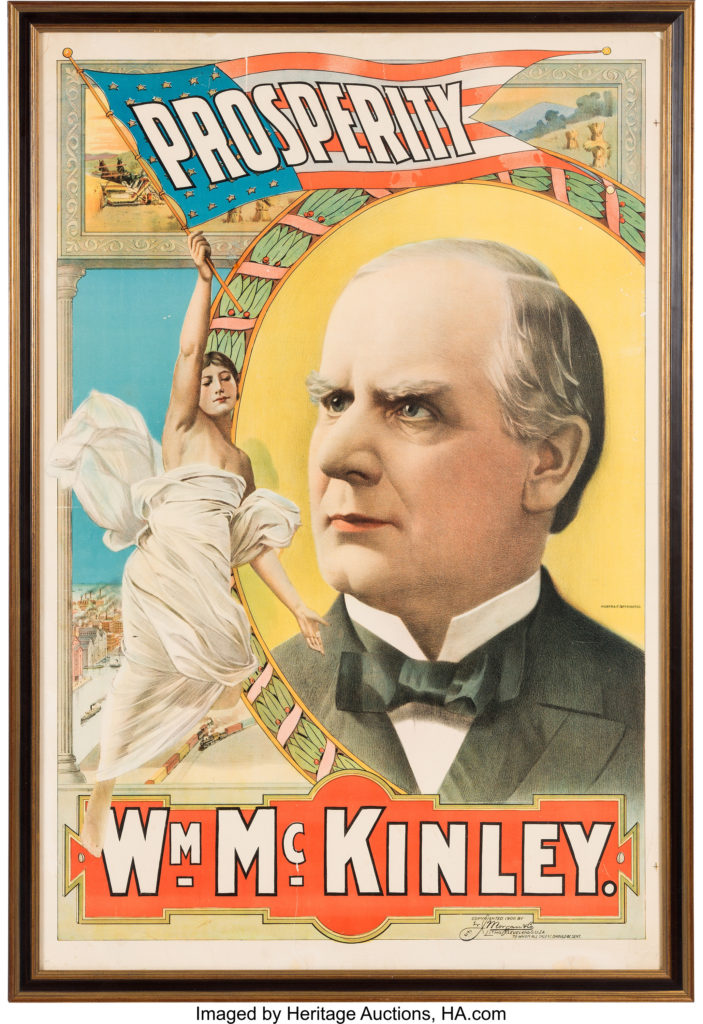
This William McKinley political poster, dated 1900, sold for $6,875 at a May 2015 Heritage auction.

By Jim O’Neal

William McKinley was 54 years old at the time of his first inauguration in 1897. The Republicans had selected him as their nominee at the St. Louis convention on the first ballot on June 16, 1896. He had spent several years as an effective congressional representative and more recently the 39th governor of Ohio. Importantly, he had the backing of a shrewd manager, Mark Hanna, and the promise of what turned out to be the largest campaign fund in history – $3.5 million – largely by describing the campaign as a crusade of the working man versus the rich, who had impoverished the poor by limiting the money supply.

In the 1896 election, he defeated a remarkable 36-year-old orator, William Jennings Bryan, perhaps the most talented public speaker who ever ran for any office. McKinley wisely decided he could not compete against Bryan in a national campaign filled with political speeches. He adopted a novel “front porch” campaign that resulted in trainloads of voters arriving at his home in Canton, Ohio.

Bryan would lose again to McKinley in 1900, ducked Teddy Roosevelt in 1904, and then lose a third time in 1908 against William Howard Taft. The three-time Democratic nominee did serve two years as secretary of state for Woodrow Wilson (1913-15) and then died five days after the end of the Scopes Monkey Trial in 1925.

William and Ida McKinley followed Grover and Frances Cleveland into the White House after Cleveland’s non-consecutive terms as the 22nd and 24th president. Cleveland’s second term began with a disaster – the Panic of 1893 – when stock prices declined, 500 banks closed, 15,000 businesses failed and unemployment skyrocketed. This significant depression lasted all four years of his term in office and Cleveland, a Democrat, got most of the blame.

His excuse was the 1890 Sherman Silver Purchase Act, which required the Treasury to buy any silver offered using notes backed by silver or gold. An enormous over-production of silver by Western mines forced the Treasury to borrow $65 million in gold from J.P. Morgan and the Rothschild family in England. Since Cleveland had been unable to turn the economy around, it virtually ruined the Democratic Party and created the era of Republican domination from 1861 to 1933, with only Woodrow Wilson winning in 1912 when squabbling between Roosevelt and Taft split the vote three ways.

It’s common knowledge that McKinley was assassinated in 1901 after winning re-election in 1900, but there’s little attention paid to the time he spent in office beginning in 1897. 1898 got off to a wobbly start when his mother died, leading to a full 30 days of mourning that canceled an important diplomatic New Year’s celebration. Tensions between the United States and Spain over Cuba had electrified the diplomatic community and it was hoped that a White House reception would have provided a convenient venue to discuss strategic options.

Spain had mistreated Cuba since Columbus discovered it in 1492 and in 1895, it suspended the constitutional rights of the Cuban people following numerous internal revolutions. Once again, the countryside raged with bloody guerilla warfare; 200,000 Spanish troops were busy suppressing the insurgents and cruelly governing the peasant population. American newspapers horrified the public with details that offended their sense of justice and prompted calls for U.S. intervention. Talk of war with Spain was in the air again.

On Feb. 9, two days before a reception to honor the U.S. Army and Navy, the New York Journal published a front-page article revealing the details of a Spanish diplomat denouncing McKinley as a weakling, “a mere bidder for the admiration of the crowd.” The same day, the Spanish minister in Washington retrieved his passport from the State Department and boarded a train to Canada.

A rapid series of events led to war with Spain, including $50 million that Congress placed at the disposal of the president to be used for defense of the country, with no conditions attached. McKinley was wary of war due to his experience in the Civil War, but he carefully discussed the issue with his Cabinet and key senators to ensure concurrence. This was the first significant step to war and ultimately the transformation of presidential power. On April 25, Congress formally declared war on Spain and the actual landing of forces took place on June 6, when 100 Marines went ashore at Guantanamo Bay.

McKinley’s skillful assumption of authority during the Spanish-American War subtly changed the presidency, as Professor Woodrow Wilson of Princeton University wrote: “The president of the United States is now … at the front of affairs as no president since Lincoln has been since the start of the 19th century.” Those who followed McKinley into the White House would develop and expand these new powers of the presidency … starting with his vice president and successor Theodore Roosevelt, who had eagerly participated in the war with Spain with his “Rough Riders at San Juan Hill.”

We see their fingerprints throughout the 20th century and even today as the concept of formal declarations of war has become murky. Urgency has gradually eroded the power enumerated to Congress and there is almost always “no time to wait for an impotent Congress to resolve their partisan differences.”

The Founding Fathers would be surprised at how far the pendulum has swung.

Intelligent Collector blogger JIM O’NEAL is an avid collector and history buff. He is president and CEO of Frito-Lay International [retired] and earlier served as chair and CEO of PepsiCo Restaurants International [KFC Pizza Hut and Taco Bell].
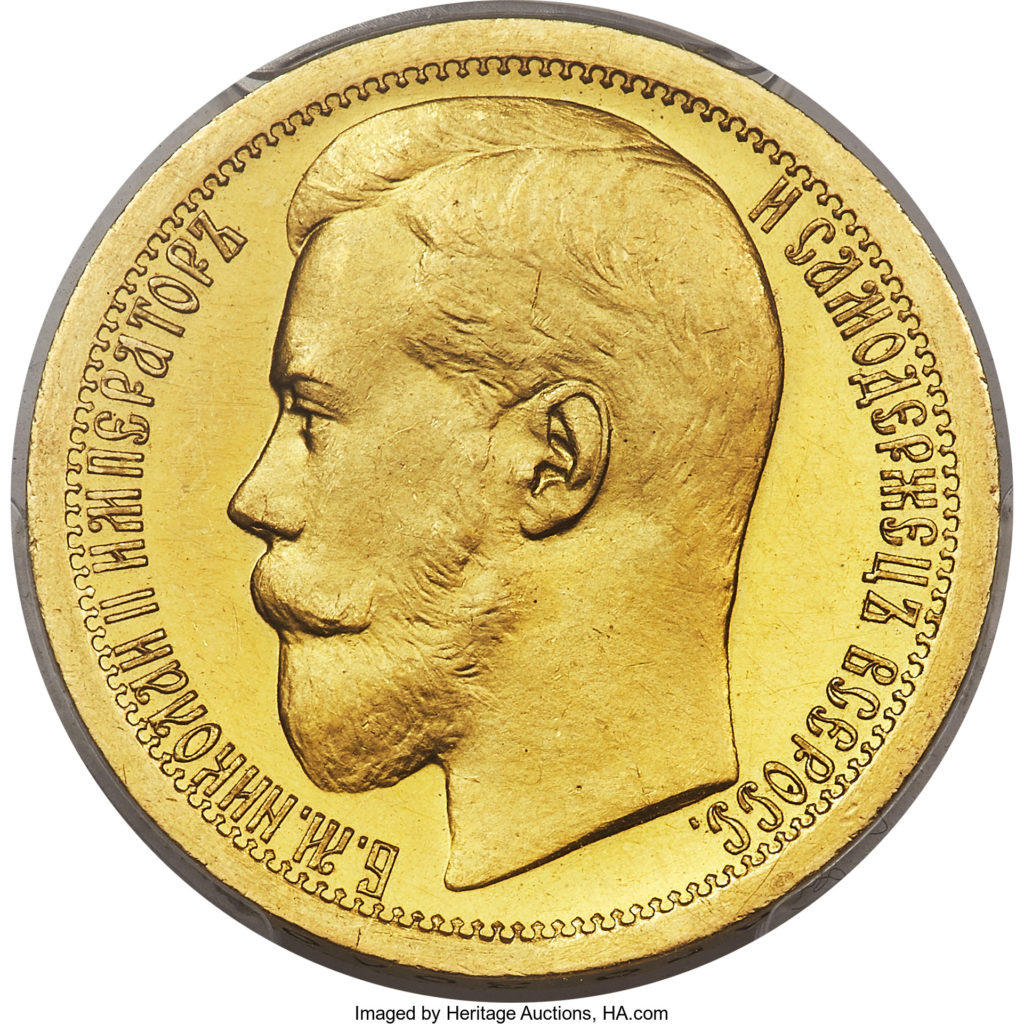
Head-Butting with Russia Dates Back Nearly 300 Years

This Nicholas II gold specimen Imperial of 10 Roubles, 1895, sold for $228,000 at a January 2018 Heritage auction.

By Jim O’Neal

In the 21st century, the United States-Russian Federation relationship has become more contentious and complex. The deterioration accelerated during the second Obama term following disagreements over the Ukraine and the reabsorption of Crimea in 2014 after Secretary of State Hillary Clinton was unable to hit the reset button. The U.S. presidential election of 2016 ended with reports of Russian interference and has steadily morphed into a major issue covered obsessively by the media.

Formal investigations include both Houses of Congress, the FBI-Justice Department and a Special Prosecutor who is delving into possible obstruction and conspiracy activities, plus an unknown series of related crimes. It has become a “cottage industry” that is either really big (e.g. subpoenas, indictments and impeachment) or simply another partisan distraction.

For perspective, it is useful to recall that difficulties involving Russia are not a recent or even a 20th-century phenomenon. They started well before we became an independent nation and continued until we jointly became the world’s two superpowers. From 1732 to 1867, there were a number of squabbles with Tsarist Russia that stretched from the Bay Area in Northern California up the Pacific Coast to Alaska.

Like other European nations, Russia was interested in expanding through a strategy of colonization. They had become powerful under Peter the Great (1672-1725), who needed to develop new territories with fur-bearing mammals after over-hunting depleted the stocks in Siberia. He dispatched cartographer Vitus Bering to explore Alaska, and the first permanent settlement was a fur-trading settlement in 1784. This was followed by the Russian-American Company (RAC), formed in an attempt to monopolize the fur trade and convert Alaskan natives to pseudo-Russian subjects to help with maritime fur trading.

They migrated to the pristine Northern California Pacific Ocean area and in 1812 were able to establish an outpost called Fort Ross. Fort Ross lasted until 1841 and is now a California Historical Landmark an hour’s drive north of the bustling San Francisco Bay. However, the Russians were never able to make North America profitable and Secretary of State William Seward negotiated the purchase of Alaska for $7.2 million in 1867. Originally scoffed at as “Seward’s Folly,” the territory was admitted as the 49th state on Jan. 3, 1959.

At two cents an acre, the state’s 663,268 square miles was larger than the combined areas of Texas, California and Montana. Along with the Louisiana Purchase, it became one of the better land deals the United States made, excluding, of course, areas where we simply overpowered American Indians and took their land and anything else that was unoccupied.

Although we were allies with Russia during World War II, post-war Germany was up for grabs and Berlin became the next area of contention. It was decided to divide it with the United States, the United Kingdom and France taking three parts (West) and Russia taking the remainder (East) in 1945. In 1952, Russia closed the border and in 1961, they built the Berlin Wall to hinder defections to the West. It was here that President Reagan made his famous speech in 1987 … “Secretary General Gorbachev … tear down this wall,” and it did fall on Nov. 9, 1989, and Germany was officially reunited on Oct. 3, 1990. By then, George Herbert Walker Bush was president.

Oh, yes, Reagan’s speech was made on June 12 … while President Bush was celebrating his 63rd birthday. Happy Birthday, President Bush! We miss you. Get well soon.

Intelligent Collector blogger JIM O’NEAL is an avid collector and history buff. He is president and CEO of Frito-Lay International [retired] and earlier served as chair and CEO of PepsiCo Restaurants International [KFC Pizza Hut and Taco Bell].
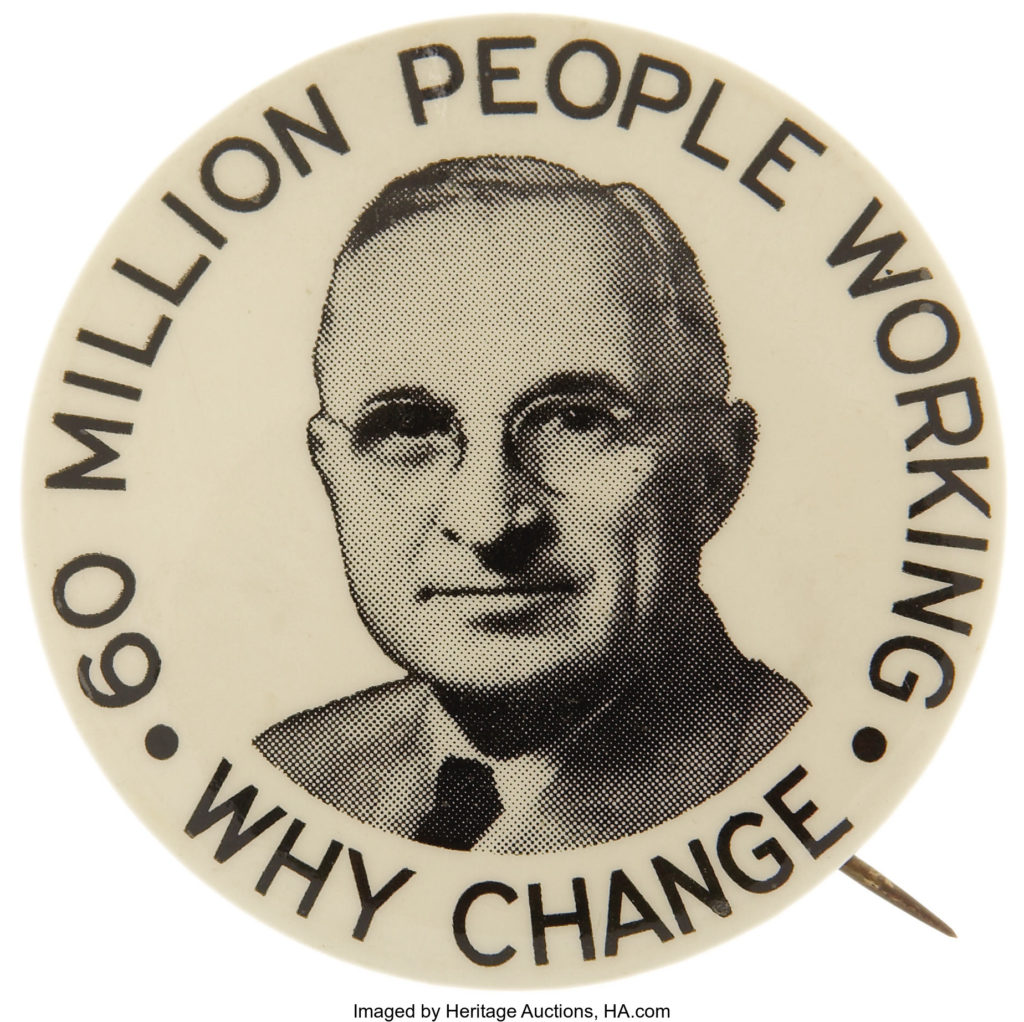
Tremendous Challenges Awaited the Plainspoken Truman

Fewer than 10 examples of this Harry Truman “60 Million People Working” political pin are known to exist. This pin sold for $19,717 at an August 2008 Heritage auction.

By Jim O’Neal

When Franklin Roosevelt died on April 12, 1945, Harry Truman became the seventh vice president to move into the Oval Office after the death of a president. Truman had been born during the White House years of Chester Arthur, who had followed James Garfield after his assassination (1881). And in Truman’s lifetime, Teddy Roosevelt and Calvin Coolidge had ascended to the presidency after the deaths of William McKinley (1901) and Warren Harding (1923). However, none of these men had been faced with the challenges awaiting the plainspoken Truman.

FDR had been a towering figure for 12 years, first leading the country out of the Great Depression and then deftly steering the United States into World War II after being elected a record four times. Unfortunately, Truman had not been involved in several important decisions, and was totally unaware of several strategic secrets (e.g. the development of the atom bomb) or even side agreements made with others, notably Winston Churchill. He was not prepared to be president.

Even the presidents who preceded FDR tended to exaggerate the gap in Truman’s foreign-relations experience. Woodrow Wilson was a brilliant academic and Herbert Hoover was a world-famous engineer. There were enormously important decisions to be made that would shape the world for the next half century. Even Truman had his sincere doubts about being able to follow FDR, despite the president’s rapidly failing health.

The significance of these decisions has gradually faded, but for Truman, they were foisted upon him in rapid order: April 12, FDR’s death; April 28, Benito Mussolini killed by partisan Italians; two days later Adolf Hitler committed suicide; and on April 29, German military forces surrendered. The news from the Pacific was equally dramatic as troop landings on the critical island of Okinawa had apparently been unopposed by the Japanese. It was clearly the apex of optimism regarding the prospects for an unconditional surrender by Japan and the welcomed return of world peace.

In fact, it was a miracle that turned out to be a mirage.

After victory in Europe (V-E Day), Truman was faced with an immediate challenge regarding the 3 million troops in Europe. FDR and Churchill did not trust Joseph Stalin and were wary of what the Russians would do if we started withdrawing our troops. Churchill proved to be right about Russian motives, as they secretly intended to continue to permanently occupy the whole of Eastern Europe and expand into adjacent territories at will.

Then the U.S. government issued a report stating that the domestic economy could make a smooth transition to pre-war normalcy once the voracious demands from the military war-machine abated. Naturally, the war-weary public strongly supported “bringing the boys home,” but Truman knew that Japan would have to be forced to quit before any shifts in troops or production could start.

There was also a complex scheme under way to redeploy the troops from Europe to the Pacific if the Japanese decided to fight on to defend their sacred homeland. It was a task that George Marshall would call “the greatest administrative and logistical problem in the history of the world.”

Truman pondered in a diary entry: “I have to decide the Japanese strategy – shall we invade proper or shall we bomb and blockade? That is my hardest decision to date.” (No mention was made of “the other option.”)

The battle on Okinawa answered the question. Hundreds of Japanese suicide planes had a devastating effect. Even after 10 days of heavy sea and air bombardment on the island; 30 U.S ships sunk, 300 more damaged; 12,000 Americans killed; 36,000 wounded. It was now obvious that Japan would defend every single island, regardless of their losses. Surrender would not occur and America’s losses would be extreme.

So President Truman made a historic decision that is still being debated today: Drop the atomic bomb on Japan and assume that the effect would be so dramatic that the Japanese would immediately surrender. On Aug. 6, 1945, “Little Boy” was dropped on Hiroshima with devastating effects. Surprisingly, the Japanese maintained their silence, perhaps not even considering that there could be a second bomb. That second bomb – a plutonium variety nicknamed “Fat Man” – was then dropped two days ahead of schedule on Aug. 9 on the seaport city of Nagasaki.

No meeting had been held and there was no second order given (other than by Enola Gay pilot Paul Tibbets). The directive that had ordered the first bomb simply said in paragraph two that “additional bombs will be delivered AS MADE READY.” However, two is all that was needed. Imperial Japan surrendered on Aug. 15, thus ending one of history’s greatest wars.

Intelligent Collector blogger JIM O’NEAL is an avid collector and history buff. He is president and CEO of Frito-Lay International [retired] and earlier served as chair and CEO of PepsiCo Restaurants International [KFC Pizza Hut and Taco Bell].
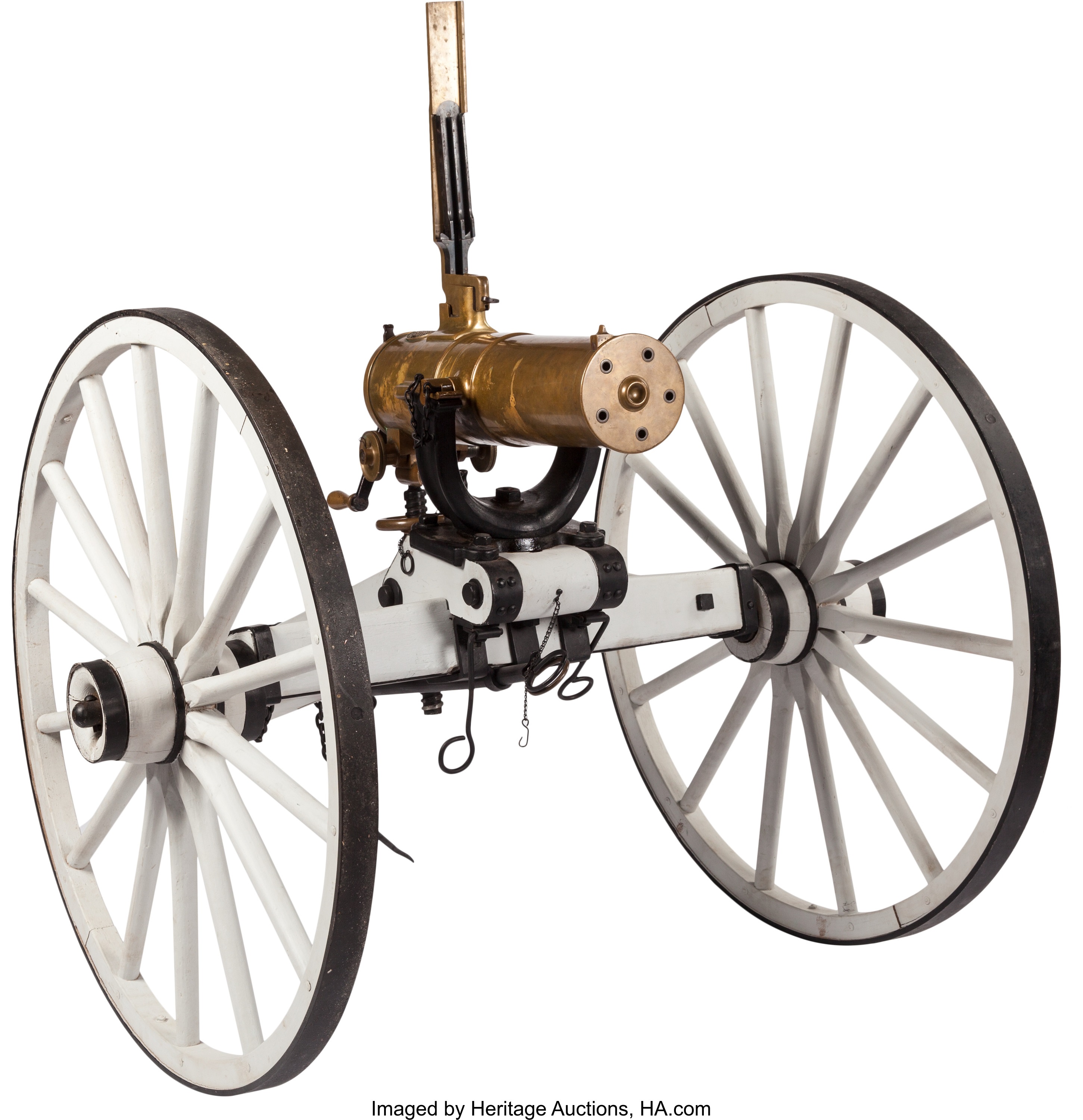
If President Jackson had Followed Through with a Threat…

This U.S. Colt Model 1877 Bulldog Gatling Gun, with five 18-inch barrels secured in brass casement, realized $395,000 at a December 2014 Heritage auction.

“An army travels on its stomach.”

By Jim O’Neal

Both Frederick the Great and Napoleon Bonaparte are credited with aphorisms similar to this theme intended to emphasize the concept that a well-provisioned military is critical to its performance. In 1775, France offered 10,000 francs to anyone who could improve this persistent problem. In 1809, a confectioner named Nicolas Appert claimed the prize by inventing a heating, boiling and sealing system that preserved food similar to modern technology.

During the Revolutionary War, General Washington had to contend with this issue, as well as uniforms and ordnance (e.g. arms, powder and shot), which were essential to killing and capturing the British enemies. Responsibilities were far too dispersed and decision-making overly reliant on untrained personnel.

By the dawn of the War of 1812, the War Department convinced Congress that all these activities should be consolidated under experienced military personnel. On May 14, 1812, the U.S. Army Ordnance Corps was established. Over the past 200-plus years, 41 different men (mostly generals) have held the title of Army Chief of Ordnance. The system has evolved slowly and is regarded as a highly effective organization at the center of military actions in many parts of the world.

However, when the Civil War started in 1861, the man in charge was General James Wolfe Ripley (1794-1870), a hardheaded, overworked old veteran that Andrew Jackson had once threatened to hang for disobedience during the war with the Creek Indians. Ripley believed that the North would make this a short war and all they needed was an ample supply of orthodox weapons. He flatly refused to authorize the purchase of additional rifle-muskets for the infantry; primarily because of a large inventory of smooth bore muskets in various U.S. ordnance centers. Furthermore, he adamantly refused to allow the introduction of the more modern breech-loading repeating rifles due to a bizarre belief that ammunition would be wasted.

After two years of defiantly resisting the acquisition of new, modern weaponry, he was forced to retire. He was derided by the press as an old foggy, while some military historians claim he was personally responsible for extending the war by two years – a staggering indictment of enormous significance if in fact true!

One prominent example occurred in early June 1861 when President Lincoln met the first-known salesman of machine guns: J.D. Mills of New York, who performed a demonstration in the loft of a carriage shop near the Willard Hotel. Lincoln was so impressed that a second demonstration was held for the president, five generals and three Cabinet members. The generals were equally impressed and ready to place an order on the spot. But, Ripley stubbornly managed to delay any action.

Lincoln was also stubborn and personally ordered 10 guns from Mills for $1,300 each without consulting anyone. It was the first machine gun order in history.

Then, on Dec. 18, 1861, General George McClellan bought 50 of the guns on a cost-plus basis for $750 each. Two weeks later, a pair of these guns debuted in the field under Colonel John Geary, a veteran of the Mexican War, the first mayor of San Francisco and, later, governor of both Kansas and Pennsylvania. Surprisingly, he wrote a letter saying they were “inefficient and unsafe to the operators.” But the colorful explorer General John C. Fremont, who commanded in West Virginia, sent an urgent dispatch to Ripley demanding 16 of the new machine guns.

Ripley characteristically replied:

“Have no Union Repeating Guns on hand and am not aware that any have been ordered.”

After several other tests produced mixed results, Scientific American wrote a requiem for the weapon, saying, “They had proved to be of no practical value to the Army of the Potomac and are now laid up in a storehouse in Washington.”

Then, belatedly, came a gifted inventor, Richard J. Gatling, who patented a six-barrel machine gun on Nov. 4, 1862. Gatling tried to interest Lincoln, who had now turned to other new weapons. However, some managed to get into service and three were used to help guard The New York Times building in the draft riots of July 1863. The guns eventually made Gatling rich and famous, but it was more than a year after the end of the war – Aug. 14, 1866 – when the U.S. Army became the first to adopt a machine gun … Gatlings!

It is always fun to consider counterfactuals (i.e. expressing what might have happened under different circumstances). In this case, if Andrew Jackson had hanged Ripley, then the North would have had vastly superior weaponry – especially the machine gun – and the war would have ended two years earlier. Many battles would have been avoided … Gettysburg … Sherman’s March to the Sea. Lincoln would have made a quick peace, thereby avoiding the assassination on April 14, 1865.

If … if … if …

Intelligent Collector blogger JIM O’NEAL is an avid collector and history buff. He is president and CEO of Frito-Lay International [retired] and earlier served as chair and CEO of PepsiCo Restaurants International [KFC Pizza Hut and Taco Bell].
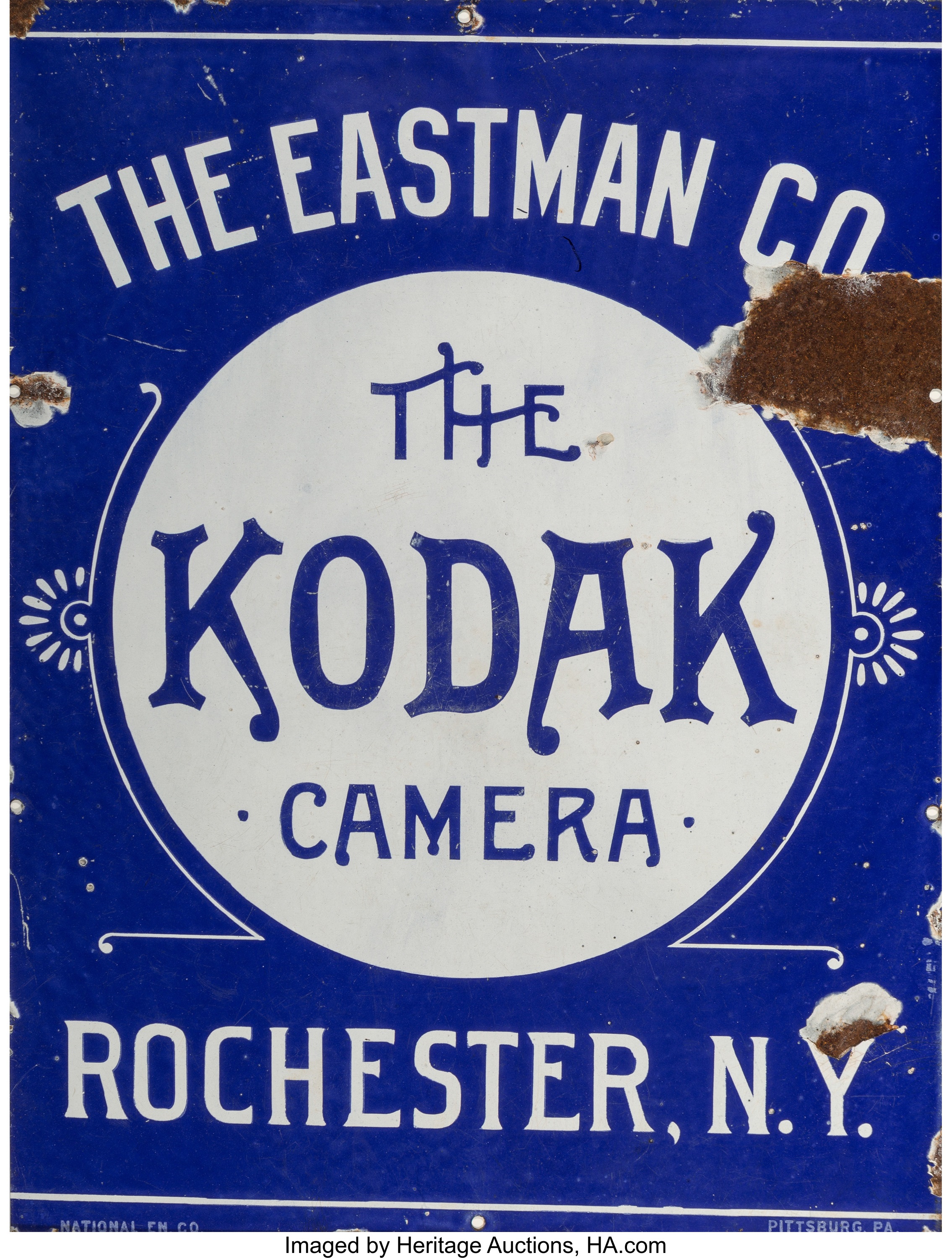
Much has Changed Since the Invention of ‘Instant’ Cameras

An Eastman Company porcelain enamel on steel advertising sign sold for $1,625 at a September 2017 auction.

By Jim O’Neal

In 2014, Internet Trends reported that people uploaded 1.8 billion images every day, or 657 billion per year. One curious statistician calculated that every two minutes, more photos are snapped than the total number in existence 150 years ago. Since there is an obvious correlation between smartphones, populations and photos, if my math is correct, that translates to 1.2 trillion photos taken in 2017. However, all that I am certain of is that in the past three years I’ve personally taken approximately zero – despite having the newest iPhone around almost constantly. There must be a term for people like me, but I’m not familiar with it.

Anyway, the man who probably deserves most of the credit for this photographic phenomenon is George Eastman. In 1888, he invented the Kodak camera and a dry, transparent, flexible photographic film to use with the camera. Eastman was the founder of the once-famous Eastman Kodak Company and personally dreamed up a brilliant advertising slogan to induce average people to buy his new invention: “You push the button – we do the rest.”

Then in 1900, Eastman unveiled the first Brownie cameras and people quickly joined the Brownie Camera Club by the thousands. It was truly the birth of the snapshot and fostered the novel idea that every family (not just the rich) could actually create their own visual history for themselves and the generations that followed. Individual snapshots may have been relatively small from a mere size standpoint, but it was hugely democratic.

Those first Brownies used film that sold for 15 cents a roll, making photography financially feasible for virtually everyone in the country, no matter where they lived. More than a quarter of a million Brownies were sold in the first year and an astonishing 50 million by the early 1940s.

Eastman (1854-1932) was supremely confident about the positive effect of advertising to increase sales; and even more confident that a major effort to educate the public would be an essential element to make it a mass-market product. He wrote all the ads personally and championed the expansion of the brand internationally. One specific example was the word “Kodak” sparkling down from an electric sign on Trafalgar Square in central London.

When asked about the derivation of the word Kodak, Eastman would invariably say that “the letter K was my favorite. It’s a strong, incisive sort of letter. So it was simply a matter of trying out a great number of combinations of words that started and ended with K.” Add the distinctive yellow color that Eastman selected and Kodak became an instantly recognized brand all over the world.

The word that didn’t seem to fit the true impact of Eastman’s invention was “hobby.” His Brownie meant that aspiring photographers no longer had to be bothered by technical camera settings, precise focus or even film development. After exposing the film, the entire camera was then shipped back to Eastman’s factory. The film was developed, camera reloaded and mailed back to the customer along with the mounted prints. As early as 1896, the 100,000th Kodak camera was manufactured and the factory was churning out 400 miles of film and photography paper each month.

Eastman not only had powerful, creative ideas; he understood that he had to execute better than any of the inevitable competition. In time, Kodak had developed an impeccable reputation for affordable cameras and film. It was a formula that was replicated by Gillette (for razors and blades) and Sony (its Walkman provided a private, convenient concert in your ear any time of your choosing).

Yet as successful as Kodak became, there was someone else who would perceive our desire for even greater speed and instant gratification. (No, not Jeff Bezos.)

His name was Edwin Land (1909-1991) and in December 1943, he was on vacation with his family, walking around taking pictures (probably with a Kodak). Back in their room, his daughter posed a simple question: “But Daddy, why can’t I see the pictures now?” Instead of the standard reply … “Because you can’t” … Land started working on solving that problem. He recalled, “Within an hour, the camera, the film and the physical chemistry became so clear. I rushed to my patent attorney and described in great detail a dry camera which would give a picture immediately after exposure.”

Of course, he had conceptualized the Polaroid instant photographic process, which would own that category for decades. Their SX-70 instant color camera was an overnight success as we all responded to the massive TV advertising in which Sir Laurence Olivier sold us on the revolutionary idea of instant photography.

Alas, these two iconic photographic companies ended up in the largest patent suit, with Polaroid suing Kodak for infringing on 12 patents in 1976 and the litigation lasted until 1985, when Kodak was found guilty of infringing seven patents. The story has a sad ending since Kodak is now a shadow of its size and Polaroid ended up in bankruptcy, both victims of 20th century digital photography, which basically obsoleted everything else in sight.

But, think about all the memories that are stored in every house in America, just waiting for someone to take another look and spend time trying to figure out who all these people were and the stories about when they were taken. There is joy in all those cabinets.

Intelligent Collector blogger JIM O’NEAL is an avid collector and history buff. He is president and CEO of Frito-Lay International [retired] and earlier served as chair and CEO of PepsiCo Restaurants International [KFC Pizza Hut and Taco Bell].
America has a Long History of Rough-and-Tumble Politics

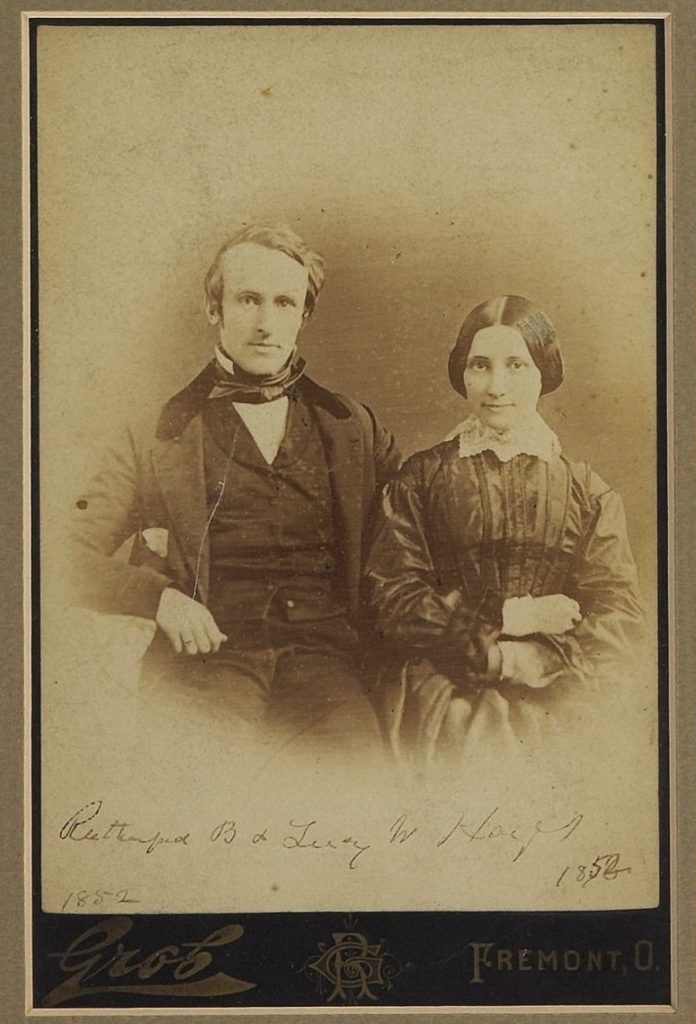
A cabinet card photograph dated 1852, shortly after the marriage of Rutherford and Lucy Hayes, went to auction in October 2008.

By Jim O’Neal

A surprisingly high number of political pundits ascribe the current bitter partisan divide to the presidential election of 2000, when the Supreme Court ordered the recount of “under-votes” in Florida to cease. As a result, the previously certified election results would stand and George W. Bush would receive all 25 Florida electoral votes, thus providing him a 271-266 nationwide victory over Al Gore. Democrats almost universally believed the election had been “stolen” due to the seemingly unprecedented action by the Supremes.

Although obviously a factor in the situation today, it seems too simplistic to me, as I remember the Clinton Impeachment, the start of the Iraq War (and the president who lied us into war), and, of course, Obamacare – all of which were also major contributors to the long, slow erosion of friendly bipartisanship. Now, we’re in an era when each new day seems to drag up a new issue that Americans can’t agree on and the schism widens ever so slightly.

Could it be worse?

The answer is obviously “yes,” since we once tried to kill each other into submission during the Civil War. Another good example is the highly controversial presidential election of 1876, which resulted in Rutherford B. Hayes becoming president. The loser, Samuel J. Tilden, had such staunch supporters that they promised “blood would run in the streets” if their candidate lost. After a highly ultra-controversial decision threw the election to Hayes, Democrats continued to make wild threats, and public disturbances were rampant across New York City hotels, saloons, bars and any other venues where crowds gathered.

The unrest was so high that outgoing President Ulysses S. Grant gradually became convinced that a coup was imminent. This was the closest the Dems had come to the White House since James Buchanan’s election 20 years earlier in 1856 and passions were so high that they would not be calmed easily. The level of resentment was much more than about losing an election or the ascendancy of the Republican Party with all their fierce abolitionists. It seems apparent even today that the election results had been politically rigged or, at a minimum, very cleverly stolen in a quasi-legalistic maneuver.

Grant’s primary concern was one of timing. The normal inauguration date of March 4 fell on a Sunday and tradition called for it to be held the next day, on Monday, March 5 (as with Presidents James Monroe and Zachary Taylor). Thus the presidency would be technically vacant from noon on Sunday until noon on Monday. The wily old military genius knew this would be plenty of time to pull off a coup d’état. He insisted Hayes not wait to take the oath of office.

In a clever ruse, the Grants made arrangements for a secret oath-taking on Saturday evening by inviting 38 people to an honorary dinner at the White House. While the guests were being escorted to the State Dining Room, Grant and Hayes slipped into the Red Room, where Chief Justice Morrison Waite was waiting with the proper documents. All went as planned until it was discovered there was no Bible available. No problem … Hayes was sworn in as the 19th president of the United States with a simple oath.

The passing of power has been one of the outstanding aspects of our constitutional form of governance.

Hayes was born on Oct. 4, 1822 – 2½ months after his father had died of tetanus, leaving his pregnant mother with two young children. From these less-than-humble beginnings, the enterprising “Rud” got a first-rate education that culminated with an LLB degree from Harvard Law School. Returning to Ohio, he established a law practice, was active in the Civil War and finally served two non-consecutive terms as governor of Ohio, which proved to be a steppingstone to the White House.

Most historians believe Hayes and his family were the richest occupants of the White House until Herbert and Lou Hoover showed up 52 years later. They certainly had a reputation for living on the edge of extravagance, and some cynics believe this was in large part due to the banning all alcohol in the White House (presidents in those days paid for booze and wine personally). Incidentally, the nickname for the first lady, “Lemonade Lucy,” did not happen until long after they left the White House.

President Hayes kept his pledge to serve only one term; he died of a heart attack in 1893 at age 70. The first Presidential Library in the United States was built in his honor in 1916.

Intelligent Collector blogger JIM O’NEAL is an avid collector and history buff. He is president and CEO of Frito-Lay International [retired] and earlier served as chair and CEO of PepsiCo Restaurants International [KFC Pizza Hut and Taco Bell].
Here’s Why Scientists Like Joseph Lister Have Made Life Better for All of Us

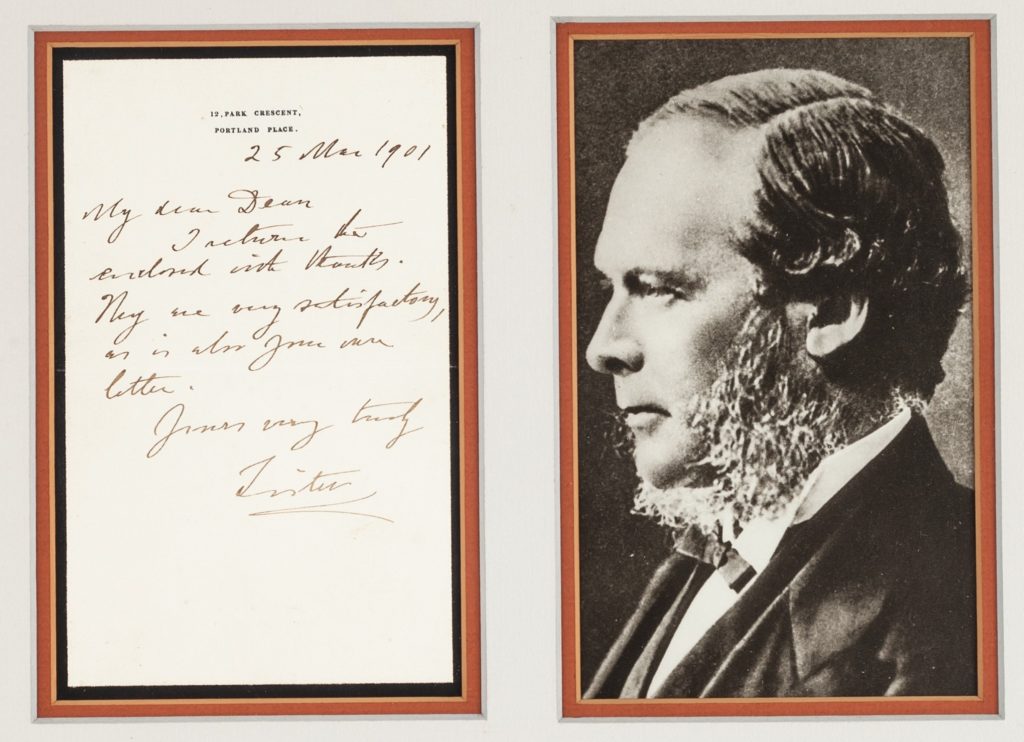
A March 25, 1901, letter signed by Joseph Lister went to auction in October 2014.

By Jim O’Neal

In the 1880s, American physicist Albert Michelson embarked on a series of experiments that undermined a long-held belief in a luminiferous ether that was thought to permeate the universe and affect the speed of light ever so slightly. Embraced by Isaac Newton (and almost venerated by all others), the ether theory was considered an absolute certainty in 19th century physics in explaining how light traveled across the universe.

However, Michelson’s experiments (partially funded by Alexander Graham Bell) proved the exact opposite of the theory. In the words of author William Cropper, “It was probably the most famous negative result in the history of physics.” The fact was that the speed of light was the same in all directions and in every season – reversing Newton’s law that had been thought to be a constant for the past 200 years. But, not everyone agreed for a long time.

The more modern scientist Max Planck (1858-1947) helped explain the resistance to accept new facts in a rather novel way: “A scientific truth does not triumph by convincing its opponents and making them see the light, but rather because its opponents eventually die and a new generation grows up that is familiar with it.”

Even if true, it still makes it no less easy to accept the fact that the United States was the only nation “that remained unconvinced of the merits of Joseph Lister’s methods of modern antiseptic medicine.” In fact, Henry Jacob Bigelow (1818-1890), the esteemed Harvard professor of surgery and a fellow of the Academy of Arts and Sciences, derided antisepsis as “medical hocus-pocus.” This is even more remarkable when one considers he was the leading surgeon in New England and his contributions to orthopedic and urologic surgery are legendary.

But this short story begins with a sleight of hand by asking: In the 19th century, what do you think was the most dangerous place in the vast territories of the British Empire? The frozen wastes of the Northwest Passage or the treacherous savannas of Zululand? Or perhaps the dangerous passes of Hindu Kush? The surprising answer is almost undoubtedly the Victorian teaching hospital, where patients entered with a trauma and exited to a cemetery after a deadly case of “hospital gangrene.”

Victorian hospitals were described as factories of death, reeking with an unmistakable stench resembling rotting fish, cheerfully described as “hospital stink.” Infectious wounds were considered normal or beneficial to recovery. Stories abound of surgeons operating on a continuous flow of patients, and bloody smocks were badges of honor or evidence of their dedication to saving lives. The eminent surgeon Sir Frederick Treves (1853-1923) recalled, “There was one sponge to a ward. With this putrid article and a basin of once clear water, all the wounds in the ward were washed twice a day. By this ritual, any chance that a patient had of recovery was eliminated.”

Fortunately, Joseph Lister was born in 1827 and chose the lowly, mechanical profession of surgery over the more prestigious practice of internal medicine. In 1851, he was appointed one of four residents of surgery at London’s University College Hospital. The head of surgery was wrongfully convinced that infections came from miasma, a peculiar type of noxious air that emanated from the rot and decay.

Ever skeptical, Lister scoured out rotten tissue from gangrene wounds using mercury pernitrate on the healthy tissue. Thus began Lister’s lifelong journey to investigate the cause of infection and prevention through modern techniques. He spent the next 25 years in Scotland, becoming the Regius Professor of Surgery at the University of Glasgow. After Louis Pasteur confirmed germs caused infections rather than bad air, Lister discovered that carbolic acid (a derivative of coal tar) could prevent many amputations by cleaning the skin and wounds.

He then went on the road, advocating his gospel of antisepsis, which was eagerly adopted by the scientific Germans and some Scots, but plodding and practical English surgeons took much longer. Thus left were the isolated Americans who, like Dr. Bigelow, were too stubborn and unwilling to admit the obvious.

Planck was right all along. It would take a new generation, but we are the generation that has derived the greatest benefits from the astonishing advances in 20th century medical breakthroughs, which only seem to be accelerating. It is a good time to be alive.

So enjoy it!

Intelligent Collector blogger JIM O’NEAL is an avid collector and history buff. He is president and CEO of Frito-Lay International [retired] and earlier served as chair and CEO of PepsiCo Restaurants International [KFC Pizza Hut and Taco Bell].

How Far Will We Go In Amending American History?

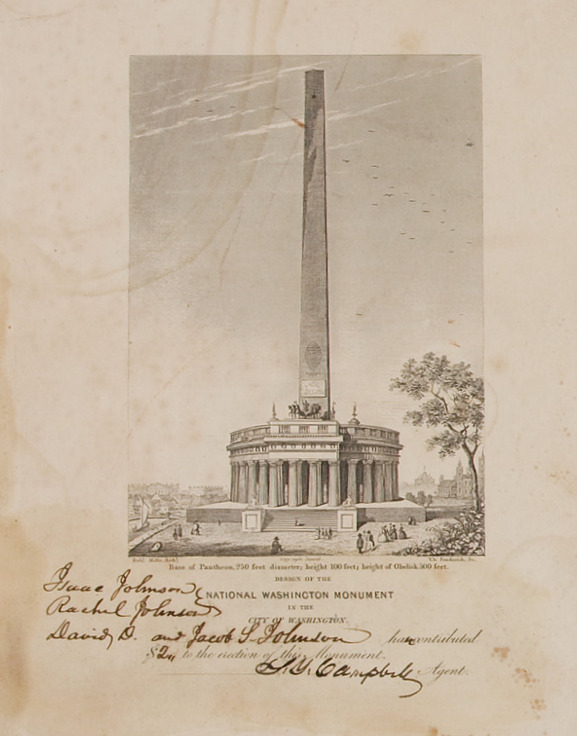
A collection of items related to the dedication of the Washington Monument went to auction in May 2011.

By Jim O’Neal

Four years ago, George Clooney, Matt Damon and Bill Murray starred in a movie titled The Monuments Men, about a group of almost 400 specialists who were commissioned to try and retrieve monuments, manuscripts and artwork that had been looted in World War II.

The Germans were especially infamous for this and literally shipped long strings of railroad cars from all over Europe to German generals in Berlin. While they occupied Paris, they almost stripped the city of its fabled art collections by the world’s greatest artists. Small stashes of hidden art hoards are still being discovered yet today.

In the United States, another generation of anti-slavery groups are doing the exact opposite: lobbying to have statues and monuments removed, destroyed or relocated to obscure museums to gather dust out of the public eyes. Civil War flags and memorabilia on display were among the first to disappear, followed by Southern generals and others associated with the war. Now, streets and schools are being renamed. Slavery has understandably been the reason for the zeal to erase the past, but it sometimes appears the effort is slowly moving up the food chain.

More prominent names like President Woodrow Wilson have been targeted and for several years Princeton University has been protested because of the way it still honors Wilson, asserting he was a Virginia racist. Last year, Yale removed John C. Calhoun’s name from one of its residential colleges because he was one of the more vocal advocates of slavery, opening the path to the Civil War by supporting states’ rights to decide the slavery issue in South Carolina (which is an unquestionable fact). Dallas finally got around to removing some prominent Robert E. Lee statues, although one of the forklifts broke in the process.

Personally, I don’t object to any of this, especially if it helps to reunite America. So many different things seem to end up dividing us even further and this only weakens the United States (“United we stand, divided we fall”).

However, I hope to still be around if (when?) we erase Thomas Jefferson from the Declaration of Independence and are only left with George Washington and his extensive slavery practices (John Adams did not own slaves and Massachusetts was probably the first state to outlaw it).

It would seem to be relatively easy to change Mount Vernon or re-Washington, D.C., as the nation’s capital. But the Washington Monument may be an engineering nightmare. The Continental Congress proposed a monument to the Father of Our Country in 1783, even before the treaty conferring American independence was received. It was to honor his role as commander-in-chief during the Revolutionary War. But when Washington became president, he canceled it since he didn’t believe public money should be used for such honors. (If only that ethos was still around.)

But the idea for a monument resurfaced on the centennial of Washington’s birthday in 1832 (Washington died in 1799). A private group, the Washington National Monument Society – headed by Chief Justice John Marshall – was formed to solicit contributions. However, they were not sophisticated fundraisers since they limited gifts to $1 per person a year. (These were obviously very different times.) This restriction was exacerbated by the economic depression that gripped the country in 1832. This resulted in the cornerstone being delayed until July 4, 1848. An obscure congressman by the name of Abraham Lincoln was in the cheering crowd.

Even by the start of the Civil War 13 years later, the unsightly stump was still only 170 feet high, a far cry from the 600 feet originality projected. Mark Twain joined in the chorus of critics: “It has the aspect of a chimney with the top broken off … It is an eyesore to the people. It ought to be either pulled down or built up and finished,” Finally, President Ulysses S. Grant got Congress to appropriate the money and it was started again and ultimately opened in 1888. At the time, it was 555 feet tall and the tallest building in the world … a record that was eclipsed the following year when the Eiffel Tower was completed.

For me, it’s an impressive structure, with its sleek marble silhouette. I’m an admirer of the simplicity of plain, unadorned obelisks, since there are so few of them (only two in Maryland that I’m aware of). I realize others consider it on a par with a stalk of asparagus, but I’m proud to think of George Washington every time I see it.

Even so, if someday someone thinks it should be dismantled as the last symbol of a different period, they will be disappointed when they learn of all the other cities, highways, lakes, mountains and even a state that remain to go. Perhaps we can find a better use for all of that passion, energy and commitment and start rebuilding a crumbling infrastructure so in need of repairs. One can only hope.

Intelligent Collector blogger JIM O’NEAL is an avid collector and history buff. He is president and CEO of Frito-Lay International [retired] and earlier served as chair and CEO of PepsiCo Restaurants International [KFC Pizza Hut and Taco Bell].