Here’s Why Rosenwald Belongs with Titans Like Rockefeller, Carnegie

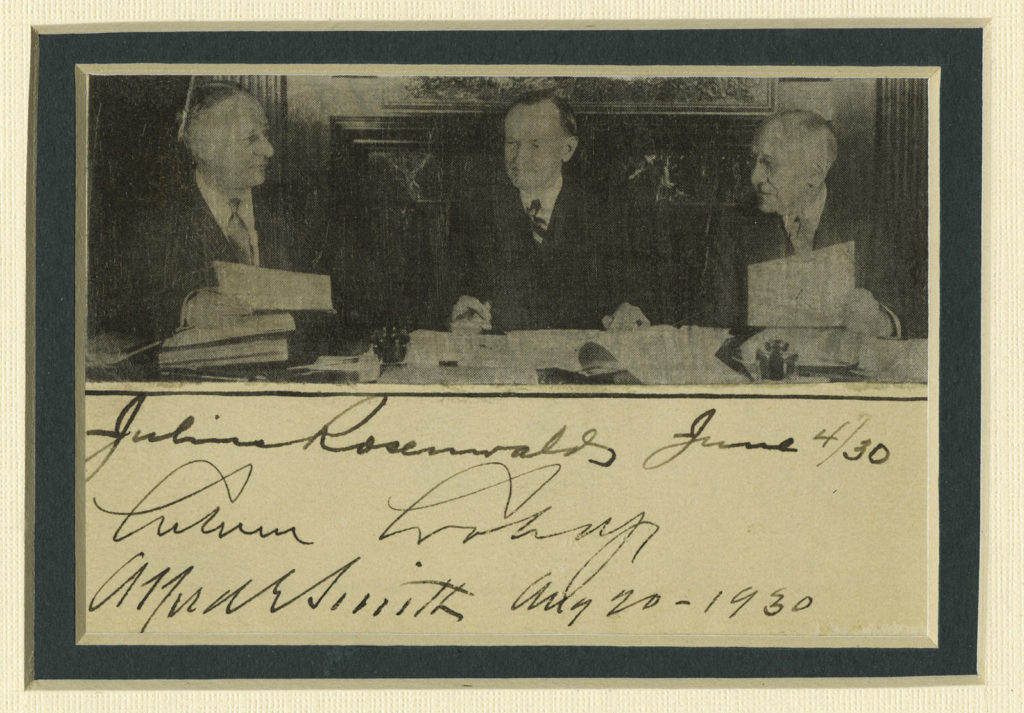
A card with signatures and a photograph of President Calvin Coolidge, New York Governor Alfred E. Smith and Julius Rosenwald, circa 1930, went to auction in 2008.

By Jim O’Neal

One fact that is difficult to verify is the total net worth of the Rockefeller family fortune. John Davison Rockefeller Sr. (1839-1937) rose from pious beginnings to become the world’s richest man by creating America’s most powerful monopoly, Standard Oil Company. Scores of muckrakers (especially Ida Tarbell) scorned it as “The Octopus” and posters protested the company by showing it swallowing the world … whole.

He is definitely the most prominent and controversial businessman in our history, especially when the trust he created came from refining 90 percent of the oil produced and marketed in America. His vocal critics charged he was an unscrupulous man who colluded with railroads to fix prices, and conducted illegal industrial espionage and outright bribery of political officials. It took Teddy Roosevelt and his team of stalwart trustbusters to break the trust, but even that inured to his benefit since he had ownership shares in all the new, smaller entities that were created.

Although the business practices were as ruthless and corrupt as charged, he was a quirky, passionate, temperate advocate who was generous and gave enormous sums to organizations like the Rockefeller Foundation, University of Chicago and what is now Rockefeller University. As an old man (he lived to be 98), he was parodied as a harmless billionaire who delighted in giving shiny dimes to needy children.

The actual story has grown much more complex after his only son, John D. Rockefeller Jr. (1874-1960), took over the massive estate and had five sons of his own. The last one, David Rockefeller, died last year and his personal estate was auctioned off this month by an East Coast firm. The total net proceeds were consigned to 12 of his favorite charities, which will create another layer of veneer over the money. What we know is that 1,500 items sold for over $832 million, setting 22 records in the process.

Another son of Junior was Nelson Rockefeller (1908-1979), who was governor of New York and made unsuccessful attempts to snag the GOP presidential nomination in 1960, 1964 and 1968. After serving in other high-profile positions, he was chosen by Gerald Ford to be the 47th vice president of the United States after Richard Nixon’s resignation. Rockefeller holds the distinction of being the last VP to decline to seek re-election when he decided not to join the 1976 Republican ticket with Ford.

Andrew Carnegie (1835-1919) was another famous philanthropist who made a fortune in steel and spent the last 18 years of his life giving $350 million to charities, foundations and universities. “I should consider it a disgrace to die a rich man.” Both the Rockefeller and Carnegie names have been well known throughout the 20th century, primarily because of the numerous foundations and buildings that bear their names.

But let’s focus now on an equally generous man who is largely forgotten because no foundations and few buildings mention him.

Julius Rosenwald (1862-1932) made his fortune the old-fashioned way. He earned it. He started running a clothing store in Springfield, Ill., and then went to New York to learn about the garment business. When he returned to Chicago, he opened another modest clothing store, but also started shrewdly investing in a small catalog store with the undistinguished name of Sears, Roebuck & Company. When co-founder Richard Sears left the company in 1908, Rosenwald assumed a leadership role. With financial help from Henry Goldman (son of Marcus Goldman of Goldman Sachs), he expanded the company with a massive 40-acre mail-order plant on Chicago’s West Side.

Then, in an unprecedented move in 1906, an IPO with Goldman was created, and Sears became a public company. Rosenwald had climbed from a vice president to chairman and CEO, and the new plant in Chicago, with a staggering 3 million square feet, became the largest building in the world. In the process, Sears became America’s largest retailer and people all over the United States discovered how to order using the mail, after hours of thumbing through the sacred Sears catalog.

The demise of Sears is well known and the company is currently being dismantled and sold by brand. It may not be as quickly forgotten as Julius Rosenwald, who went to extremes to be modest. When he died in 1932, it is estimated that he had donated $2 billion to a wide range of interests, including projects that funded African-American education in the South. He funded a program to construct elementary and secondary schools in any willing black community. Over a 20-year period, 5,000 schools were constructed in the South, 90 percent of all buildings in which Mississippi’s black youngsters received an education.

Not bad for a generous man who had no need for recognition, just a desire to help needy people. Now another generation of people will know what he did, in such a humble and modest way, by insisting on closing his foundation after his death and opposing the attachment of his name to so many projects.

Bravo.
Intelligent Collector blogger JIM O’NEAL is an avid collector and history buff. He is president and CEO of Frito-Lay International [retired] and earlier served as chair and CEO of PepsiCo Restaurants International [KFC Pizza Hut and Taco Bell].
Fillmore Among Presidents Who Juggled Balance Between Free and Slave States

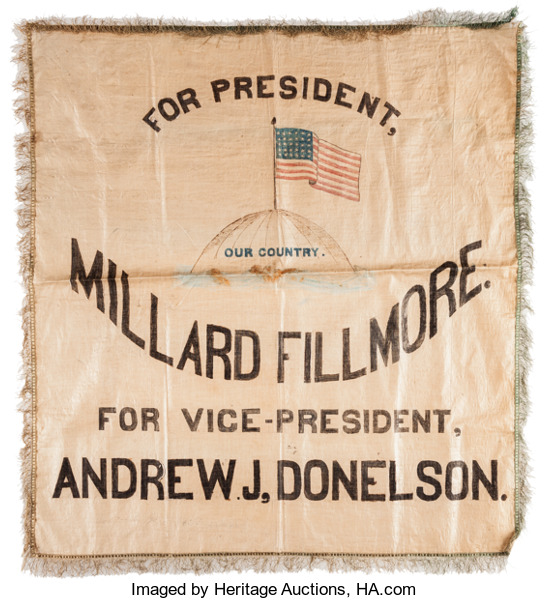
This folk art campaign banner for Millard Fillmore’s failed 1856 bid for the presidency sold for $11,950 at a June 2013 Heritage auction.

By Jim O’Neal

On his final day in office, President James Polk wrote in his diary: “Closed my official term of President of the United States at 6am this morning.”

Later, after one last stroll through the silent White House, he penned a short addendum: “I feel exceedingly relieved that I am now free from all public cares. I am sure that I will be a happier man in my retirement than I have been for 4 years ….” He died 103 days later, the shortest retirement in presidential history and the first president survived by his mother. His wife Sarah (always clad only in black) lived for 42 more lonely years.

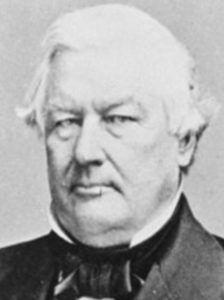
Fillmore

The Washington, D.C., that greeted his successor, General Zachary Taylor (“Old Rough and Ready”), still looked “unfinished” – even after 50 years of planning and development. The Mall was merely a grassy field where cows and sheep peacefully grazed. The many plans developed in the 1840s were disparate projects. Importantly, the marshy expanse south of the White House was suspected of emitting unhealthy vapors that were especially notable in the hot summers. Cholera was the most feared disease and it was prevalent until November each year when the first frost appeared.

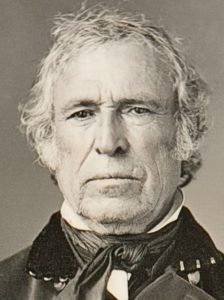
Taylor

Naturally, the affluent left the Capitol for the entire summer. Since the Polks had insisted on remaining, there was a widespread belief that his death so soon after departing was directly linked to spending the presidential summers in the White House. The theory grew even stronger when Commissioner of Public Buildings Charles Douglas proposed to regrade the sloping fields into handsome terraces under the guise of “ornamental improvement.” Insiders knew the real motive was actually drainage and sanitation to eliminate the foul air that hung ominously around the White House. (It’s not clear if Donald Trump’s campaign promise to “drain the swamp” was another effort or a political metaphor.)

President Taylor was inaugurated with a predictable storm of jubilation since his name was a household word. After a 40-year career in the military (1808-1848), he had the distinction of serving in four difference wars: War of 1812, Black Hawk War (1832), Second Seminole War (1835-1842), and the Mexican-American War (1846-1848). By 1847, Taylormania broke out and his picture was everywhere … on ice carts, tall boards, fish stands, butcher stalls, cigar boxes and so on. After four years under the dour Polk, the public was ready to once again idolize a war hero with impeccable integrity and a promise to staff his Cabinet with the most experienced men in the country.

Alas, a short two years later, on July 9, 1850, President Taylor became the second president to die in office (William Henry Harrison lasted 31 days). On July 4, after too long in the hot sun listening to ponderous orations and too much ice water to cool off, he returned to the White House. It was there that he gorged on copious quantities of cherries, slathered with cream and sugar. After dinner, he developed severe stomach cramps and then the doctors took over and finished him off with calomel opium, quinine and, lastly, raising blisters and drawing blood. He survived this for several days and the official cause of death was cholera morbus, a gastrointestinal illness common in Washington where poor sanitation made it risky to eat raw fruit and fresh dairy products in the summer.

Vice President Millard Fillmore took the oath of office and spent the rest of the summer trying to catch up. Taylor had spent little time with his VP and then the entire Cabinet submitted their resignations over the next few days, which Fillmore cheerfully accepted. He immediately appointed a new Cabinet featuring the great Daniel Webster as Secretary of State. On Sept. 9, 1850, he signed a bill admitting California as the 31st state and as “a free state.” This was the first link in a chain that became the Compromise of 1850.

The Constitutional Congress did not permit the words “slave” or “slavery” since James Madison thought it was wrong to admit in the Constitution the idea that men could be considered property. In order to get enough states to approve it, it also prohibited Congress from passing any laws blocking it for 20 years (1808), by which it was assumed slavery would have long been abandoned for economic reasons. However, cotton production flourished after the invention of the cotton gin and on Jan. 1, 1808, President Thomas Jefferson signed into law that “Congress will have the power to exterminate slavery from our borders.”

This explains why controlling Congress was key to controlling slavery, so all the emphasis turned to maintaining a delicate balance whenever a new state was to be admitted … as either “free” or “slave.” Fillmore thus became the first of three presidents – including Franklin Pierce and James Buchanan – who worked hard to maintain harmony. However, with the election of Abraham Lincoln in 1860, it was clear what would happen … and all the Southern states started moving to the exit signs.

A true Civil War was now the only option to permanently resolving the slavery dilemma and it came with an enormous loss of life, property and a culture that we still struggle with yet today. That dammed cotton gin!

Intelligent Collector blogger JIM O’NEAL is an avid collector and history buff. He is president and CEO of Frito-Lay International [retired] and earlier served as chair and CEO of PepsiCo Restaurants International [KFC Pizza Hut and Taco Bell].
Here’s Why Washington Remains Our Greatest President

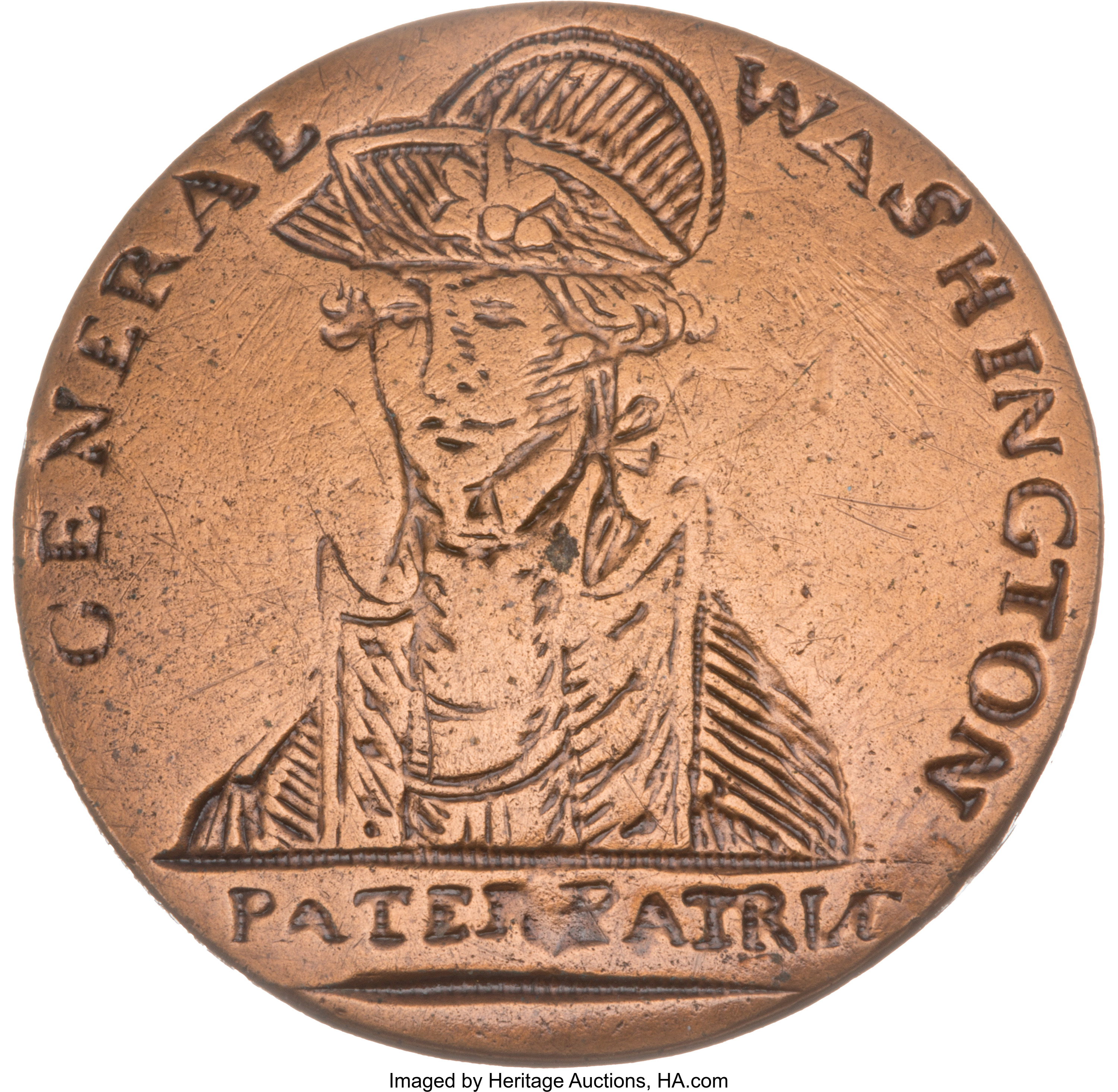
A George Washington inaugural button, perhaps the earliest artifact that refers to Washington as the “Father of His Country,” realized $225,000 at a February 2018 Heritage auction.

By Jim O’Neal

Presidential scholars typically list George Washington, Abraham Lincoln and Franklin Delano Roosevelt as our finest presidents. I tend to favor Washington since without him, we would probably have a much different country in so many aspects. If there were any doubts about the feats of the “Father of Our Country,” they were certainly dispelled in 2005 when David McCullough’s 1776 hit bookstores, followed five years later by Ron Chernow’s masterful Washington: A Life, which examined the man in exquisite detail. They didn’t leave much ground uncovered, but there are still a few tidbits that haven’t become overused and still interesting for those interested in fresh anecdotes.

For example, Washington wasn’t aware that on Nov. 30, 1782, a preliminary Treaty of Paris was signed that brought American Revolutionary hostilities to an end. The United States was prevented from dealing directly with Great Britain due to an alliance with France that stipulated we would not negotiate with Britain without them. Had he known, Washington would have been highly suspicious since King George III “will push the war as long as the nation will find men or money.” In a way, Washington would have been right since the United States had demanded full recognition as a sovereign nation, in addition to removal of all troops and fishing rights in Newfoundland. The king rejected this since he was still determined to keep the United States as a British colony, with greater autonomy. Ben Franklin naturally opposed this and countered with adding 100 percent of Canada to the United States. And so it went until May 12, 1784, when the documents bringing the Revolutionary War to an end were finally ratified and exchanged by all parties.

It was during these protracted negotiations that Washington was concerned that the army might lose its fighting edge. He kept drilling the troops while issuing a steady stream of instructions: “Nothing contributes so much to the appearance of a soldier, or so plainly indicates discipline, as an erect carriage, firm step and steady countenance.” After all these years of hardships and war, Washington was still a militant committed to end the haughty pride of the British. To help ensure the fighting spirit of his army, Washington introduced a decoration designated as the Badge of Military Merit on Aug. 7, 1782. He personally awarded three and then authorized his subordinate officers to issue them in cases of unusual gallantry or extraordinary fidelity and essential service. Soldiers received a purple heart-shaped cloth, to be worn over the left breast. After a lapse, it was redesigned and is now the Purple Heart medal, awarded to those wounded or killed. The first was awarded on Feb. 22, 1932, the 200th anniversary of Washington’s birthday.

The victorious conclusion of the Revolutionary War left many questions unanswered concerning American governance, prominently the relationship between the government and the military. At the end, army officers had several legitimate grievances. Congress was in arrears with pay and had not settled officer food and clothing accounts or made any provisions for military pensions. In March 1783, an anonymous letter circulated calling on officers to take a more aggressive stance, draw up a list of demands, and even possibly defy the new government! Washington acted quickly, calling for a meeting of all officers and at the last moment delivered one of the most eloquent and important speeches of his life.

After the speech, he drew a letter from a pocket that outlined Congressional actions to be undertaken. He hesitated and then fumbled in his pockets and remarked, “Gentlemen, you will permit me to put on my spectacles, for I have not only grown gray, but almost blind, in the service of my country.” By all accounts, the officers were brought to tears, and the potentially dangerous conspiracy collapsed immediately.

He gets my vote.

Intelligent Collector blogger JIM O’NEAL is an avid collector and history buff. He is president and CEO of Frito-Lay International [retired] and earlier served as chair and CEO of PepsiCo Restaurants International [KFC Pizza Hut and Taco Bell].
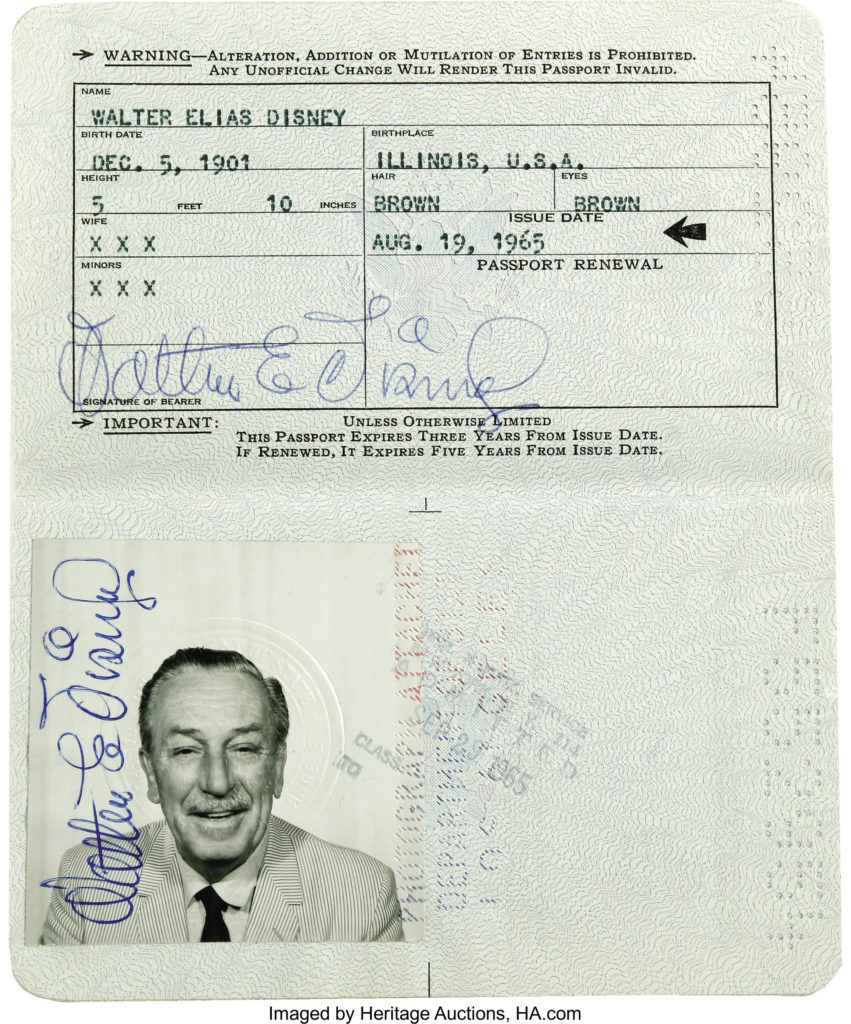
Walt Disney is Proof that Great Ideas Can Come Out of Nowhere

Walt Disney’s passport, dated Aug. 19, 1965, sold for $28,680 at an April 2007 Heritage auction.

By Jim O’Neal

I never met Walt Disney. He died four months after I joined Frito-Lay in 1966 and was among the last of a generation that smoked three packs of unfiltered cigarettes a day. He died of lung cancer.

However, like virtually everyone else in Southern California, we were familiar with the incredible theme park he built in nearby Anaheim. Disneyland opened to the public on July 17, 1955, and Frito-Lay had a direct relationship with Disneyland through a Mexican food restaurant in Frontierland called Casa de Fritos (Home of Fritos). It featured a unique product called a “Ta-cup” … basically, traditional taco ingredients served in a fried tortilla cup that helped with eating on-the-go using one hand.

I met the manager, Joe Nugent, during a meeting with Frito-Lay corporate officers from Dallas (The Flying Circus) who were in Los Angeles to review our zone’s 1967 profit plan and operating budgets. The only surprise was a mild rebuke to Nugent: “Dammit Joe, we told you last year that we don’t want to make a profit. The whole idea is to expose more people to Fritos and build the brand!” Joe just nodded and resorted to his previous tactic of lowering prices in the hope of lowering profits. Alas, it seemed that the more he dropped prices, the more the crowds waited in line to buy even more. What he experienced was the 1960s version of leveraging overhead costs, which lowered margins but increased total profitability. The Sam Walton slogan of “stack ’em high and sell ’em low.”

Another surprise was the mid-1967 completion of Club 33 at Disneyland, a private club with a top-notch restaurant that could only be accessed with a special card and hidden elevator. Frito-Lay was one of 33 local companies with membership, along with Carnation, Bell Telephone and Bank of America. It was the only place in the park where alcoholic beverages were served and in 2010, I read there was a 14-year waiting list for new members. Frito-Lay is now the crown jewel in the PepsiCo empire and analysts are advocating they get out of the beverage business.

From what I’ve read, Walter Elias Disney was a lot like the two men who started the Frito and Lay companies: humble beginnings, entrepreneurial and ambitious. Disney went broke when no one would buy his first animated films, Alice Comedies, so he moved from Kansas City to Hollywood in 1923, took out a home equity loan for $2,500 and rented the back room of a local real estate office where he created the studio that would become the Walt Disney Company‍. What a success story from another “garage” operation it has become.

We then moved to Cupertino in the Bay Area, where the business guys only seemed to talk about technology (using names like Ampex, Atari and H-P) and whispered about the next garage operation that would be a huge success. What we didn’t realize is that we had moved into one of the greatest wealth-creation areas in the history of the world … where two members of the Homebrew Computer Club – both college dropouts – set up shop to sell their techie friends the circuit boards one of them had invented. There are several versions of why they named their company Apple, but the consensus is Steve Jobs had been working at an apple orchard. Our old backyard is not far from the $5 billion Apple campus, but nobody tipped us about what the future might be.

We never heard the term “Silicon Valley” or about two guys in Vermont who had pooled their resources to make ice cream in an abandoned gas station after installing a 4½-gallon freezer. Ben Cohen and Jerry Greenfield were on the opposite end of the technology spectrum when they made a low-tech fortune with Ben & Jerry’s. Of course, not every inventor sticks his hand into a tin and comes up with “Chunky Monkey.” Most will fail. Even those who receive patents and set up small companies will not make these kinds of fortunes. Consider poor Eli Whitney, who invented the cotton gin in 1793 while working as a tutor at a Georgia plantation. His was probably the most influential invention in the 18th century and it got him into the history books, but nothing in the bankbook.

But that’s not the point. The dream that it’s possible, that an idea can come out of nowhere and can – with a lot of hard work – lead to success is more alive than ever. That kid working away or thinking about dropping out of Harvard to start his own company can change the world. Still skeptical? Just ask Bill Gates.

Intelligent Collector blogger JIM O’NEAL is an avid collector and history buff. He is president and CEO of Frito-Lay International [retired] and earlier served as chair and CEO of PepsiCo Restaurants International [KFC Pizza Hut and Taco Bell].
Frenetic Times Created Old West Scandals, Hoaxes

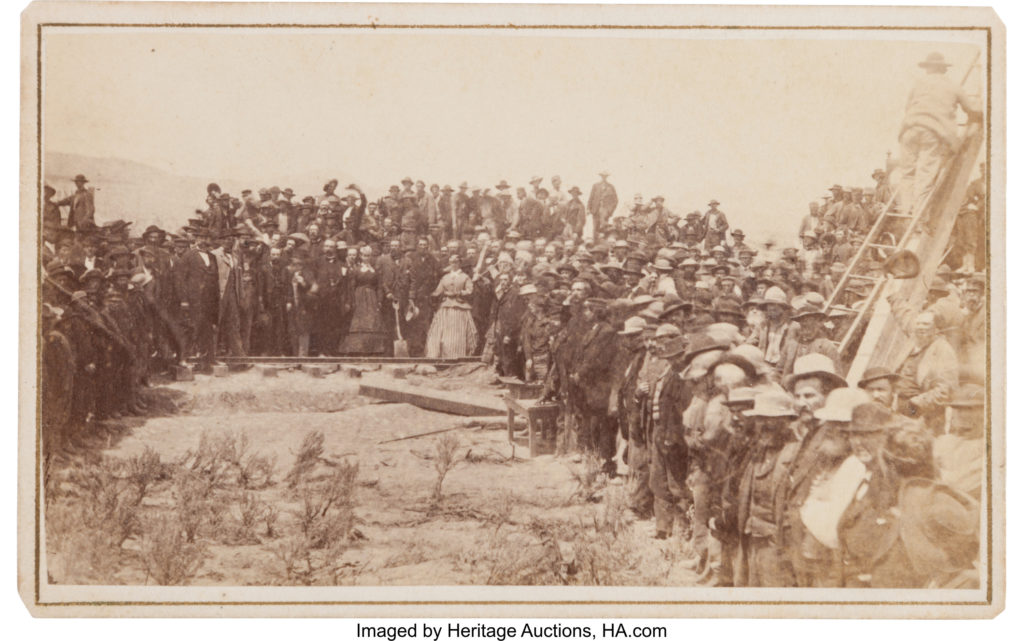
A carte-de-visite depicting people gathered at Promontory Point, Utah, for the official ceremony completing the Transcontinental Railroad, sold for $1,750 at a May 2015 auction.

By Jim O’Neal

Undoubtedly, the greatest achievement in America during the 19th century was the completion of the Transcontinental Railroad in 1869. Virtually everyone knows at least part of the story when the two railroad lines were joined on May 10 and Central Pacific President Leland Stanford drove the 14-ounce “Last Spike” (later the Golden Spike) at Promontory Point in Utah. But fewer are aware the spike was dated May 8 – bad weather caused a two-day delay – or that he whiffed and missed it. Still, the telegraph operator sent the message “Done” to both East and West Coasts in the first mass media event in history.

This was a long-overdue project that had been mired in slavery politics when Congress was unable to reach agreement on how to maintain the status quo on new states ready to join the Union. The exception was the Republic of Texas, which was added as the 28th state on Dec. 29, 1845, the same day the annexation took place, bypassing the traditional territorial phase. It also included two unique provisions: Up to four additional states could be created within the territory and Texas did not have to cede its public lands to the federal government.

However, the growth of railroads in the existing states had been astonishing. Starting from a modest base of 762 miles in 1834, 10 years later it had grown to 4,311 track miles and by Jan. 1, 1864, to a staggering 33,860! In the 1850s, an average of 2,160 miles of new track were added every year, more than the rest of the world combined. Horace Greeley, founder of the New-York Tribune, put it in perspective after an overland trip from NYC to SFO. He wrote that a railroad to the Pacific would add more growth and wealth to the nation than acquiring a dozen Cubas!

Eventually, the discovery of gold in California and the rapid growth in population combined to create a booming economy that helped balance West-to-East traffic and improve two-way profitability. It was during the frenetic times after the railroad was completed that two men walked into the Bank of California in downtown San Francisco in early 1872 carrying a canvas bag they wanted to store in the bank’s vault. They claimed to be prospectors and the cashier demanded to inspect the contents.

He found hundreds of diamonds, emeralds, rubies and sapphires of unimaginable value. Bank President William Ralston, who had made a personal fortune mining Nevada’s Comstock Lode, was able to get them to identify themselves and get their version of this remarkable story. Thus began the saga of Philip Arnold and John Slack, who purported to be miners from Kentucky who had stumbled onto a hill where precious stones were protruding and abundantly scattered around the site. Ralston quickly formed a magnificently named company, the San Francisco and New York Mining and Commercial Company, and persuaded blue-chip investors to chip in $80,000 each for a total capitalization of $2 million.

When word got out, it created a diamond frenzy and even the great jeweler Charles Tiffany jumped in after the two men agreed to show two blindfolded diamond experts the site and they brought back another bag filled with diamonds and verified the area was saturated with precious stones. The two nervous prospectors agreed to sell their share for $300,000 each and a percentage of future profits. Naturally, it was an extremely clever scam that involved them “salting” the mine and concocting the elaborate hoax details.

Then, on Sept. 4, 1872, in the middle of the presidential election, headlines in The New York Sun were screaming THE KING OF FRAUDS… COLOSSAL BRIBERY… HOW SOME MEN GET FORTUNES. But they were talking about the biggest scandal of the 19th century: the Crédit Mobilier scam, which involved railroads, bogus companies, worthless bonds and bribes using stocks involving congressmen and even U.S. Vice President Schuyler Colfax.

It was that kind of year.

Intelligent Collector blogger JIM O’NEAL is an avid collector and history buff. He is president and CEO of Frito-Lay International [retired] and earlier served as chair and CEO of PepsiCo Restaurants International [KFC Pizza Hut and Taco Bell].
Civil War Soldiers Found Themselves in New, Far Deadlier Warfare

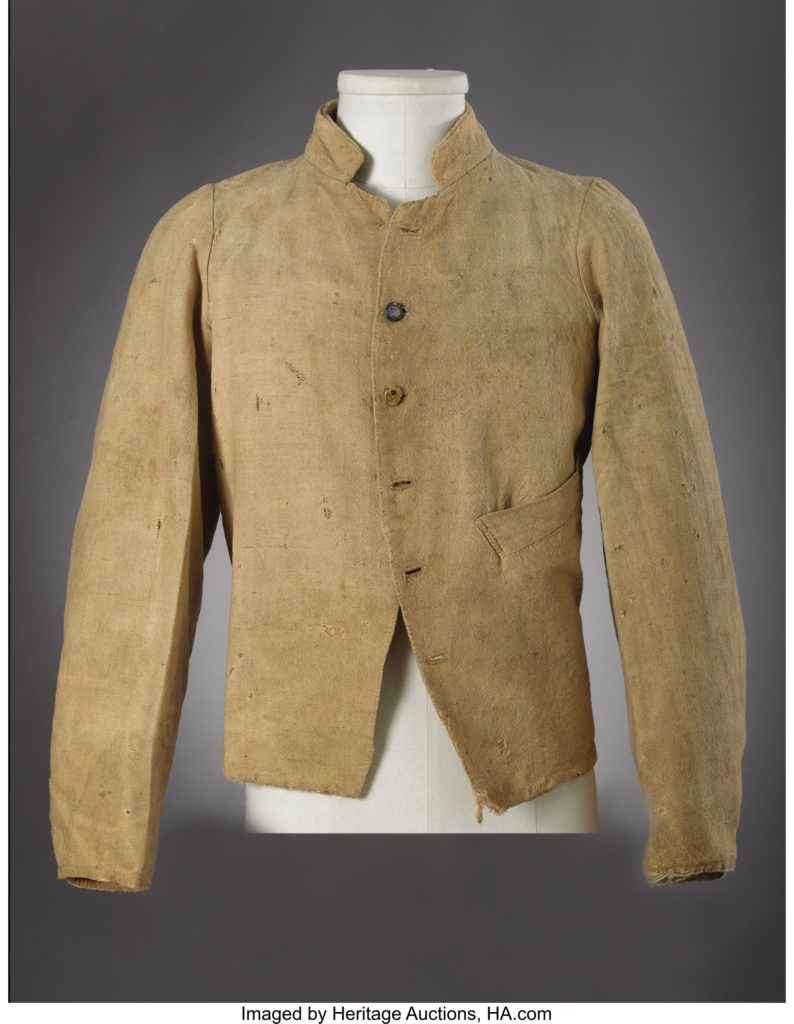
A Confederate Civil War enlisted man’s jacket, captured by Union soldiers at Cumberland Gap, sold for $41,825 at a June 2008 Heritage auction.

By Jim O’Neal

Surprisingly, very little written about the Civil War attempts to correlate the level of carnage with changes in armaments and tactics by both sides that almost literally required sacrificing troops in battles over real estate, rather than simply destroying the other side’s capacity to wage war.

When shots first rang out, American officers – Federal and Confederate – had last faced combat in 1846-47 in the Mexican-American War, armed with smoothbore flintlock muskets with a range of barely 200 yards. Now, more modern rifle-muskets, the English-made caliber .557 or Austrian Lorenz caliber .54, were accurate up to 600 yards and capable of killing at 1,000 yards. Soldiers found themselves in a new, far more deadly sort of war.

Artillery was no longer viable within 300 yards without suffering prohibitive losses. Cavalry charges against unbroken infantry attacks were risky, costly encounters. The result was an infantryman with a rifle-musket suddenly dominated and literally forced into the use of field fortifications. Both sides began the war with the same drill manuals and same tactics, only modifying them to fit the infantry weapons. However, it was a slow process and well into 1862 before either side had a majority of rifle-muskets, and even then the slow rate of fire made it necessary to use masses of men to attack or defend.

At Shiloh in April 1862, Confederate General Albert Sidney Johnston’s initial attack was delivered by two corps – one behind the other – and two more held in column as reserves. The two-day casualty count was nearly 24,000, a new historic high (including the death of Johnston). At Gettysburg (July 1863), Pickett’s famous charge, “the high-water mark of the Confederacy,” was three brigades deep and at Atlanta in 1864, Confederate General John Bell Hood formed his brigades with their regiments in columns – one behind the other – giving them a depth of eight to 12 men all lined up to be slaughtered.

Perhaps the most marked tactical feature of the Civil War was the employment of heavy entrenchments, made of whatever material was available. Little-used before 1863, but after the sunken roads at Fredericksburg and stone farm fences at Gettysburg, the average soldier wisely concluded to dig in. Throughout 1864 and 1865, troops in the vicinity of the enemy, even if ordered to attack, would entrench using tin cups, discarded halves of canteens and knives or sticks.

It gradually transformed the war to one of attrition, a fact that was not lost on General Ulysses Grant, who was willing to make big sacrifices since he knew the South was resource-constrained and General William Tecumseh Sherman was on a rampage destroying everything in a broad swath through the South and confident he could stamp out the last vestiges of hope and willingness to continue in the process. It was a lethal combination that was impossible to defend against.

Though the war ended in his defeat, the Confederate infantryman earned a reputation for hard fighting, swift maneuvering, and endurance amid extreme hardships against vastly superior forces. Trusted officers could lead them against any danger, except for any West Pointers or those with pomp and circumstances, which became a moot point, since both victory and defeat killed large numbers and eventually it became impossible to replace them with men of courage and competence. Even Grant in his memoirs commented on how his men were hesitant to fight even when they had a 5-to-1 advantage at times.

A British observer concluded that the Confederate infantry could accomplish wonders – but at a cost the South could not afford.

Intelligent Collector blogger JIM O’NEAL is an avid collector and history buff. He is president and CEO of Frito-Lay International [retired] and earlier served as chair and CEO of PepsiCo Restaurants International [KFC Pizza Hut and Taco Bell].
Bell’s Influence on National Geographic Society Often Overlooked

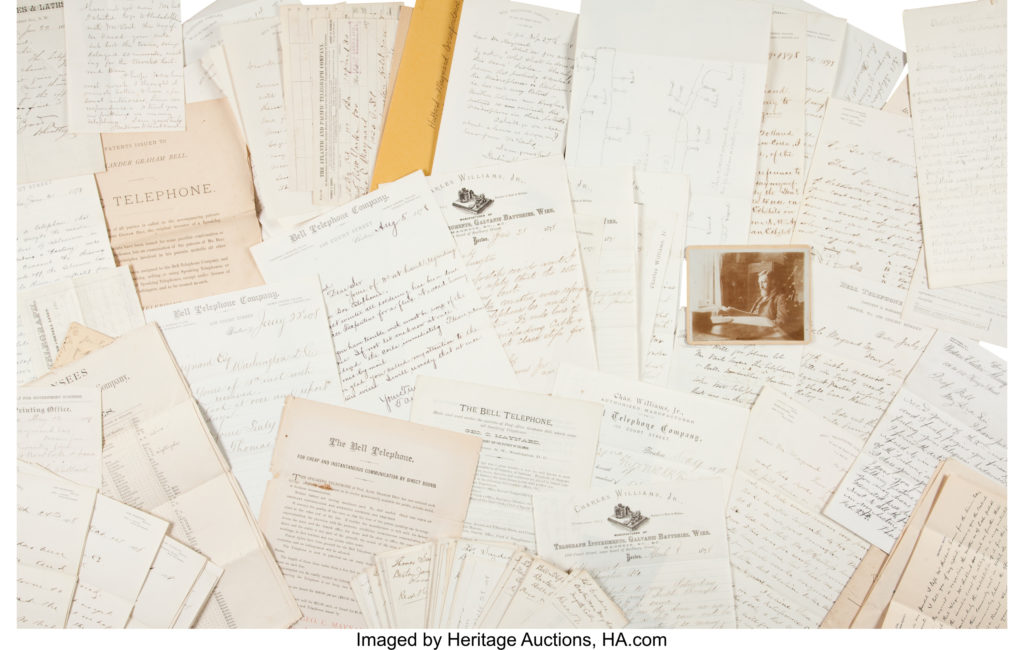
An archive of documents from the early days of Bell Telephone Company – including correspondence by Gardiner G. Hubbard, Alexander Graham Bell’s father-in-law – sold for $10,157 at an October 2012 Heritage auction.

By Jim O’Neal

In 2013, Nancy and I took a cruise from New York City to Montreal. On Sept. 23, we had the great pleasure of touring the Alexander Graham Bell museum in Baddeck, Nova Scotia. We were struck by its unusual design, which is based on the tetrahedron form used in his many flight experiments with kites. There were also numerous original artifacts, photographs and exhibits of his groundbreaking scientific accomplishments.

Alexander Graham Bell

Bell (1847-1922) was awarded patent #174465 just four days after his 29th birthday for the first practical telephone – “the most valuable single patent ever issued” in any country. Our guide informed us that Bell would not allow a telephone in his study or laboratory since he considered it a distraction to his reading and experiments. I was aware that both his mother and wife were deaf and this had a profound effect on his passion for working on sound, speech and hearing. What surprised me was the breadth of his scientific achievements. He was awarded 18 patents and collaborated on another 12 in medicine, aeronautics, genetics, electricity, sound and marine engineering.

Another surprise was that his wife Mabel was the daughter of Gardiner Greene Hubbard, founder and first president of the National Geographic Society (founded in 1888) and also the first president of Bell Telephone Company (later AT&T). Although AGB (he got a middle name only after constantly nagging his father) was not a founder of National Geographic, he was its second president, following his father-in-law. This was organizational incest on a scale that rivaled the British monarchy.

But the result was an organization that has given several generations a certain sense of where we are and where we want to go. Commanders-in-chief, explorers, schoolchildren and even daydreamers have put their full trust in the splendid maps of the National Geographic Society and their brilliant cartographers. The elegant and clearly legible typefaces for place names, one source of the map’s mystique, were designed by the magazine’s staff in the 1930s.

It was founded in Washington, D.C., at the Cosmos Club, another venerable organization founded in 1878 and boasting of membership by three presidents, two vice presidents, 12 Supreme Court justices, and 36 Nobel and 61 Pulitzer Prize winners (they don’t bother with ordinary U.S. senators).

During World War II, National Geographic maps were at the epicenter of the action, thanks in part to a U.S. president who was deeply interested in geography. The society had furnished Franklin D. Roosevelt with a cabinet that was mounted on the wall behind the desk in his private White House study. Maps of continents and oceans could be pulled down by the president like window shades; they were in constant use throughout the war.

In the early winter of 1942, President Roosevelt urged the American people to have a world map available for his next fireside chat, scheduled for the evening of Feb. 23. FDR told his aides, “I’m going to speak about strange places that many have never heard of – places that are now the battleground for civilization. … I want to explain to the people something about geography – what our problem is and what the overall strategy of the war has to be. I want to tell it to them in simple terms of ABC so that they will understand what is going on and how each battle fits into the picture. … If they understand the problem and what we are driving at, I am sure that they can take any kind of news on the chin.”

There was an unprecedented run on maps and atlases. The audience, more than 80 percent of the country’s adult population, was the largest for any geography lesson in history.

The National Geographic Society went on, expanding the scope of its focus – with maps for the amazing Mount Everest to outer space and the ocean floor. As the Society’s former chief cartographer put it: “I like to think that National Geographic maps are the crown jewels of the mapping world.”

He was right, until Google maps created a new technology in need of its own headware.

Intelligent Collector blogger JIM O’NEAL is an avid collector and history buff. He is president and CEO of Frito-Lay International [retired] and earlier served as chair and CEO of PepsiCo Restaurants International [KFC Pizza Hut and Taco Bell].
Since the Days of the Pony Express, It’s Been All About Speed

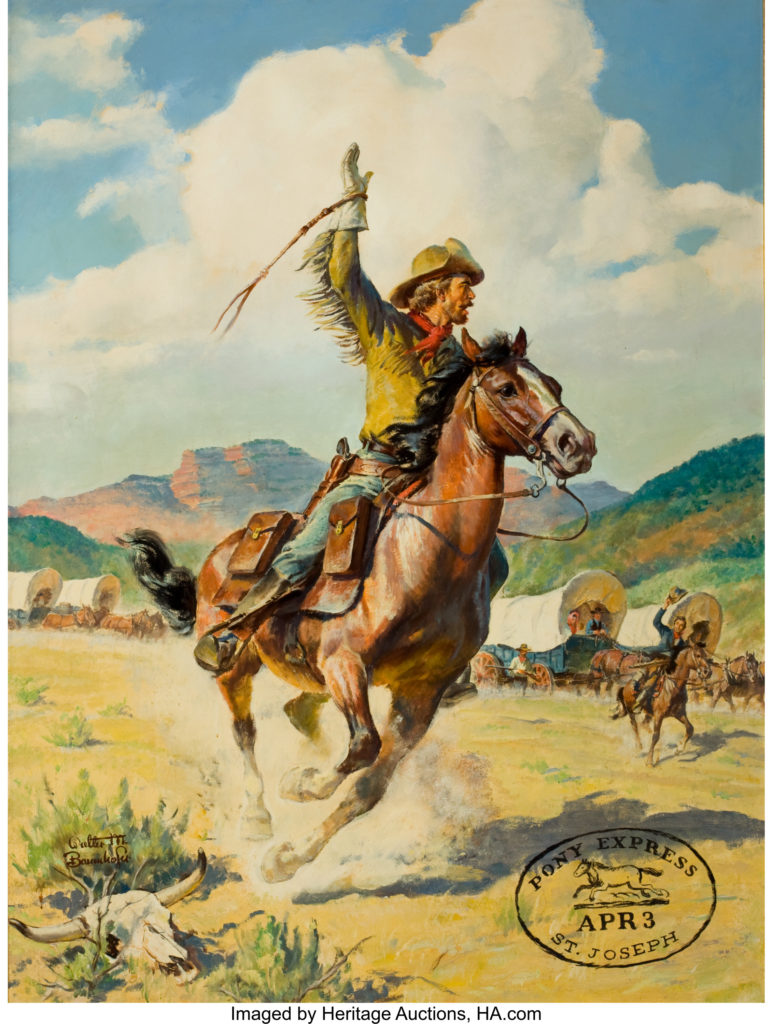
Walter Martin Baumhofer’s oil on board titled The Pony Express, St. Joseph, sold for $10,000 at a March 2012 Heritage auction.

By Jim O’Neal

On Nov. 19, 2007, I watched Charlie Rose interview Jeff Bezos about the new Kindle that debuted that day and sold out in 5½ hours. Books had been the last bastion of analog holdouts, although there were lots of Ebooks for sale.

The Kindle was something new.

It was a light (10 ounces) device that didn’t require a computer and would store up to 200 books in a library. One hundred and one of the 112 New York Times bestsellers were already available for $9.99, in addition to all major newspapers and magazines. You could order it from Amazon.com for $399 and when it arrived, it automatically recognized the user. Plus, there were lots of other cool features like a 250,000-word dictionary, access to Wikipedia and its 400 million pages, and you could read the first chapter of any book for free before deciding to buy it.

I immediately ordered mine and there was already a two-month waiting time. It is still around somewhere gathering dust, but my new Kindle is on my iPad (with an audio feature).

I guess we have always been an impatient culture with the “need for speed” in our DNA. Until the spring of 1860, it took 20 days for mail to get from St. Joseph, Mo., to Sacramento … far too long for most merchants and businessmen. Stagecoaches were just too slow until one of them – Russell, Majors and Waddell of Leavenworth, Kan. – came up with an idea to cut the delivery time by 50 percent.

For a fee of $2 to $10 per ounce, depending on the distance, you could use their new innovative mail service: the Pony Express. Starting on April 3, 1860, every Wednesday and Saturday one rider on horseback would leave at noon from Sacramento heading east, and another at 8 a.m. from St. Joseph heading west. Averaging about 8 miles an hour, every 10 miles or so, they would change horses at a relay station and continue at breakneck speed.

The typical payload of 20 pounds of letters was tucked into a Mexican mochila (knapsack) with four cantinas (locked pockets) for the oiled silk-wrapped letters that kept them dry when the rider inevitably had to cross streams or rivers. The mochila was designed to slip over the saddle horn and the rider sat on it until the next change of horses. Every 75 to 80 miles was a “home station,” where the incoming rider would pass the mochila to a fresh rider and then bunk down until the mail arrived from the opposite direction. Then, somewhat rested, he was off again, back the way he came.

The young hell-bent for leather riders intrigued the nation and their dedication became a staple for many bedtime stories. Some children heard the tale about 19-year-old Jack Keetley, who rode 340 miles in 31 hours non-stop until taken from the saddle … sound asleep. Fifteen-year-old William Frederick Cody was one of the daring young riders who would later become famous as Buffalo Bill with his own traveling Wild West show.

Still, speed was what mattered and the formal record for the central route’s 1,966 miles is 7 days and 17 hours. This was of special significance since it allowed California newspapers to publish President Abraham Lincoln’s inaugural address. The Pony Express was, in every way, about speed. Even its history went by in a flash— 19 months, 2 weeks, 3 days and kaput! The bold experiment was finished, partially because it was costing about $30 a letter, but it was really just another victim of a new technology.

The ride lasted from April 3, 1860, to Nov. 20, 1861 … 596,501 miles, 30,700 pieces of mail and only one lost mochila! The Pony Express and its 80 dedicated riders, 400 horses and 190 relay stations all became irrelevant on Oct. 21, 1861, with the completion of the transcontinental telegraph line. That pattern of one innovation, one technology, giving way to another seems to be accelerating as our impatience and expectations continue to grow.

I just ordered four C batteries from Amazon and discovered they won’t be here until tomorrow (bummer!).

Intelligent Collector blogger JIM O’NEAL is an avid collector and history buff. He is president and CEO of Frito-Lay International [retired] and earlier served as chair and CEO of PepsiCo Restaurants International [KFC Pizza Hut and Taco Bell].
Maybe a Simple Theory Explains Nature’s Mysteries

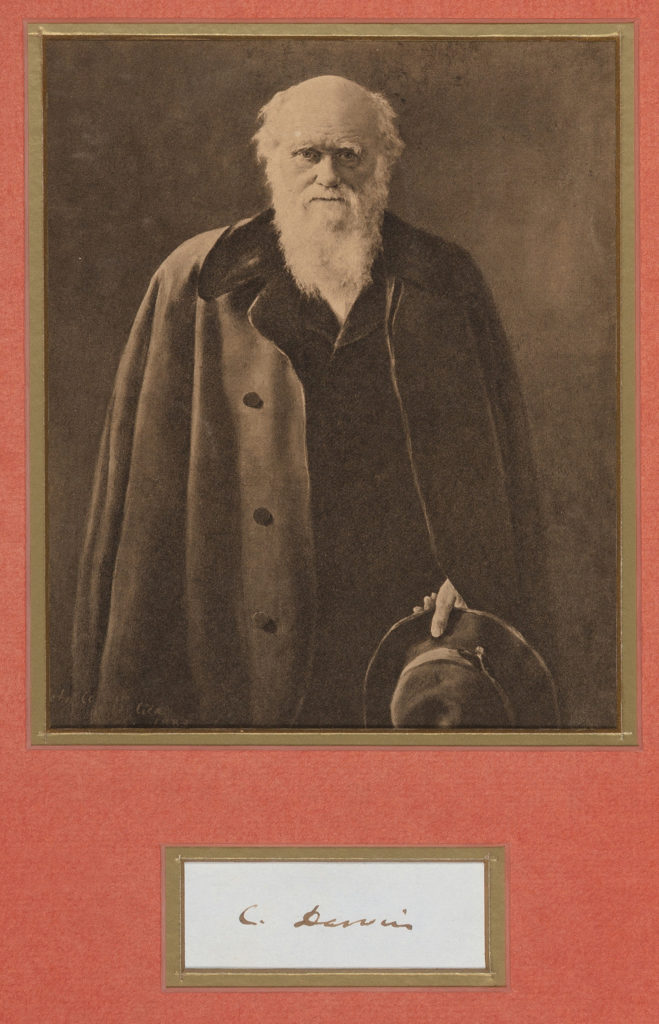
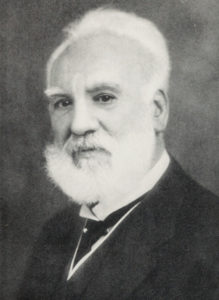
A Charles Darwin signature is among a set of autographs by famed scientists that sold for $4,750 at a January 2017 auction.

By Jim O’Neal

Cosmologists generally agree the universe is 13.8 billion years old, and Earth 4.6 billion years old. They also agree the universe is expanding at an ever-increasing rate, and is creating new space in the process. It is already so immense that even by traveling at the speed of light, you would simply end up back where you started due to the curvature of space. This eliminates one of my lifelong desires to poke my head thru and “see what’s out there.” The answer is nothing, a hard concept to grasp … at least for me.

What no one seems to know is where, when or how life on Earth began. Or, for that matter, if life (as we know it) exists anywhere other than on our small tiny orb tucked in a remote part of our modest galaxy, at the precise distance from the Sun to permit our existence.

Author Bill Bryson writes about the work of a graduate student at the University of Chicago, Stanley Miller, who in 1953 tried to synthesize life in a chemistry lab. He hooked up two flasks, one containing water and the other a mixture of methane, ammonia and hydrogen gases. By adding electrical sparks to simulate atmospheric lightning, he was able to convert this concoction to a green and yellow broth of amino acids, fatty acids and other organic compounds. His euphoric professor – Nobel laureate Harold Urey – exclaimed, “If God didn’t do it this way, he missed a good bet!” Since it was subsequently pointed out that Earth never had such noxious conditions, we are no closer to creating life today, 65 years later.

Others have speculated that life on Earth arrived when a meteorite crashed into the planet in a process known as panspermia. The problem with this theory is that it still doesn’t explain how life BEGAN and just moves the problem to some other remote place.

Since modern man dates back 200,000 years to Africa, I’m more curious as to why it took us so long to fly. It was only rather recently, on Dec. 17, 1903, that two brothers from Dayton, Ohio – Orville and Wilbur Wright – rose into the air in Kitty Hawk, N.C., and descended 120 feet further than the take-off point. Wilbur had tried first and stalled, but Orville took the controls and set off into a strong wind with Wilbur steadying the wingtip running alongside.

They made three more flights that morning, with the longest covering 852 feet. When a wind gust broke the airframe, they just packed all the parts and went back to Dayton. What makes this achievement even more remarkable is that neither had any formal academic education in physics, although both were high school graduates. Today, the “Flyer” hangs proudly above the entrance at the Smithsonian Air and Space Museum in Washington under a long inscription that ends “…Taught Men to Fly and Opened the Era of Aviation.”

Of course, flying in the true sense has mostly been restricted to birds, as Charles Darwin theorized. In his travels aboard the Beagle survey ship, he noted that finch beaks on different islands in the Galapagos varied to exploit local resources. He speculated the birds had not been originally created this way, but had adapted themselves to gain a strategic advantage to acquire scarce resources. They had indeed, but it should be noted that Darwin did not coin the phrase “survival of the fittest” and even the word “evolution” didn’t appear until the sixth printing of On the Origin of Species. And even this book was delayed for many years since his editor urged him to write about pigeons. “Everyone is interested in pigeons.”

A lot has been written about “locomotion,” with the flight of birds being the most interesting … and the Pterosaur from 100 million years ago especially so. With a wingspan of 16 feet and weighing a mere 22 pounds, it was able to dominate eastern England by staying aloft for extended periods on rising warm-air currents … presumably as a hovering predator.

Once again, we face the same questions. How it developed is a mystery, as is its anatomy, since it couldn’t manage take-off via traditional wing flapping. Perhaps it relied on gravity and thermals to become airborne. But this would have required plunging into the air from seaside cliffs, like modern frigate birds.

My theory to cover all these mysterious questions is more simplistic: Evolution is just “one damned thing after another.”

Intelligent Collector blogger JIM O’NEAL is an avid collector and history buff. He is president and CEO of Frito-Lay International [retired] and earlier served as chair and CEO of PepsiCo Restaurants International [KFC Pizza Hut and Taco Bell].
It’s a Long Way from Hot Air Balloons to Lethal Drones

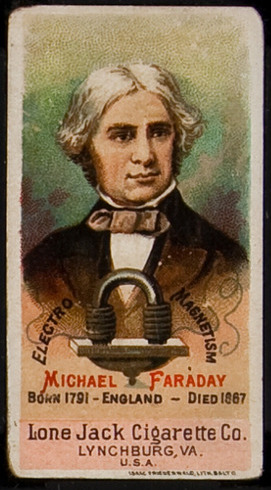
An 1887 complete set of 25 Lone Jack “Inventors and Inventions” cards, featuring Michael Faraday, sold for $3,107 at a November 2011 Heritage auction.

By Jim O’Neal

Wars fought from the air can be traced back to the creation of rubber balloons first made by Professor Michael Faraday in 1824 for use in his experiments with hydrogen at the Royal Institution in London (where he would later become the first Fullerian Professor of Chemistry). However, it was his work with electricity and magnetism that earned him greater fame. Virtually all electricity produced today is based on Faraday’s principles, whether it is coal, oil, gas, nuclear, hydro or wind.

Faraday (1791-1867) declined an offer of knighthood since he believed the Bible forbade earthly accumulations of wealth or honor and stated that he “preferred to be plain Mr. Faraday to the end.” He also declined to assist the British government with the production of chemical weapons, on ethical grounds, for the Crimean War (1853-1856) … a position the current government now apparently agrees with given recent activities in Syria.

I can attest to the many honorific symbols in greater London today and Albert Einstein kept a picture of Faraday on a wall next to Isaac Newton to acknowledge their enormous contributions to the extension of electromagnetism in space. Not bad for “plain” Mr. Faraday.

His work on balloons was preceded by the French Montgolfier brothers in 1783 while perched on a hillside watching a bonfire:

“I wonder what makes the smoke go up.”

“Perhaps warm air is lighter and the cold air pushes it up.”

“Then if we filled a bag with hot air, it would fly!”

Aeronautics was born.

Then on June 18, 1861, a stunned audience in Washington watched a giant balloon, the Enterprise, rise 500 feet. A man in it sent a telegraph to President Lincoln … “Sir: From this point of observation we command an area of nearly 50 miles in diameter. I have the pleasure of sending you this first telegram ever dispatched from an aerial station… T.S.C. Lowe”

This was a prelude to the short-lived formal use of aerial observations by the Armed Forces. The first balloon bought for the American military was an $850 model of raw India silk built by John Wise of Lancaster, Pa. Both sides in the Civil War were basically incapable of utilizing balloons for little more than observation of troop positions since any kind of armament was simply too heavy to be carried aloft. Aerial photography service was offered but never acted on. After viewing the First Battle of Bull Run, Lowe and other balloonists formed the Union Army Balloon Corps, but disbanded in August 1863. Confederate efforts were even more modest and legend has it that (sadly) the very last silk dress in the entire Confederacy was used to try and make a balloon.

Then a man by the name of Billy Mitchell enlisted as a private in the Spanish-American War, where he became a member of the U.S. Army Signal Corps. Subsequently, he served in France during World War I and ultimately became regarded as the father of the U.S. Air Force. It was his stubborn insistence that “the day has passed when armies or navies on the sea can be the arbiter of a nation’s destiny in war. The main power of defense and the power of initiative against an enemy has passed to the air” (November 1918).

That and a statement accusing senior leaders in the Army and Navy of incompetence and “almost treasonable administration of national defense” got him court-martialed. The court, which included Major General Douglas MacArthur as one of the judges, found him guilty on Dec. 17, 1925, and suspended him for five years. Ironically, MacArthur suffered a similar fate decades later for challenging conventional military wisdom.

We are now in the era where wars are fought using lethally armed unmanned aerial vehicles (UAVs) piloted from remote locations, and cruise missiles launched from ships up to 1,500 miles away. I was hoping we had the cyber-technology to destroy an enemy’s power infrastructure, disable their communications and simply render their offensive and defensive capabilities useless.

Maybe that’s only feasible for presidential elections using Facebook.

Intelligent Collector blogger JIM O’NEAL is an avid collector and history buff. He is president and CEO of Frito-Lay International [retired] and earlier served as chair and CEO of PepsiCo Restaurants International [KFC Pizza Hut and Taco Bell].