
Hollywood Westerns Embody Essential History of the United States

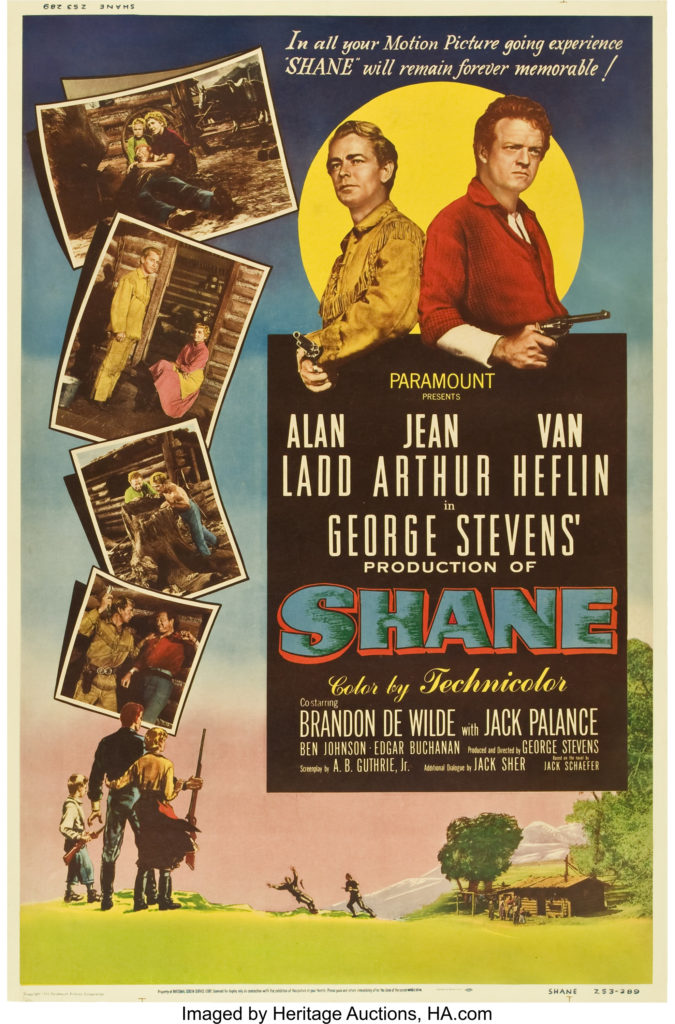
This original movie poster for 1953’s Shane sold for $5,676.25 at a November 2008 Heritage auction.

By Jim O’Neal

Inexplicably, there was a 60-year gap between the first Western to win an Academy Award for Best Picture and the next one. Cimarron (1931), starring Richard Dix and Irene Dunne, was based on the 1929 novel by Edna Ferber that told the tales of the Oklahoma land rushes of 1889 and 1893. The next winner was Dances With Wolves, the 1990 Kevin Costner film that won seven Oscars, including Best Picture and Best Director.

This was despite the fact that there were a number of notable Western films in the intervening decades: High Noon (1952), Shane (1953), and Butch Cassidy and the Sundance Kid (1969), to name a few. My favorite remains Red River (1948), directed by Howard Hawks and introducing Montgomery Clift, the brilliant actor who was Elizabeth Taylor’s close friend and who died too young after a car accident led him to too many pain-killers (that did as advertised).

These were laconic men with a code to live by: Don’t run, stand up and don’t rely on anyone but yourself. Men who liked simple stories that seemed almost incidental to the action. In 1966, Hawks called Robert Mitchum for a role in El Dorado.

“You available, Bob?”

“Sure, Howard. Uh, what’s the story?”

“Oh, you know, Bob. There’s no story.”

Peter Bogdanovich, the director and writer, has six personal favorites and all were directed by either John Ford or Howard Hawks. His nucleus of favorites underscores the Western’s focus: clarity between right and wrong. “Certainly,” Bogdanovich wrote, “the Western is one of the most pervasive icons of Americana; a symbol of frontiers challenged and tamed; a series of morality tales of good and evil that contain within them the essential history of the United States.”

Director John Ford was reputedly prickly and fearless. From his early efforts until his last Western, The Man Who Shot Liberty Valance (1962), his films helped hype the myth of the West and the men and women who belonged there. “When the legend becomes fact, sir, print the legend,” a young reporter tells Jimmy Stewart, playing a U.S. Senator in Liberty Valance. That is advice Ford gave and followed.

The mythic Western theme is pervasive, thanks in part to the movies and television. It was how the rest of the world saw us for a long time. We’re all cowboys, gunslingers operating under some unwritten rules way out in the open spaces. Ford’s stories were simply about the individual as the last line of defense. A man takes a stand, no matter what the price, refusing to ask for help. (He had no regard for High Noon, because “No real Western sheriff would ever ask for help.”)

Then it almost seems like television was made for the Western and in the 1950s, we had plenty to choose from on every network. Even popular radio Westerns found it easy to make the transition. The best example may be Gunsmoke, which had established itself as a Saturday night special on radio with William Conrad in the venerable role of Marshal Matt Dillon. The rotund Conrad didn’t fit the visual image, so CBS tried to lure an ex-Glendale High School football star who had lost his USC scholarship due to a surfing accident. His name was Marion Morrison.

We know him as John Wayne, who Ford had molded into a superstar in Western movies. Wayne declined the offer, but agreed to introduce the first episode in 1955 with James Arness (the elder brother of Peter Graves) in the Matt Dillon role. Not surprisingly, it became the longest-running American prime-time TV drama – 639 episodes from 1955 to 1975 and still running in syndication today, a mere 63 years later!

Personally, I’m quite happy that Wayne kept making movies, because in my opinion, he was the Western. But why? Maybe no one summed it up better than director Raoul Walsh when he said, “Dammit, the son of a bitch looked like a man.” Perhaps that’s it. He did look and act like a man, and we never read or heard anything to make us doubt it. Journalist and writer Joan Didion in a profile spoke for a lot of us when she said, “When John Wayne rode through my childhood, he determined forever the shape of certain of our dreams.”

I miss John Wayne and all the things he stood for.
Intelligent Collector blogger JIM O’NEAL is an avid collector and history buff. He is president and CEO of Frito-Lay International [retired] and earlier served as chair and CEO of PepsiCo Restaurants International [KFC Pizza Hut and Taco Bell].

New York Times Reflects One of Our Greatest Freedoms

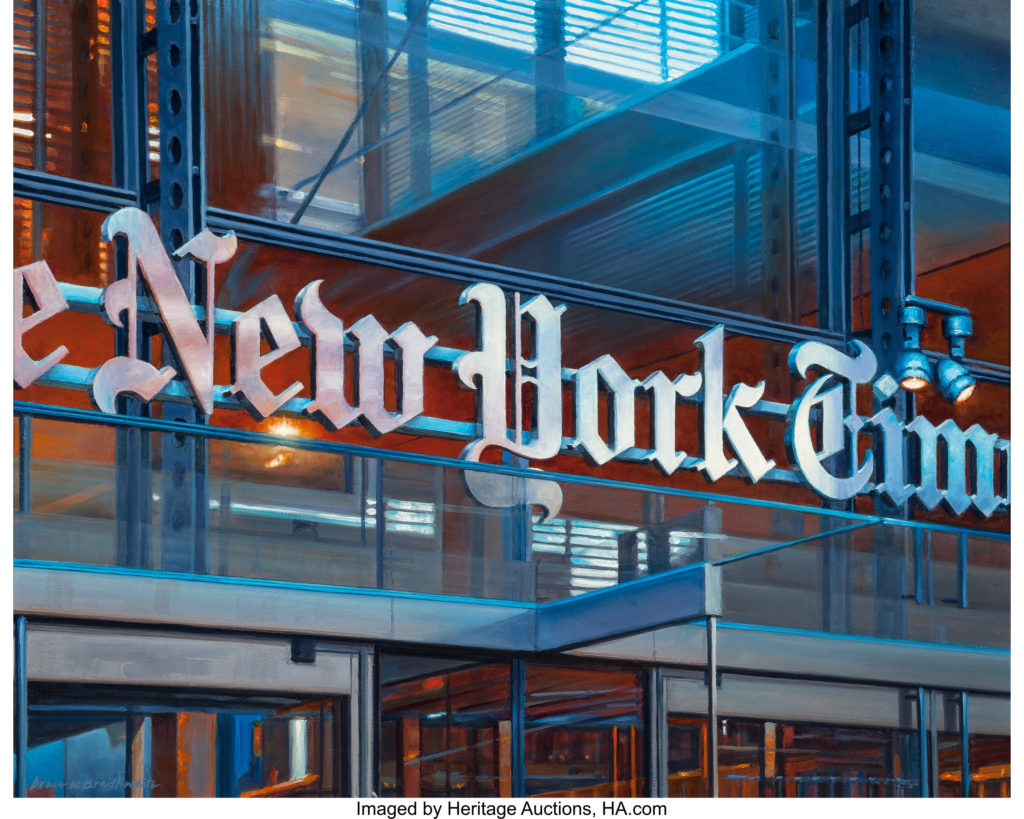
Bruce Braithwaite’s oil on canvas The New York Times, 2014, went to auction in November 2016.

By Jim O’Neal

Ah, freedom of speech, of religion, of assembly – things we all associate with the centrality of our democracy. For me, freedom of the press is the key to an open mind and an open market, the twin foundations of a truly free society. In political philosophical terms and in government, it has been a distinctly American idea since the founding of our great nation.

Others have made claims of a similar nature, but rarely endure. The classic example is the Soviet Constitution of 1936 (the Stalin Constitution), which stressed the inclusion of “freedom of the press,” but the words were cheap imitations since the press was the handmaiden of the ruling Communist Party and merely echoed the party line with absolute fidelity. It was hailed at the time as a paragon of virtue unequalled in history but, ironically, on the very eve of the reign of brutality that started the following year.

Adolph Ochs bought the bankrupt New York Times for $75,000 in 1896 when he was 38 years old. The newspaper had $300,000 in unpaid bills and was losing on average a $1,000 a day. Ochs had a humble beginning, starting as a floor sweeper at 14 with the Knoxville Chronicle. He was a typesetter and reporter with the Louisville Courier Journal at age 18 and by 20 became the owner of the declining Chattanooga Times. He had plunked down $250 of the total sale of $5,750.

The New-York Daily Times had been founded by Henry Jarvis Raymond (1820-1869), who was also credited with being the “Godfather of the GOP” after his political actions in the elections of 1856 and 1860.

Moving quickly after his purchase of the NYT, Ochs repeated what he did with the Chattanooga publication – making it into a newspaper and not a gazette of opinion, or a showcase for star writers. He avoided being a champion for the underdog or top dog or a crusader for political or social reform. Ochs had something to sell – news – and he intended to sell it dispassionately and with the guarantee that it was reliable, verifiable and not deviously insipid.

He eliminated installments of romantic fiction that earlier management believed would lure readers and eschewed scandalous stories based on gossip. Instead, he expanded coverage of financial news, business trends, real estate transactions, and the official activities of government that other newspapers had long ignored. He wanted a paper of record, one that each day would publish a record of every fire in NYC, the arrival of every mail ship, the names of every official visitor to the White House, the precise moment the sun set and the moon rose. His unbending objective was to be impartial and complete – and “not soil the breakfast linen.”

Throughout his publishing career, he made brilliant business decisions – his genius had not only been in the type of newspaper he created, but that he had made such a newspaper profitable. And on the occasion of his 75th birthday in 1933, he issued an optimistic public statement in the midst of the Great Depression in which he asserted that “we are sobering up and painfully getting our house in order. The tragic experience we are having will result in educating the people that care, caution and conservatism are as necessary in economics as in physical health and that the Ten Commandments and the Sermon on the Mount cannot be ignored, nor forgotten. They should continue to be our guide to a philosophy of life.”

The New York Times motto of “All the News That’s Fit to Print” has been reviewed for relevance several times and always decided in the affirmative. It’s proudly printed on the upper left-hand section of the front page every day. I wonder if anyone is still aware of its existence?

Intelligent Collector blogger JIM O’NEAL is an avid collector and history buff. He is president and CEO of Frito-Lay International [retired] and earlier served as chair and CEO of PepsiCo Restaurants International [KFC Pizza Hut and Taco Bell].
Steve Jobs Admired Our Greatest Industrial Designers – and It Shows

A 15-piece “Manhattan” Chrome-Plated Brass Cocktail Set, designed by Norman Bel Geddes and manufactured circa 1937, sold for $9,000 at a December 2008 auction.

By Jim O’Neal

In Walter Isaacson’s biography of Steve Jobs, he devotes a chapter (12) to the evolution of Job’s lifelong obsession with design after listening to his father’s habit of describing the styling intricacies of various cars. It includes brief periods of infatuation with Sony, flirting with the aesthetically sublime Zen Buddhism, Porsche (not Ferrari), rectangles with rounded edges (which drove the Apple team crazy), and, finally, the power of sleek (not slick), thin, clean and (above all) SIMPLE.

Jobs bemoaned the fact that there were no towering figures energizing the world of industrial design the way that Raymond Loewy (1893-1986) and Herbert Bayer (1900-1985) – the last living member of Bauhaus – had done. Especially not in Silicon Valley.

This was certainly not true in September 1935, when a New York Times critic wrote about a stage play in New Haven: “Meeting the scenic requirements of the play called for ingenuity, inspiration and a superior sense of the practical.” This stage designer did not foresee that his design sense would have a far more pervasive effect on everyday American life than he ever could have had as a stage designer. What the critic recognized was a “superior sense of the practical” – that would be obvious throughout the rest of this designer’s career.

His name was Henry Dreyfuss (1904-72), one of the pivotal figures in the emergence of industrial design.

Dreyfuss would move to center stage in the comparatively new discipline of industrial design, where participants were energized by the belief that anything could be improved by design … with the possible exception (perhaps) of the common egg. They would bring this supremely confident attitude to improving the design of a typical door handle as they would the interior of Air Force One.

Shape, color, utility, tactility, materials, even whimsy. All could be brought to bear as needed.

Dreyfuss’ work would influence everything from airplanes to alarm clocks, from locomotives to telephones (personally, I thought his “Princess” phone was a clumsy, unstable pink dud), and thermostats to John Deere tractors. Norman Bel Geddes (1893-1958) – a stage designer himself and one of the seminal figures of industrial design – was an early lasting influence on Dreyfuss. One of his precepts held that “the value of form lies in its ability to express significance clearly.”

I’m not exactly sure what that means, but others use the Honeywell thermostat as an example. While its presence became invisible because it became basic to our lives, I think the Honeywell-type thermostat’s longevity has more to do with the fact that it plays its role so well.

I’m more familiar with Loewy, another giant of industrial design who made a statement whose truth seems indisputable: “The most difficult things to design are the simplest. To improve the design of a threshing machine is easy, particularly compared to, say, a scalpel or needle.” Perhaps the complexity of redesigning the simplest things derived from these items already being so close to the essence of their purpose.

Industrial design, at its best, sends powerful signals of speed, of desirability, of sleekness, of sensuality. Much of the energy in industrial designs defining decades was directed toward streamlining or, more accurately, to use Dreyfuss’ word, “cleanlining.” Loewy summed it up: “Industrial design amounts to the shaping of everyday life”… the most inspired of those designs shape it for the better.

Steve Jobs must have embraced this to the fullest since all the Apple products I use seem to have a uniquely superior combination of form and function that I find addictive.

Intelligent Collector blogger JIM O’NEAL is an avid collector and history buff. He is president and CEO of Frito-Lay International [retired] and earlier served as chair and CEO of PepsiCo Restaurants International [KFC Pizza Hut and Taco Bell].
Muggy Day in 1958 Gave Us One of Coolest Events in Music History

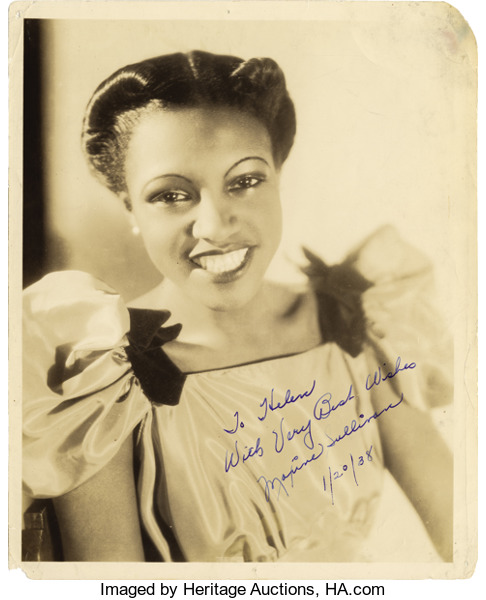
A vintage photograph of jazz vocalist Maxine Sullivan, signed, was offered in an October 2007 auction.

By Jim O’Neal

On an otherwise routine day in August 1958 (most claim it was the 12th – a few are not positive), the epicenter of American jazz was at 126th Street, between 5th and Madison, in New York City. Perhaps 57 or 58 of the greatest and near-greatest jazz musicians were assembled to have their picture taken – Willie “The Lion” Smith may have gotten bored and wandered off. They had been invited by Esquire magazine for a cover story, “The Golden Age of Jazz,” published in January 1959.

Jimmy McPartland was definitely not there since his wife, Marian, could not get him out of bed early enough for the scheduled 10 a.m. event. In fact, Marian was one of only three women there, including vocalist Maxine Sullivan and pianist Mary Lou Williams. Three other luminaries – Charlie Parker, Duke Ellington and Louis Armstrong – were not pictured, but many legends like Gene Krupa, Roy Eldridge and Thelonious Monk were there for the 10 a.m. event and right on time.

One cat said (seriously) he was surprised when he found out there were two 10 o’clocks every day!

The idea was Art Kane’s, an ambitious freelance photographer/art director who also volunteered to take the photograph, in spite of his almost total inexperience. Presumably, no one involved was aware they might be making history; primarily what gets recorded as history – like the very best jazz – can be surprising and unpredictable. Kane’s photograph was a way cool picture taken on a typical muggy New York City day.

To really understand the story behind the picture, watch the 1995 Oscar-nominated documentary A Great Day in Harlem. It was directed by first-time documentary filmmaker Jean Bach, who in her late 70s had more gumption, style and resilience than any of today’s self-proclaimed, oh-so-hip filmmakers could ever muster. She knew and loved jazz and the only city where that historic picture could possibly have been taken. She worked on the film with a great producer, Matthew Seig, and a superb editor, Susan Peehl. They all knew what they were doing and that shows, too, from the opening frame to the final credit. Jazz critic Whitney Balliett wrote in The New Yorker that the film is “about the taking of the picture, and it’s also about mortality, loyalty, talent, musical beauty and the fact that jazz musicians tend to be the least pretentious artists on earth.”

Of the 57 jazz musicians/artists in the photograph, only two are still alive. Walter Theodore “Sonny” Rollins (87). He’s a terrific tenor/soprano saxophonist who has lived a remarkable life that includes music (check out his album Saxophone Colossus, recorded in 1956 and preserved in the Library of Congress for artistic significance); a stint in Rikers Island for armed robbery; and being one of the guinea pigs for using methadone to break a heroin habit. There are way too many honorary awards to list.

The other survivor is Benny Golson (89), a tenor saxophonist, composer and arranger who worked with superstars like Lionel Hampton and Dizzy Gillespie. Golson also gained a modicum of fame from the 2004 Steven Spielberg movie The Terminal, which stars Tom Hanks as a traveler trapped in JFK airport over a visa issue. Hanks is on a fictional quest to get Golson’s autograph – the only one his jazz enthusiast father needs to have all 57 autographs of the musicians in the original photograph. Trivia spoiler… he gets it!

Man those cats could play!

Intelligent Collector blogger JIM O’NEAL is an avid collector and history buff. He is president and CEO of Frito-Lay International [retired] and earlier served as chair and CEO of PepsiCo Restaurants International [KFC Pizza Hut and Taco Bell].
Navajo Code Talkers Represented One of the Boldest Gambits of World War II

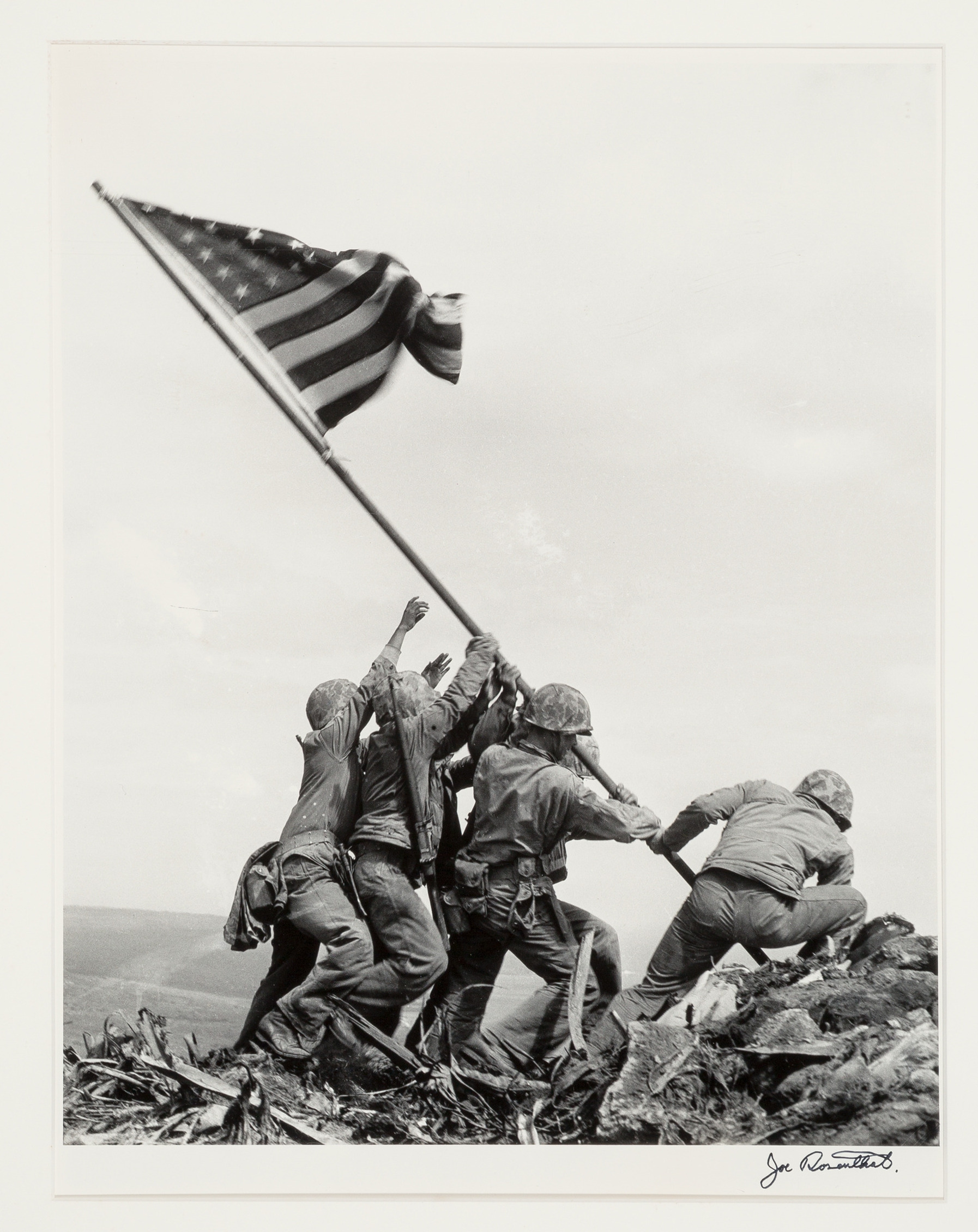
A gelatin silver print of Raising the Flag on Mount Suribachi, Iwo Jima, 1945, signed by photographer Joe Rosenthal, sold for $7,500 at an October 2016 Heritage auction.

By Jim O’Neal

Feb. 23, 1945, was a dramatic day in World War II when six Marines raised the American flag on Mount Suribachi to signal a decisive victory at Iwo Jima. Associated Press photographer Joe Rosenthal was there and his photo “Raising the Flag on Iwo Jima” won him the Pulitzer Prize for photography in 1945 – the only one to ever win in the same year it was published.

One of the Marines who hoisted the flag, Ira Hamilton Hayes, portrayed himself in the 1949 movie The Sands of Iwo Jima, which was nominated for four Academy Awards. It starred John Wayne, who received his first Academy Award nomination for Best Actor. He would have to wait 21 years to actually win one for Best Actor in the movie True Grit. Sadly, Hayes, an American Indian, died in 1955 at the tender age of 32 from alcoholism-related circumstances.

The battle for Iwo Jima was the first U.S. attack on the Japanese Imperial home islands and soldiers defended it tenaciously since it was the first stepping stone to the mainland. Of the 21,000 Japanese troops dug into tunnels and heavily fortified positions, 19,000 were killed as they had made a sacred commitment to fight to their death. There were numerous reports of soldiers committing suicide rather than surrendering, although there was also a curious situation where several actually hid in caves for two years before finally giving up. The battle for the entire island lasted from Feb. 23 until March 26 and it was considered a major strategic victory.

The first word of this momentous news crackled over the radio in odd guttural noises and complex intonations. Throughout the war, the Japanese had been repeatedly baffled and infuriated by these bizarre sounds. They conformed to no linguistic system known to Japanese language experts. The curious sounds were the U.S. military’s one form of communicating that master cryptographers in Tokyo were never able to decipher.

This seemingly perfect code was the language of the American Navajo Indian tribe. Its application in WWII as a clandestine system of communication was one of the 20th century’s best-kept secrets. After a string of cryptographic failures, the military in 1942 was desperate for lines of communication among troops that would not be easily intercepted. In the 1940s, there was no such thing as a “secure line.” All talk had to go out over the public airwaves. Standard codes were an option, but cryptographers in Japan had become adept at quickly cracking them. And there was another problem. The Japanese were also proficient at intercepting short-distance communications – walkie-talkies for example – and then having well-trained English-speaking soldiers either sabotage the message or send out false commands to set up an ambush.

That was the situation in 1942 when the Pentagon authorized one of the boldest gambits of the war by recruiting Navajo code talkers. Because the Navajo lacked technical terms for military artillery, the men coined a number of neologisms specific to their task and their war. Thus, the term for a tank was “turtle,” a battleship was “whale,” a hand grenade was “potato” and plain old bombs were “eggs.”

It didn’t take long for the original 29 recruits to expand to an elite corps of Marines, numbering 425 Navajo code talkers, all from the American Southwest. The talkers were so valuable that they traveled everywhere with personal bodyguards. In the event of capture, they had all agreed to commit suicide rather than allow America’s most valuable tool to fall into the hands of the enemy. If a captured Navajo didn’t follow that grim instruction, the bodyguard was told to shoot and kill the code talker.

Their mission and every detail of their messaging was a secret not even their families knew about. It wasn’t until 1968, when the military felt convinced they would not be needed in the future, that America learned about the incredible contributions a handful of American Indians made to winning history’s biggest war. The Navajo code talkers, sending and receiving as many as 800 error-free messages every day, were widely credited with giving troops the decisive edge at Guadalcanal, Tarawa, Saipan, Iwo Jima and Okinawa.

Semper fi.

Intelligent Collector blogger JIM O’NEAL is an avid collector and history buff. He is president and CEO of Frito-Lay International [retired] and earlier served as chair and CEO of PepsiCo Restaurants International [KFC Pizza Hut and Taco Bell].
Clear Objectives, an Overwhelming Force, Exit Strategy Crucial to Any War

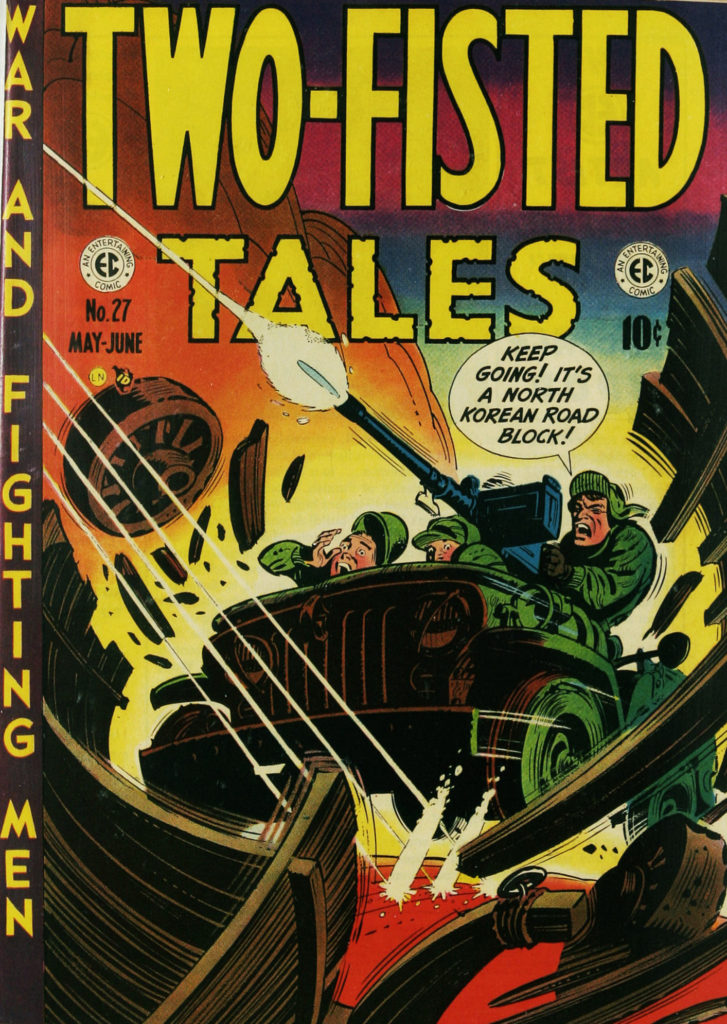
Korean War stories were popular in comic books published in the early 1950s, like this Two-Fisted Tales from EC Comics.

By Jim O’Neal

When I started studying the history of war in early 1962, I was surprised that so many wise military men all warned about the danger of a land war in Asia. Words like “bogged down,” “embroiled” and “mired” were liberally sprinkled around in the hope of shaping foreign policy. I knew President Eisenhower had quickly ended the “police action” in Korea that President Truman had left unfinished. As an experienced military strategist, Eisenhower knew that fighting on the Korean Peninsula could easily expand into a direct confrontation with China. He had been determined to avoid restarting the global conflict he had helped end.

The 1950s were a good time for America as we helped rebuild the world.

Then the seeds of war in Vietnam started slowly showing up on the evening news. The implications were blurred by events in San Francisco. Hippies, flower children, sex, drugs and rock ’n’ roll were far more entertaining. President Johnson started complaining about “JFK’s war” while he and Secretary of Defense Bob McNamara were quietly acceding to military requests for more troops and guns.

Eventually, draft protests grew more violent, followed by riots in major cities and MLK and Bobby Kennedy being assassinated. By 1968, the United States had 550,000 troops in Vietnam, having steadily grown from a few hundred “military advisers.” It would take another seven years and a different president to extricate the nation from an incremental war that had caused such domestic turmoil. The Vietnam Veterans Memorial in Washington, D.C., lists 58,318 names (including eight women) as of May 2017 who were “declared dead.”

The wise military officers had been right.

One hundred years earlier, a similar series of events had culminated in a civil war. In the three months following President Lincoln’s election, seven states seceded from the Union. The new president was paranoid that the Confederates would attack Washington after they forced the garrison at Fort Sumter to surrender. He urged his military advisers to preemptively attack rebel forces in Virginia, but the Union army lacked training and was too slow.

Finally, on July 16, 1861, Union General Irvin McDowell led 33,000 slightly trained soldiers toward Manassas, Va. (later better known as Bull Run). Before they arrived, spies tipped off P.G.T. Beauregard, who quickly called for 10,000 reinforcements to bolster his 22,000 troops. Rumors of the pending battle spread quickly and there was a large contingent of politicians and civilians perched on a hillside with blankets and picnic baskets, eager to see a good fight. Among them was a young senator from Ohio, John Sherman, whose brother William Tecumseh would play a key role with General Ulysses S. Grant in ending the war.

However, 10 hours of combat on July 21, 1861, changed the way a nation viewed war. Both Federals and Confederates had come to these fields supremely confident of swift, relatively bloodless victories. Even Abraham Lincoln had attended church that day after being assured of an easy Union victory. Senator Sherman was one of the first to learn otherwise. “Our army is defeated and my brother is dead,” Secretary of War Simon Cameron informed him.

They left behind more than 800 dead and 2,700 wounded. They also left behind any illusions that the war would be won or lost on a single, lazy Sunday afternoon. Confederate officer Samuel Melton wrote, “I have no idea that they intend to give up the fight. On the contrary, five men will rise up where one has been killed, and in my opinion, the war will have to be continued to the bloody end.”

Another wise man who understood war.

Now flash forward to October 1998 when official U.S. foreign policy was changed by a benign-sounding Congressional action to remove the Iraqi government: the Iraq Liberation Act. Then, four years later in October 2002, the U.S. Congress passed the “Iraq Resolution,” which authorized the president to “use any means necessary” against Iraq. At 5:34 a.m. Baghdad time on March 20, 2003, the military invasion of Iraq began. Fifteen years later, we are still in Iraq, Afghanistan, Libya, Syria and Niger. Some now call this the “long war” and there is no end in sight.

My friend Colin Powell says he did not invent the “Pottery Barn Rule” (if you break it, you own it). But he does believe that any war should have a clear objective, an overwhelming force to achieve it and a clear exit strategy.

He is a wise man.

Intelligent Collector blogger JIM O’NEAL is an avid collector and history buff. He is president and CEO of Frito-Lay International [retired] and earlier served as chair and CEO of PepsiCo Restaurants International [KFC Pizza Hut and Taco Bell].
Sea Battle off Coast of France a Crucial Union Victory

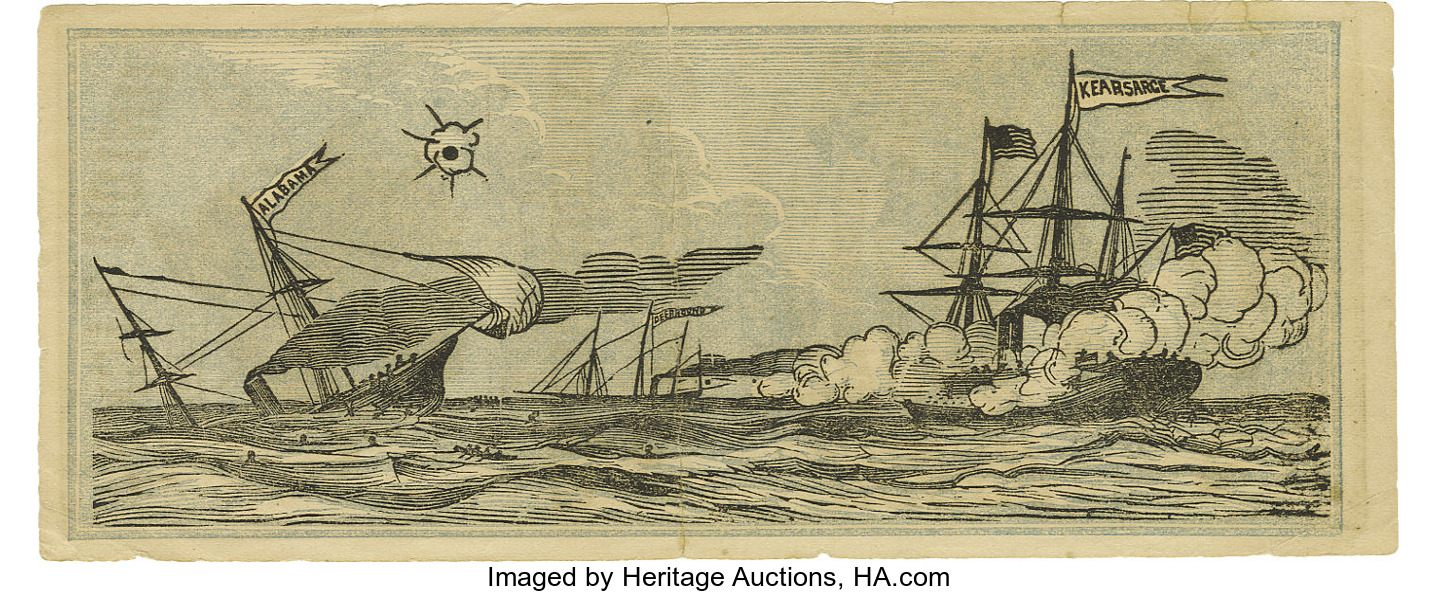
The USS Kearsarge’s sinking of the CSS Alabama gave the North a much-needed boost in morale. This image appeared on an 1864 Union ballot.

By Jim O’Neal

On Sunday, June 19, 1864, in the English Channel off Cherbourg, France, one turbulent hour brought to a climax the worldwide struggle for sea power between the North and South. Within sight of the French cliffs, lined with hundreds of people who came to see the announced spectacle of duel, were the USS Kearsarge and the Confederate warship the CSS Alabama.

French spectators munched from food baskets as the drama unfolded.

These ships, so far from home, appeared to be twins as far as the landsman could see. However, major differences in guns, crews, armor and ammunition could not be seen from shore. The Kearsarge’s 11-inch guns outmatched those of her foe. Her sides were sheathed in metal chains – covered with boards. She had been in dock for repairs the past three months, engines carefully tuned and both powder and shot in excellent condition.

By coincidence, the two captains, Raphael Semmes of the Alabama and John Winslow of the Kearsarge, were longtime friends as messmates, roommates and shipmates in the pre-war Navy – and both were Southerners. As they maneuvered their ships into position, a French warship played Confederate music as the Alabama steamed out of harbor.

The Alabama had long been on her way to this historic destiny.

Built in Liverpool, England, under subterfuge, christened anonymously as Erica and variously known as “The 190” and the “Emperor of China’s Yacht,” she had almost literally swept United States merchant shipping from the seas. In 22 months, she had cruised 75,000 miles – equal to three times around the world – overhauled 295 vessels of many flags, taken 29 Union ships as prizes, and burned another 14 valued at over $5 million!

She had been fitted with guns in the Azores to complement her large sails, modern engines and a special propeller that could be raised for greater speed under sail. It was not by chance that she caught virtually every quarry sighted. However, she had not changed her black powder (now foul) and most of her shells were possibly defective. She had arrived in port at Cherbourg to repair and take on coal. In a rare stroke of bad luck, Napoleon III could not be reached to grant the obligatory asylum needed by any belligerent.

Alerted at Flushing, the Kearsarge pounced and was at Cherbourg in two days, patrolling the harbor and visually inspecting the Alabama through glasses. Captain Semmes, basically trapped, announced he would fight rather than sneak away at night. Cherbourg was crowded with sightseers … all had come to see the Americans in action. Semmes wisely sent ashore all the ship’s valuables and had his men compose their wills before engaging to fight.

The gunners went to their posts and Semmes and his officers, in full-dress uniforms, steamed out of the harbor ready for battle. Soon, the Alabama deck was littered with bodies, many badly mutilated, and there were gaping holes at the waterline. The Alabama, with her graceful black hull, which bore no name and marked only by a motto on the stern, Aide Toi, Et Dieu T’Aidera (God Helps Those who Help Themselves), was no more.

Intelligent Collector blogger JIM O’NEAL is an avid collector and history buff. He is president and CEO of Frito-Lay International [retired] and earlier served as chair and CEO of PepsiCo Restaurants International [KFC Pizza Hut and Taco Bell].
After Independence, United States and South America Took Different Paths

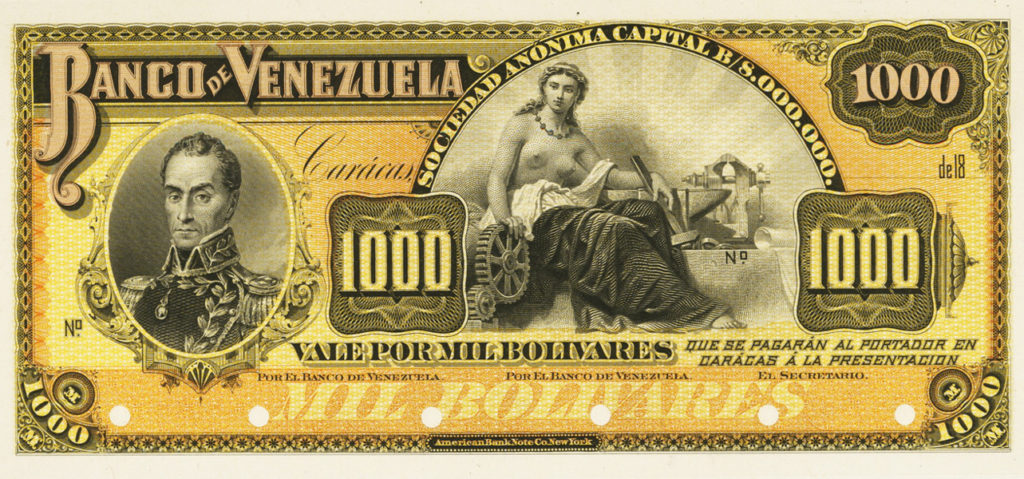
This Banco de Venezuela 1000 Bolivares ND, circa 1890, proof, featuring Simón Bolívar, sold for $2,115 at a January 2017 Heritage auction.

By Jim O’Neal

Important scholars believe that Simón Bolívar should have been the George Washington of South America. He, too, overthrew an empire (Spain) – but obviously failed to create an Estados Unidos of South America. The American Revolution not only achieved unity for the former British colonies; independence also set the United States on the road to unsurpassed prosperity and power. South America ended up in a different place entirely due to a complex set of events.

Bolívar was born in Caracas in July 1783 to a prosperous, aristocratic family. He was an orphan by age 10 and soldier at the tender age of 14. He studied in Spain and France, spending time in Paris even after all foreigners were expelled in response to a food shortage. He returned to Venezuela by 1807, inspired by Napoleon and disgusted with Spanish rule. Sent to London to seek British help, he met Francisco de Miranda, the veteran campaigner for Venezuelan independence.

On their return in July 1811, they boldly proclaimed the First Republic of Venezuela.

The Republic ended in failure since a disproportionate number were excluded from voting by a flawed constitution and Bolívar betrayed Miranda to the Spanish before fleeing to New Granada. From there, he proclaimed a Second Republic – with himself in the role of dictator and winning the epithet El Libertador.

Eventually, Bolívar became master of what he termed Gran Colombia, which encompassed New Granada, Venezuela and Quito (modern Ecuador). José de San Martín, the liberator of Argentina and Chile, yielded political leadership to him. By April 1825, his men had driven the last Spanish from Peru, and Upper Peru was renamed Bolivia in his honor. The next step was to create an Andean Confederation of Gran Colombia, Peru and Bolivia. Why did Bolívar fail to establish this as the core of a United States of Latin America? The superficial answer – his determination to centralize power and resistance of the local warlords – misses much more complicated circumstances.

First is that South Americans had virtually no experience or history in democratic decision-making or representative government of the sort that had been normal in North America’s colonial assemblies. So Bolívar’s dream of democracy turned out to be dictatorship because, as he once said, “our fellow citizens are not yet able to exercise their rights … because they lack the political virtues that characterize true republicans.” Under the constitution he devised, Bolívar was to be dictator for life, with the right to nominate his successor. “I am convinced to the very marrow of my bones that America can only be ruled by an able despotism … We cannot afford to place laws above leaders and principles above men.”

For remaining skeptics, perhaps it is better to let Simón Bolívar explain in his own words, in a December 1830 letter he wrote a month before his death:

“I ruled for 20 years … and I derived only a few certainties:

  • South America is ungovernable.
  • Those who serve a revolution plough the sea.
  • The only thing one can do in America is to emigrate.
  • This country will fall inevitably into the hands of the unbridled masses.
  • Once we have been devoured by every crime and extinguished by utter ferocity, the Europeans will not even regard us as worth conquering.
  • If it were possible for any part of the world to revert to primitive chaos, it would be [South] America in her final hour.”

This was a painfully accurate prediction for the next 150 years of Latin American history and the result was a cycle of revolution and counter-revolution, coup and counter-coup. One only needs to read of Venezuela today to grasp the totality of how dire the future remains.

By the way, much of this insight comes by way of the highly recommended Civilization: The West and the Rest by Niall Ferguson.

Intelligent Collector blogger JIM O’NEAL is an avid collector and history buff. He is president and CEO of Frito-Lay International [retired] and earlier served as chair and CEO of PepsiCo Restaurants International [KFC Pizza Hut and Taco Bell].
Napoleonic-Era Book Explains Evolving Dark Art of War

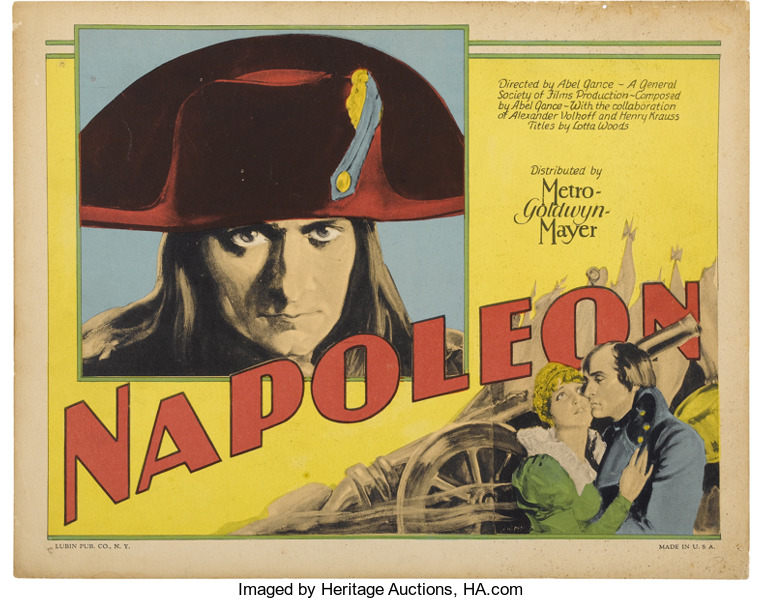
A title lobby card for the 1927 silent French epic film Napoléon sold for $10,157 at a July 2008 Heritage auction.

By Jim O’Neal

It is generally accepted dogma that the French Revolution devoured not only its own children. Many of those who fought against it were literally children. Carl von Clausewitz was only 12 when he first saw action against the French.

A true warrior-scholar, Clausewitz (1780-1831) survived the shattering defeat at Jena-Auerstedt (today’s Germany) in 1806, refused to fight with the French against the Russians in 1812 and saw action at Ligny in 1815. As noted in his book Civilization: The West and the Rest, British historian Niall Ferguson says it was Clausewitz who, better than anyone (including Napoleon himself), understood the way the Revolution transformed the dark art of war.

The Prussian general’s posthumously published masterpiece On War (1832) remains the single most important work on the subject produced by a Western author. Though in many ways timeless, Ferguson points out On War is also the indispensable commentary on the Napoleonic era. It explains why war had changed in its scale and the implications for those who chose to wage it.

Clausewitz declared that war is “an act of force to compel our enemy to do our will … (it is) not merely an act of policy but a true political instrument, a continuation of political intercourse, carried on with other means.” These are considered his most famous words, and also the most misunderstood and mistranslated (at least from what I have read … which is extensive).

But they were not his most important.

Clausewitz’s brilliant insight was that in the wake of the French Revolution, a new passion had arrived on the field of battle. “Even the most civilized of peoples [ostensibly referring to the French] can be fired with passionate hatred for each other…” After 1793, “war again became the business of the people,” as opposed to the hobby of kings, Ferguson writes. It became a juggernaut, driven by the temper of a nation.

This was new.

Clausewitz did acknowledge Bonaparte’s genius as the driver of this new military juggernaut, yet his exceptional generalship was less significant than the new “popular” spirit that propelled his army. Clausewitz called it a paradoxical trinity of primordial violence, hatred and enmity. If that was true, then it helps explain the many people-wars of the 19th century, but is a perplexer (at least to me) when applied to events a century later.

The Battle of the Somme, started on July 1, 1916, is infamous primarily because of 58,000 British troop casualties (one-third of them killed) – to this day a one-day record. It was the main Allied attack on the Western front in 1916 and lasted until Nov. 18 when terrible weather brought it to a halt. The attack resulted in over 620,000 British and French casualties. German casualties were estimated at 500,000. It is one of the bloodiest battles in human history.

The Allies gained a grand total of 12 kilometers of (non-strategic) ground!

It is hard to fit Clausewitz’s thesis into this form of military stupidity. I prefer the rationale offered by the greatest mind of the 20th century: “Older men declare war. But it is the youth that must fight and die,” said Albert Einstein.

Intelligent Collector blogger JIM O’NEAL is an avid collector and history buff. He is president and CEO of Frito-Lay International [retired] and earlier served as chair and CEO of PepsiCo Restaurants International [KFC Pizza Hut and Taco Bell].

Libertarian Streak Set United States Apart from Rest of Continent

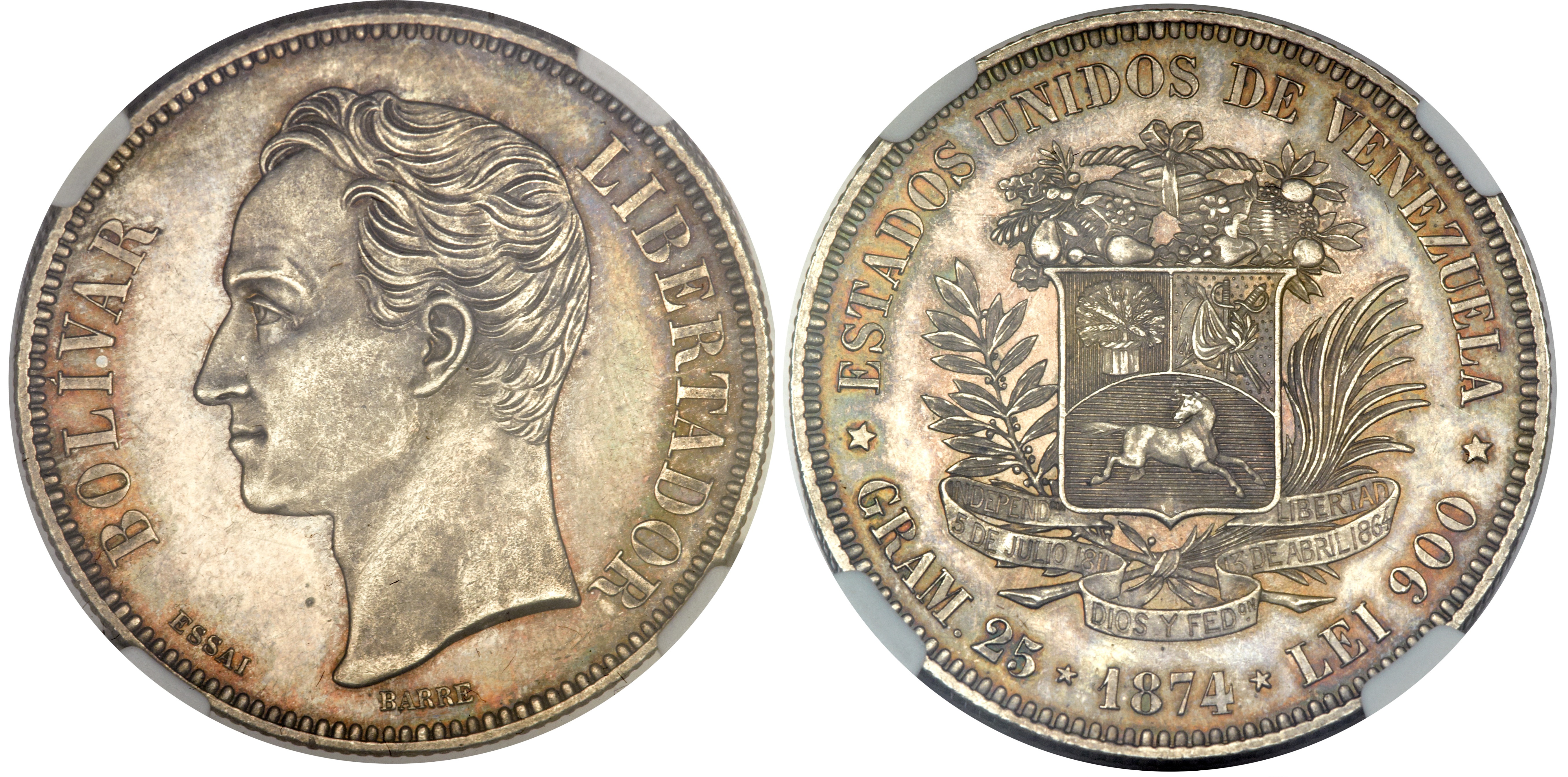
A rare 1874 Venezuelan Republic silver proof, featuring Simón Bolívar and struck by the Paris mint, realized $70,500 at an August 2014 Heritage auction.

By Jim O’Neal

By 1775, North and South America had become remarkably different from a societal standpoint, with economic systems profoundly dissimilar. The only significant similarity was they were both still composed of colonies ruled by kings in distant lands.

That was about to change, rather dramatically.

On July 2, 1776, the Second Continental Congress declared its colonies independent from Britain and King George. Spain’s rule in Latin America would end 40 years later, but the North’s revolution assured the rights of property owners and established a federal republic that would become the world’s wealthiest nation in a relatively short 100 years.

Latin American revolutions, on the other hand, consigned nations south of the Rio Grande to 200 years of instability, disunity and economic underdevelopment.

One important reason was that the independence claimed by Britain’s 13 North American colonies was driven by a libertarian society of merchants and farmers who rebelled against an overzealous extension of imperial authority. It was not only the old issues of taxation and representation; land had become a much more important issue that, in turn, fueled the revolutionary fires. The British government’s efforts to limit further settlement west of the Appalachians struck at the heart of the colonists’ vision of the future – a vision of “manifest larceny” that was especially attractive to property speculators like George Washington.

Still, war may have been averted by concessions on taxes, better diplomacy or even if British generals were more adept and less arrogant. It is even possible to imagine the colonies falling apart instead of coming together. Post-war economic conditions were severe: inflation near 400 percent, per capita income slashed by 50 percent, a mountain of debt over 60 percent of GDP. But losing the yoke of the British Crown created a sense of newfound freedom and brotherhood. These states were now united.

However, had the revolution not progressed beyond the Articles of Confederation, then perhaps the fate of the United States would have been more like that of South America – a story of fragmentation rather than unification. It took the Constitution of 1787, the most impressive piece of political institution-building in all of history, to establish a viable federal structure for the new republic. There was a single market, a single trade policy, a single currency, a single army, and a single law of bankruptcy for people whose debts exceeded assets.

The major flaw was not resolving the issue of slavery and the naive assumption it would vanish over time. It obviously did not and the burden of the Civil War nearly destroyed all of the astonishing progress that followed. The sheer brilliance of Abraham Lincoln’s insight to avoid any action that would lead to disunion trumped the temptation to co-mingle states’ rights or slavery. “One nation, indivisible…”

Yet independence from Spain left much of Latin America with an enduring legacy of conflict, poverty and inequality. Why did capitalism and democracy fail to thrive?

The short answer was Simón Bolívar.

A longer, more balanced view will have to wait for its own blog entry.

Intelligent Collector blogger JIM O’NEAL is an avid collector and history buff. He is president and CEO of Frito-Lay International [retired] and earlier served as chair and CEO of PepsiCo Restaurants International [KFC Pizza Hut and Taco Bell].