
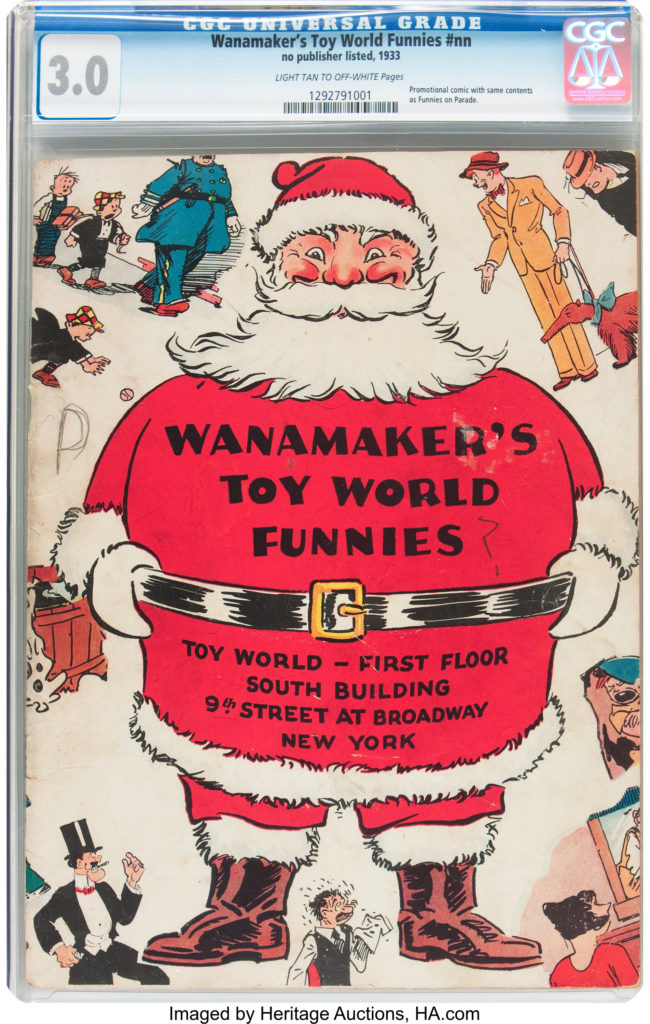
Department stores once played a vital role in American life

Wanamaker’s Toy World Funnies was produced in 1933 as a promotional item for the department store’s New York location. This sample went to auction in May 2016.

By Jim O’Neal

In the complicated hierarchy of Greek mythology, the Titans were the first 12 children of Gaia (Mother Earth) and Uranus (Father Sky). They ruled during the mythical period of the Golden Age of Greek deities. In astronomy, Titan is the largest moon of Saturn, the second-largest natural satellite in our solar system.

In modern times, the adjective “titanic” derives from Titan. The famous ship Titanic was one of three RMS Olympic-class ocean liners built in the early 20th century. The other two were christened Olympic and Britannic. The Titanic sank in 1912 after hitting an iceberg on its maiden voyage. Britannic went down to a watery grave in 1916 after hitting a mine laid by a German U-boat during World War I.

Titanic was on its way from Southampton (UK) to NYC after calls in Cherbourg in France and Cobh, Ireland. On board were an estimated 2,224 passengers and crew. It is believed that about 1,500 people perished. Writer/director James Cameron’s 1997 award-winning film of the same name was a blockbuster at the box office. It received 14 Oscar nominations, snagging 11. It is in second place in box-office revenues, right behind Cameron’s other big hit, Avatar.

Titanic was the largest ship in the world and built at a cost of $7.5 million. It was also equipped with the latest in wireless technology. The crew immediately sent out a distress signal that was received in Newfoundland and retransmitted to all ships in the area. Full speed ahead! Unfortunately, none was near enough to reach Titanic before it sank.

Meanwhile, in New York City, the venerable Philadelphia Wanamaker’s Department Store had set up a unique floor exhibit (with wireless) to simply attract shoppers in the highly competitive New York market. A young employee of inventor/electrical engineer Guglielmo Marconi in NYC was routinely responsible for relaying wireless messages in Morse code to anyone in Philadelphia. His name was David Sarnoff and he would become well known for becoming the head of Radio Corporation of America (RCA) and starting the National Broadcast Company (NBC).
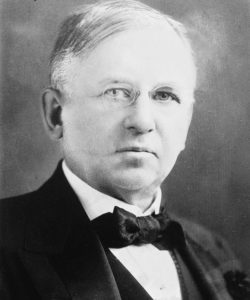
John Wanamaker

By chance, Sarnoff had taken a position at Wanamaker’s running the wireless communication operations, which included messages, ordering material and whatever else came along. What came along was the distress message from the Titanic that the ship was sinking and then that it had actually sank! All the newspapers had quit for the night, just after the first distress message came through. Starting early the next morning, Sarnoff was receiving names of both passengers who were rescued and those confirmed dead. The fact that Wanamaker’s was receiving real-time updates from the middle of the Atlantic was a big story by itself.

Eager crowds, not wanting to wait for newspapers with old stories, rushed to Wanamaker’s. Others went to Times Square, where a flashing billboard displayed the latest news. Names kept trickling in for three days and even set off a mini-financial panic involving the insurer Lloyd’s of London and other insurance companies. This obvious coup for Wanamaker’s was not just a lucky accident

John Wanamaker had started a small men’s clothing store in 1861 and was probably the most innovative marketing genius for the next 50-plus years. As the current crop of retail gurus bemoan the decline of retail due to e-commerce and pundits predict the slow death of shopping malls, they would be better served by studying Wanamaker the Retailer and Wanamaker the Employer.

On the retail side, consider that he opened the first retail store in Philadelphia … adjacent to George Washington’s President’s House (location, location, location). He played fine background music in the stores. He introduced orchestral concerts and circular rows of counters that guided shoppers through new merchandise. Even today, the 12-story granite-walled structure known as the Wanamaker Building houses the world’s largest Grand Court Organ with six keyboards and 28,000 pipes that transformed the shopping experience. At a cost of $105,000, it required 13 freight trains to convey it for installation.

Less grandiose was the customary practice to go into a shop and haggle until you got a good price (good luck with that today). John Wanamaker started the custom of putting price tags on every single item in the store … and then boldly advertising with big signs: ONE PRICE AND GOODS RETURNABLE.

For employees, he provided everyone with free medical care, recreational facilities, profit sharing and real pension plans … benefits that simply didn’t exist anywhere! I would love to see John Wanamaker and Jeff Bezos trading philosophies on growing a successful business. It would fascinating, despite the passage of two centuries.
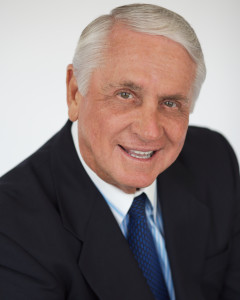
Intelligent Collector blogger JIM O’NEAL is an avid collector and history buff. He is president and CEO of Frito-Lay International [retired] and earlier served as chair and CEO of PepsiCo Restaurants International [KFC Pizza Hut and Taco Bell].
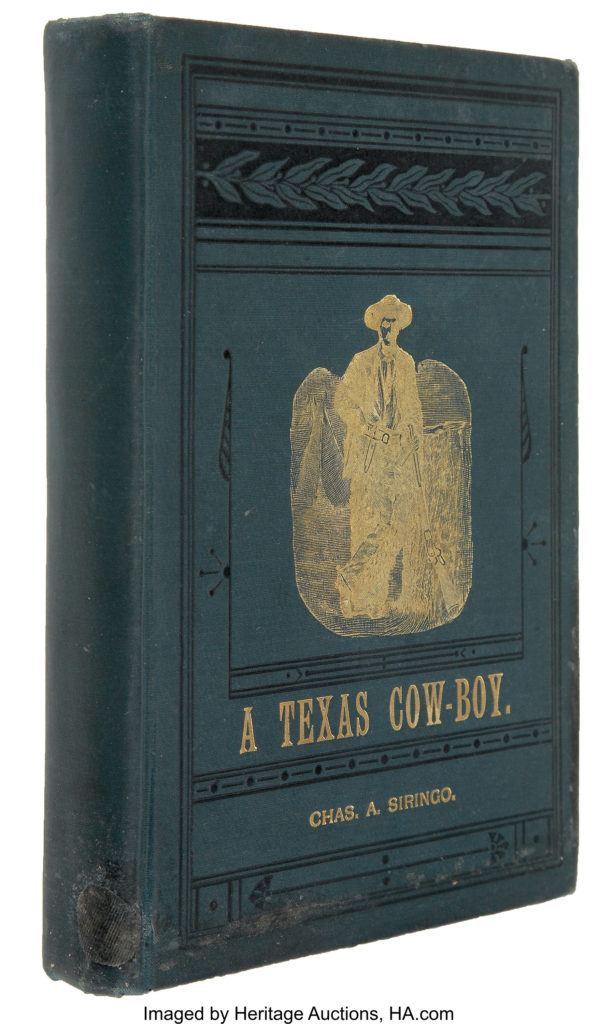
Texas cowboy helped create our fascination with the ‘Wild West’

An 1885 first edition of Charles Siringo’s A Texas Cow-Boy sold for $28,680 at a November 2009 Heritage auction.

By Jim O’Neal

In 1885, Charles Siringo published his first book. It was an autobiography with the long and awkward title A Texas Cow-Boy; Or Fifteen Years on the Hurricane Deck of a Spanish Pony. It may have been a slight exaggeration to claim it sold a million copies (accounts vary). However, it was definitely plausible, since it was the first authentic book written by a genuine working cowboy.

Siringo had a reputation for being a reckless but courageous cowboy who was an expert shot with his reliable six-shooter. This was a fascinating combination and, when added to his real-life experiences, was exactly what ranch hands and dreamy-eyed city dwellers were eager to read about.

It’s doubtful that anyone was remotely aware of just how insatiable the public appetite was for stories about the exciting American West or the paucity of books or magazines available. This was a mysterious place filled with cowboys, ranchers, outlaws rustlers, Indians and lawmen. Stories about the “Wild West” were to become bestsellers beyond wildest imaginations.

Charles Siringo was born in Texas in 1855 and, after a few rudimentary lessons, became a cowpuncher. While still a teenager, he had his own registered brand and dreams of one day having a big ranch. This was still possible by simply rounding up a bunch of “mavericks” – unbranded cows wandering the open range – claiming ownership and slapping your own brand on them. He was never able to build much of a herd and ended up as a shopkeeper in Kansas for a few years.

However, before he was 30 years old, he had plenty of stories and a zeal for making money. The book he wrote was an immediate success and played a pivotal role in creating the enduring American fascination with the Western cowboy. He had spent 20 years working as a Pinkerton detective chasing rustlers and train robbers, sometimes even going undercover and infiltrating gangs of outlaws. Some of his more notable exploits included chasing Butch Cassidy and his “Wild Bunch” all over the Southwest until they escaped to South America (much to the relief of the railroad owners). Earlier, he and Sheriff Pat Garrett put an end to the career of Billy the Kid in a famous gunfight.

He finally left Pinkerton in 1907 but had enough real-life experience to write five more novels. He died in Altadena, Calif., in 1928 at age 73, probably unaware of just how popular stories of the West would become in books, movies and television.

By fate or coincidence, 10 years later, the most prolific chronicler of the American West would also be buried in Altadena, but this storyteller made a fortune and was the first author to become a millionaire. It was none other than the incomparable Zane Grey (1872-1939). Nobody comes close to spinning tales of this genre for so long and in every media available.

Zane Grey was from Zanesville, Ohio, and would become the best selling Western author of all time. From 1917 to 1926, he was one of the top 10 bestsellers nine times and is credited with sales of over a staggering 40 million books. Then, when the paperback format was introduced, most of his books were reissued into mass distribution.

Hollywood eagerly turned most of his stories into over 50 movies. His bestseller was 1912’s Riders of the Purple Sage; Grey sold the movie rights to motion-picture executive William Fox for $2,500. Fox went on to sell his company and it eventually grew into an entertainment giant. Last week, Disney bought 21st Century Fox for $71 billion.

Zane Grey books and movies easily made the transition to television. Dick Powell’s Zane Grey Theatre ran on CBS from 1956 to 1961 with 149 episodes. Uniquely, five episodes were so popular they ended up being spun off into their own shows: Trackdown (Robert Culp), The Rifleman (Chuck Connors), The Westerner (Brian Keith), Black Saddle (Peter Breck), and Johnny Ringo (Don Durant). And, of course, there was Grey’s novel The Lone Star Ranger, which spawned four movie adaptions.

I grew up going to the movies every Saturday and I tried to see every Western at least twice. This addiction carried over into television and I loved them all, memorizing all the actors and their role names. Somewhere in this repertoire, I suspect you will recall a favorite.

Intelligent Collector blogger JIM O’NEAL is an avid collector and history buff. He is president and CEO of Frito-Lay International [retired] and earlier served as chair and CEO of PepsiCo Restaurants International [KFC Pizza Hut and Taco Bell].
Eliminating national debt will require a bit of financial wizardry

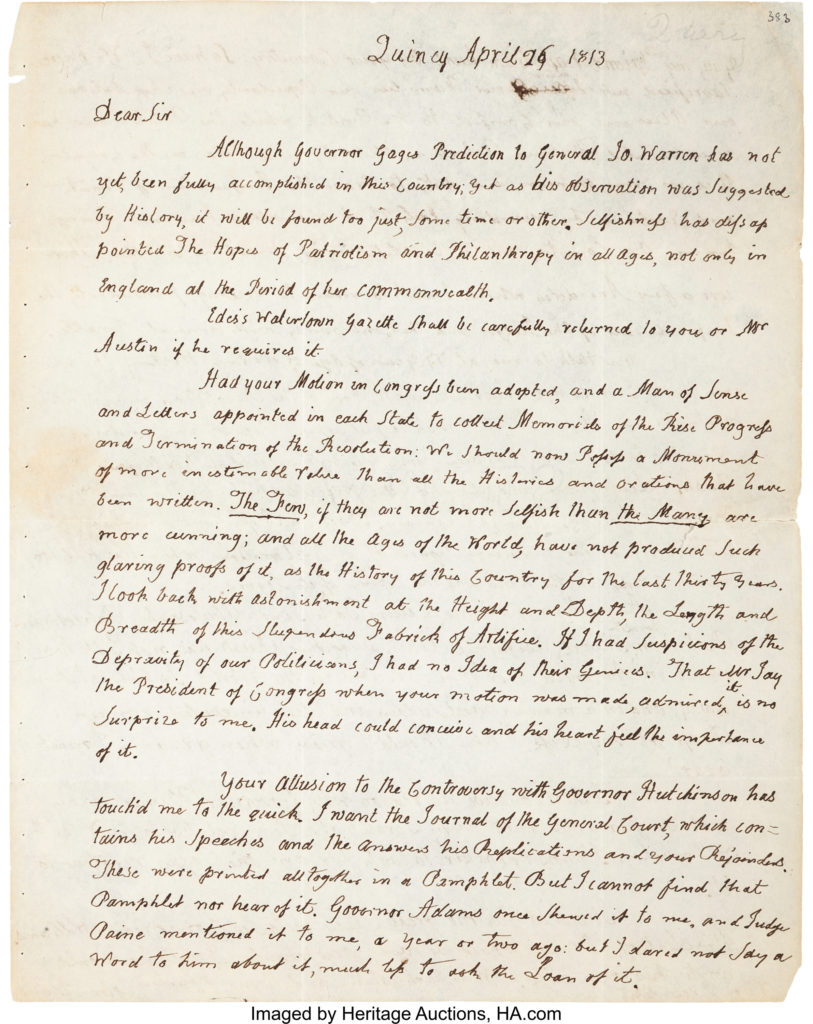
An intimate and honest letter by John Adams to Vice President Elbridge Gerry, dated April 26, 1813, sold for $46,875 at an October 2014 Heritage auction.

By Jim O’Neal

President James Madison set the rather dubious record of having both of his vice presidents die in office. George Clinton went first on April 20, 1812. Clinton also set a record as the first person to lie in state at the Capitol. However, it was for only two hours pending finalization of his burial services.

Then Vice President Elbridge Gerry died on Nov. 23, 1814, during Madison’s second term as president. Gerry’s name is still in common use today … “gerrymandering” is a way to draw voting districts to favor a candidate or political party. Gerry also holds the distinction of being the sole signer of the Declaration of Independence to be buried in the nation’s capital. He is interned at the Congressional Cemetery, which is the only “cemetery of national memory” founded before the Civil War. Although it is privately owned, the federal government has 806 plots that are used for ex-members of importance.

Neither VPs Clinton nor Gerry were replaced, since the Constitution at the time did not have a provision for filling a vice presidential vacancy. If a VP died, the job was held open pending the next election. Congress finally got around to addressing this in 1967 with the ratification of the 25th Amendment. In the aftermath of President John F. Kennedy’s assassination, the 25th provides the specific procedures for replacing the president or vice president in the event of death, removal, resignation or incapacitation (better late than never!).

Clinton had earlier served as Thomas Jefferson’s second vice president (Aaron Burr was the first) and was one of two vice presidents who served under two different presidents. John C. Calhoun was the other to have this iffy honor.

Calhoun was VP for John Quincy Adams and then Adams’ successor, Andrew Jackson. Calhoun then resigned the vice presidency to become a senator from South Carolina. The South Carolina legislature had voted to nullify federal tariff laws and threatened to secede from the Union if the issue was not resolved. Calhoun, ever the politician, thought the tariff issue could best be resolved by Congress and he thought he would be of more help to South Carolina as a senator.

However, Jackson began mobilizing federal troops to send to Charleston and made headlines by stating he would hang Calhoun if South Carolina went ahead with their threat to secede from the Union. In December 1832, Jackson issued a “Proclamation on Nullification,” warning that disunion by force was treason! Recall that this was nearly 30 years before the Civil War started.

President Jackson remained steadfast on federal tariffs. First, he was adamant that the Constitution trumped states’ rights. Asked if he had a message to those who threatened to secede, he replied: “Yes, give them my compliments and say that if a single drop of blood is shed in opposition to the laws of the United States, I will hang the first man upon the first tree I can reach!”

Secondly, he knew the federal tariffs were critical to his firm pledge to pay off the national debt. Remarkably, Jackson made good on his promise to eliminate the national debt. On Jan. 8, 1835, the federal government paid off 100 percent of the national debt … the first time in the history of the country. Fittingly, it was the 20th anniversary of the Battle of New Orleans. The following year, an even more astonishing event occurred. President Jackson approved returning surplus treasury funds to individual states.

With the current national debt at more than $22 trillion, and another $100 trillion in liabilities (Social Security and Medicare), I suspect zero national debt will require a degree of financial wizardry not seen since Bernie Madoff was reluctantly letting people give him their money to invest.

Intelligent Collector blogger JIM O’NEAL is an avid collector and history buff. He is president and CEO of Frito-Lay International [retired] and earlier served as chair and CEO of PepsiCo Restaurants International [KFC Pizza Hut and Taco Bell].
Prohibition one of the most improbable political achievements in U.S. history

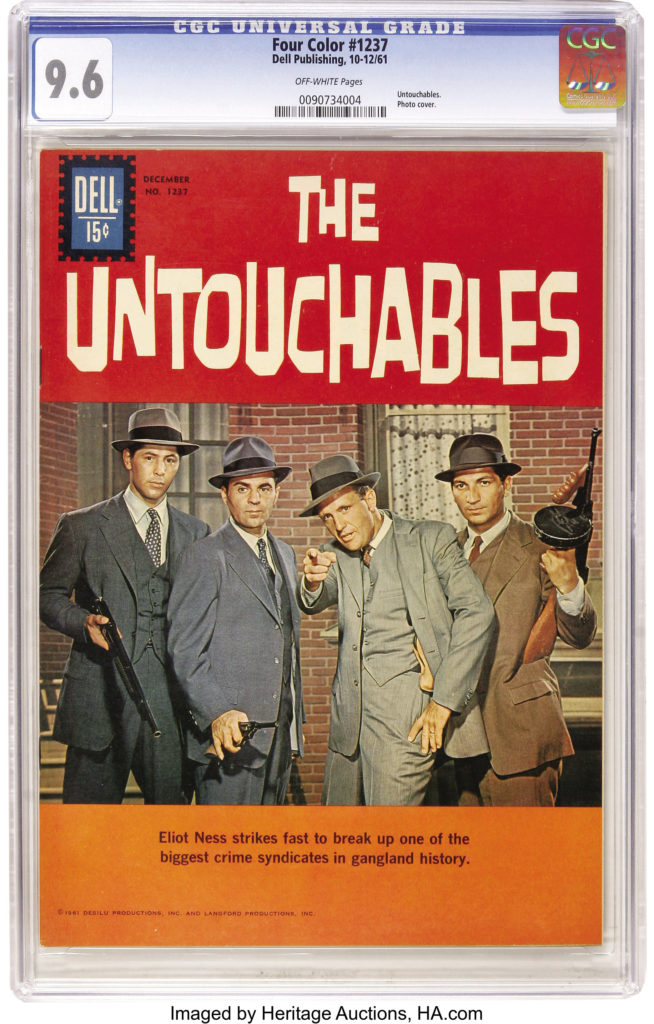
Dell in 1961 was publishing a comic-book based on The Untouchables television show.

By Jim O’Neal

In 1959, Desilu Productions aired the first episode of The Untouchables, a TV series starring Robert Stack. The storyline was from a book of the same title that recounted the exploits of an elite group of Prohibition agents working for the Treasury Department. They were battling the mafia in Chicago during Prohibition (1920-1933). “Untouchables” was a nickname for a small group of lawmen who refused to take bribes from bootleggers.

There was a real-life Eliot Ness (1903-1957), who had a career battling booze and bootleggers, but the 119 episodes on TV were generally fictional accounts. The show had a decent run over four years (1959-63) and the format used famous newspaper/radio commentator Walter Winchell as a narrator to make it seem more realistic. Winchell (who was paid $25,000 per program) and Robert Stack were the only two actors to appear in all 119 shows.

In 1987, there was a movie version starring Kevin Costner as Ness and Robert De Niro as a fictionalized Al Capone. Sean Connery played a regular street policeman, and won an Oscar for Best Actor in a supporting role.

Prohibition was one of the most improbable political achievements in American history. The idea that a democratic nation with millions of voting-age drinkers, more than 300,000 taverns and saloons (all eager to slake their thirst), and the fifth-largest industry were unable to prevent this legislation was unthinkable. However, the battle had been raging for as far back as Colonial times. A temperance movement had been fighting alcohol consumption on the basis that it would destroy the moral fiber of the nation. The effort was joined by political forces with booming voices (e.g. William Jennings Bryan) who were convincingly vociferous about the evils of John Barleycornwith only limited success.

Pragmatic business leaders discouraged the use of alcohol, pointing out the negative effects on worker reliability, job-related injuries and, importantly, productivity and quality. But the problem was gradually becoming worse as the nation’s workforce refused to heed the warnings. Perhaps the loudest and most passionate opponents of alcohol were the wives and mothers left to contend with the impact on their families if the primary breadwinner was a drunk. Gradually, it seemed that the only people who were against prohibiting alcohol were the drinkers and all the people making money providing it.

Even the government seemed supportive of alcohol since one-third of federal revenues was derived from the tax on sales. However, in 1913, the 16th Amendment replaced alcohol taxes with a federal income tax, which generated significantly higher revenues. In the 1916 presidential election, neither President Woodrow Wilson nor his opponent Charles Evans Hughes even mentioned the issue. Both parties were leery of discussing it for fear of alienating either the “drys” or the “wets” in such a close race.

But the ratification of the 18th Amendment on Jan. 29, 1919, banned the manufacture, transportation and sale of liquor – introducing a period in America’s history we still call simply Prohibition. Of course, wealthy men and institutions stocked up before the legislation went into effect. Curiously, the Act did not prohibit consumption. President Wilson moved his extensive inventory into the White House as did his successor, Warren Harding. The Yale Club in New York procured a supply that would last 14 years! Cynics were quick to point out that the president could have his martini each evening, but the working man could no longer get a beer and free sandwich at his favorite saloon.

For the less affluent, 15,000 doctors and 57,000 pharmacies got a license to supply medicinal alcohol. Drugstores were discrete sources as evidenced by Walgreens, which grew from 22 stores to over 500 in short order. Another loophole was the exemption that allowed homemade “fruit juices” for consumption exclusively in the home. Wineries in California were supplanted by millions at home. If left untended, the alcohol content in grape juice could soar to 12 percent. Grape juice production exploded.

However, a more insidious source of the banned alcohol developed. As the suburban population migrated to big cities, nightlife became synonymous with “speakeasies.” All one had to do was “speak easy,” act discreet and there was a convenient door where even women were now welcomed. The battle over alcohol shifted to the supply and distribution and there was a massive increase in organized crime as they fought over territories. Law enforcement was badly outgunned or was paid to look the other way.

Welcome to the Roaring Twenties!

As the Great Depression deepened, President Franklin Roosevelt signed legislation on March 21, 1933, that legalized the consumption of 3.2 percent beer, saying, “I think this would be a good time for a beer.”

Amen.

Intelligent Collector blogger JIM O’NEAL is an avid collector and history buff. He is president and CEO of Frito-Lay International [retired] and earlier served as chair and CEO of PepsiCo Restaurants International [KFC Pizza Hut and Taco Bell].
Richard Henry Dana Jr. turned measles into an adventure of a lifetime

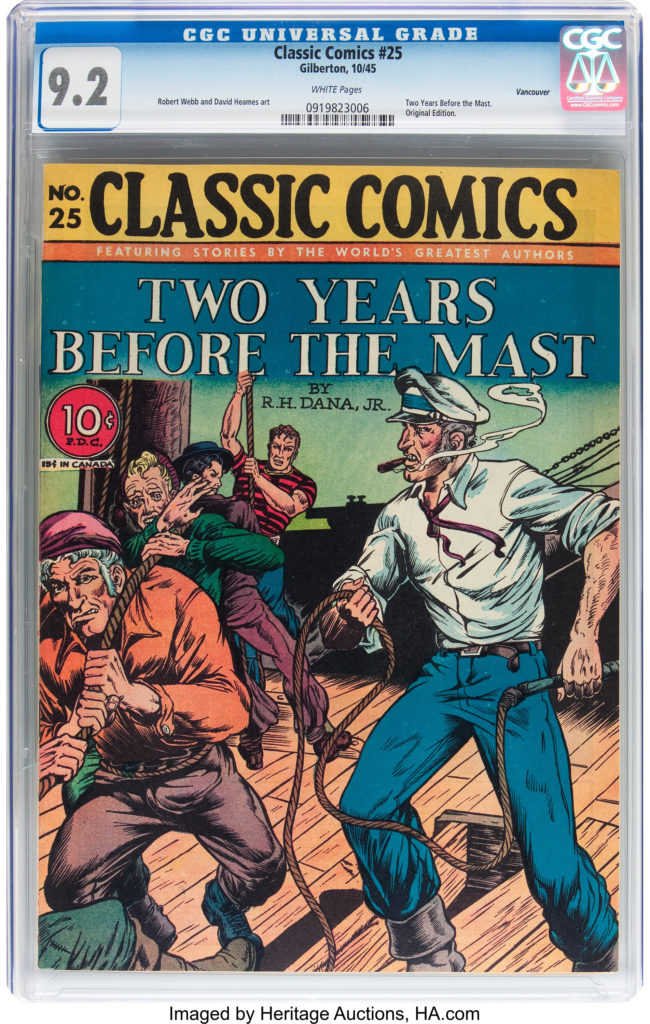
A Classic Comics adaptation of Richard Henry Dana Jr.’s Two Years Before the Mast (Gilberton, 1945) sold for $1,314.50 at an August 2014 Heritage auction.

By Jim O’Neal

People of my generation are well aware that measles is a highly communicable disease, with many people usually infected in grade school. In a typical year, up to 4 million became infected, resulting in up to 500 deaths. In 1963, an effective vaccine was developed and infections plummeted as vaccination rates soared. By 2000, measles was officially declared eliminated in the United States.

So it was a surprise on July 3, 2015, when USA Today reported the death of a woman in Washington. There was another rash of infections several years ago in Southern California and there is currently an active outbreak in the Pacific Northwest. Apparently, a bogus report in the U.K. linked autism with the MMR (mumps, measles and rubella) vaccine and although thoroughly discredited, some people are cutting back on childhood vaccinations. I imagine they’re depending on other people getting vaccinated rather than taking a personal risk themselves. This has been characterized as “the most damaging medical hoax of the last 100 years.”

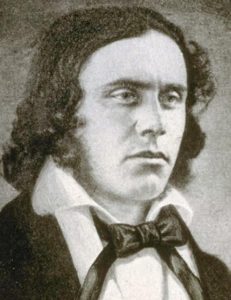
Richard Henry Dana Jr.

One man who didn’t have a choice was Harvard College student Richard Henry Dana Jr. (1815-1882). In 1831, he contracted measles and developed ophthalmia, an inflammation of the eye that’s considered a side effect. To improve his vision problems, he became a seaman in 1834 in the hope the exposure to ocean breezes would be helpful. It’s not clear if the sea air helped, but he spent two years sailing from Boston to South America and around Cape Horn to California.

The primary purpose of these voyages was to trade goods between the United States and the Spanish Colonial missions in the ports of San Diego, Santa Barbara, Monterey and San Francisco. California’s Spanish missions were a series of 21 religious outposts founded by Catholic priests to convert American Indians.

In the early 19th century, cattle ranching was the primary industry in California. The few hundred head introduced by Spanish friars 50 years earlier had flourished and grown into seemingly endless herds that roamed California’s lush grasslands. Vaqueros on horseback slaughtered the animals, skinned them and stripped off the best meat and tallow. The remains were left for coyotes and other scavengers.

The dried hides and tallow were then traded to the various ships that traveled the Pacific Coast in exchange for a wide range of goods manufactured on the East Coast of the United States. The cowhides were inevitably known as “California Banknotes” as they were the primary medium of exchange in the lucrative hide and tallow trade.

The San Diego port became a big market since it had an excellent harbor, a climate that was ideal for drying the hides and proximity to the entire coastline. The hides were destined to become shoes and boots while the tallow was used to make candles in lieu of the whale oil lamps in the East. It seemed like an ideal situation for all (except perhaps the cattle) until Dana pointed out that Californians were trading for shoes made from their own cowhides, produced far away in New England factories. Thus the leather had traveled around Cape Horn twice before Californians got to wear it – and all the profits remained in the East.

After returning home to New England, Dana wrote the memoir Two Years Before the Mast, which chronicled his sea travels, under the heavy foot of the captain, and observed that Californians were “an idle, shiftless people and can make nothing for themselves.” West Coast ranchers shipped out well over 1.2 million hides by 1845 that decimated the herds of cattle much as the buffalo would suffer in the Midwest. As Dana would observe, “In the hands of enterprising people, what a country this California could be.”

He was obviously unaware of their propensity to build a vast network of crowded freeways where cars can zip along at 5 mph or their obsession with high-speed rail between low-density, obscure locations. However, Dana’s book became a bestseller when gold was discovered and people flocked to California from all over the world. His book was one of the few travel guides available and it was highly sought after by the Forty-Niners. It was also made into a movie, released in 1946 and starring Alan Ladd and directed by John Farrow, who married Maureen O’Sullivan and had seven children (including Mia). The film was one of the most popular films released that year.

In 1869, Dana published an update of his famous book, Twenty-Four Years After, in which he was still arguing for improved conditions for seagoing men.

Intelligent Collector blogger JIM O’NEAL is an avid collector and history buff. He is president and CEO of Frito-Lay International [retired] and earlier served as chair and CEO of PepsiCo Restaurants International [KFC Pizza Hut and Taco Bell].
Couriers through history have toted a staggering volume of items

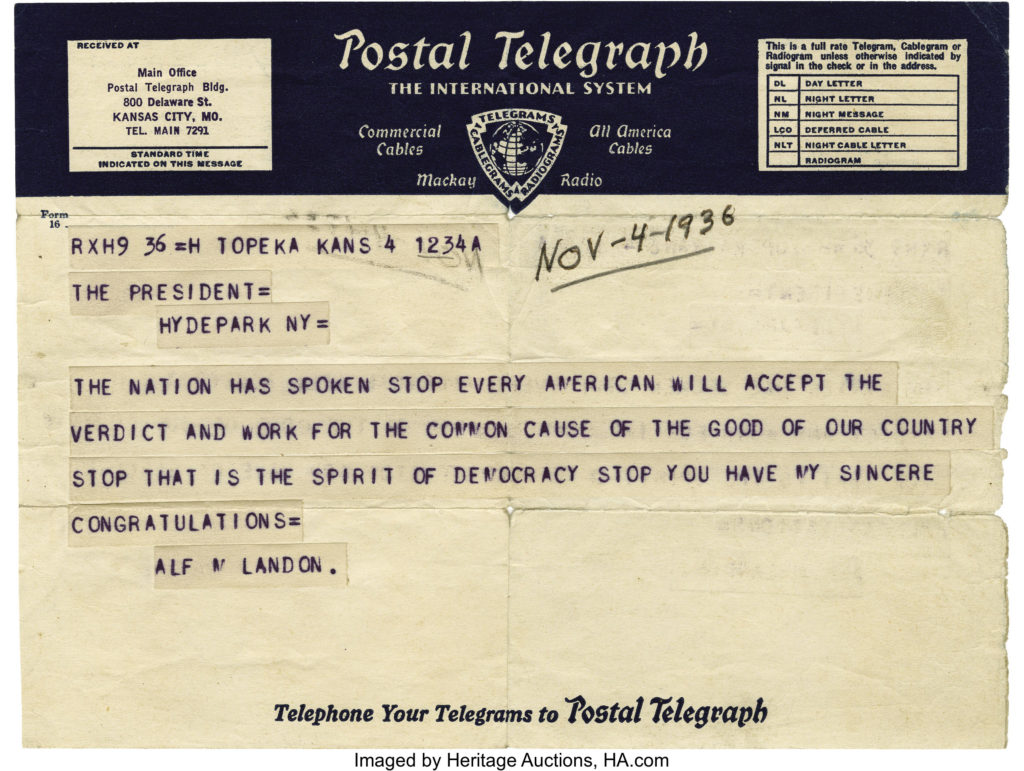
Alf Landon’s congratulatory postal telegram to Franklin D. Roosevelt on Nov. 4, 1936, realized $7,767 at a June 2008 Heritage auction.

By Jim O’Neal

The passing of information over great distances is an ancient practice that’s used many clever techniques.

In 400 B.C., there were signal towers on the Great Wall of China; beacon lights or drumbeats also were used to relay information. By 200 B.C., the Han dynasty evolved a complex mix of lights and flags. Speed has always been a priority and took many forms, including at the U.S. Postal Service. “Neither snow nor rain nor heat nor gloom of night stays these couriers from the swift completion of their appointed rounds” is the unofficial motto of the Postal Service (probable source: The Persian Wars by Herodotus).

Authorized by Congress in 1792, the many forecasts of the Post Office Department’s imminent demise appear to be exaggerated. We still get incoming six days a week and a post-office driver delivered a package to my place at 8 p.m. last week … one day after I ordered it from Amazon. The post office – renamed the U.S. Postal Service in 1971 – is now running prime-time ads claiming they deliver more e-commerce packages than anyone.

Through history, postal couriers have toted a staggering volume of items, as well as a few astonishing ones. A resourceful farmer once shipped a bale of hay from Oregon to Idaho. A real coconut was sent fourth class from Miami to Detroit with the address and postage affixed to the hull. Even sections of pre-fab houses have been mailed, delivered and then assembled into full-size homes.

Accounts vary as to where the 53-cent postage was affixed to pre-schooler Charlotte May Pierstorff the day her parents mailed her to see her grandmother in Idaho. In 1914, they had discovered it was cheaper to send her by U.S. mail than the full-fare the railroad charged for children traveling alone. At 48½ pounds, little May fell within the parcel post 50-pound weight limit. She traveled in the train’s mail compartment and was safely delivered to grandma. She lived to be 78 and died in California. She’s featured in an exhibit at the Smithsonian … at the National Postal Museum.

Another cheapskate shipped an entire bank building – 80,000 bricks, all in small packages – from Salt Lake City to Vernal, Utah, in 1916. This time, the postmaster put his foot down … no more buildings! But 9,000 tons of gold bars were transferred from New York to Fort Knox in 1940-41. This time, the post office collected $1.6 million in postage and insurance. My all-time favorite was when jeweler Harry Winston donated the famous Hope Diamond to the Smithsonian in 1958. He kept costs low by sending the 45.52-carat gem in a plain brown wrapper by registered first-class mail. (Note: It arrived safely.)

The quest for speed took a quantum leap on May 24, 1844, when Samuel F.B. Morse sent the first telegraph. Standing in the chamber of the Supreme Court, Morse sent a four-word message to his assistant in Baltimore, who transmitted the message back. Members of Congress watched the demonstration with fascination. At the time, the Supreme Court was housed in the Capitol building. They finally got their own building in 1935 after heavy lobbying by Supreme Court Justice William Howard Taft.

For Americans at the turn of the 20th century, seeing a telegram messenger at the door usually meant bad news. Western Union and its competitors weren’t pleased by the fact that their roles as bearers of bad news had spread. So in 1914, they started emphasizing good-news messages, sending them in bright, cheerful seasonal envelopes. Next were 25-cent fixed-text telegrams that gave senders pre-written sentiments in 50 categories, like Pep-Gram #1339: “We are behind you for victory. Bring home the Bacon!” Forgot Mother’s Day? Use #432: “Please accept my love and kisses for my father’s dearest Mrs.” Next were singing telegrams, but they became passé and in 2006, Western shut down its telegram service.

The message of that first Morse telegraph in 1844 is a question we still ask after every innovation, whether it was faxes, the internet, email or texts: “What hath God wrought?”

Perhaps next is mental telepathy. Who knows? It will be faster and awe us once again.

Intelligent Collector blogger JIM O’NEAL is an avid collector and history buff. He is president and CEO of Frito-Lay International [retired] and earlier served as chair and CEO of PepsiCo Restaurants International [KFC Pizza Hut and Taco Bell].
As delegates hissed, Martin Van Buren became his party’s presidential nominee

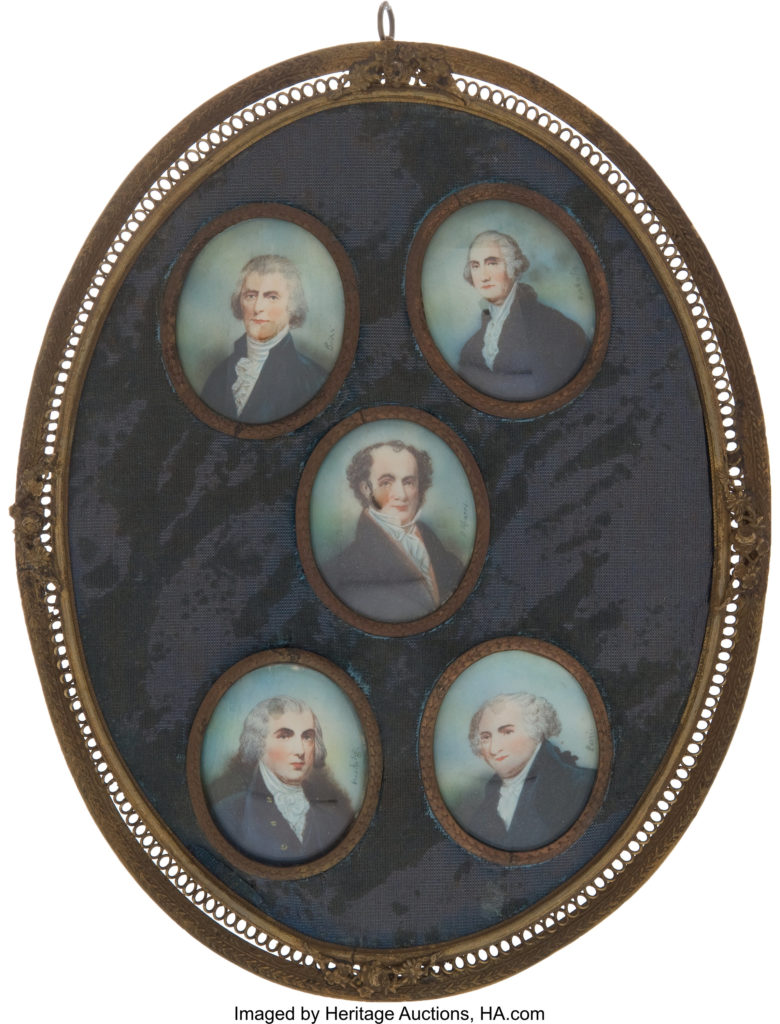
Five miniature portraits of George Washington, John Adams, Thomas Jefferson, James Madison and Martin Van Buren, likely produced in Europe during Van Buren’s presidency, sold for $14,340 at a May 2012 Heritage auction.

By Jim O’Neal

Andrew Jackson had been denied the presidency in the election of 1824, despite winning most of the popular votes and electoral votes. In situations where a political candidate did not secure a majority, the House of Representatives decided which of the top three candidates (by vote totals) would become president. The top three in 1824 were Jackson, John Quincy Adams and William Crawford. Henry Clay had finished fourth and was dropped from consideration.

The House then voted and picked Adams for president and he subsequently appointed Clay to be Secretary of State. Critics claimed that Clay had persuaded the House to vote for Adams in a secret quid pro quo for the Cabinet position. The dispute became notorious and was dubbed “the Corrupt Bargain” by Jackson supporters.

However, Jackson bounced back four years later and soundly defeated JQA for the presidency. This was the second time an incumbent president had been defeated. Thomas Jefferson had defeated President John Adams in the election of 1800. Both Adamses, father and son, were bitter about their defeats, and the “Era of Good Feelings” that existed for eight years (1817-1825) under President James Monroe came to an abrupt end. The deterioration into partisan politics was precisely what George Washington had warned about if political parties were allowed to flourish. He was a man wise beyond his years, as we know so well today.

After Jackson served two tumultuous terms (1829-1837), the Hero of New Orleans was tired and ready to go home. He had abandoned the idea of a third term and even seriously considered an early retirement that would allow close friend and adviser Vice President Martin Van Buren to assume the presidency. This would help ensure a peaceful continuation of Jacksonianism and put Van Buren in a strong place for the 1836 election. Van Buren consistently opposed this and finally the idea was dropped. Jackson would patiently wait for the end of his term.

However, earlier in 1835, Jackson had strongly urged party leaders to hold a national convention composed of delegates “fresh from the people” to pick the nominees. He made no secret of his personal preferences: Martin Van Buren for president and Col. Richard Johnson of Kentucky for vice president. This was not a popular choice, especially in the South, where many considered Van Buren a slick New York politician and Johnson worse … much worse. Johnson was anathema to Southerners. His common-law wife was a black woman and they had two children, which Johnson openly acknowledged.

To others, the “Van Buren Convention” was a farce. They complained that several states didn’t send delegates and others sent too many. They singled out Tennessee, which didn’t have delegates, but simply found a merchant from Tennessee who was in Baltimore on business at the time, quickly admitted him to the convention and allowed him to cast all 15 Tennessee votes for Van Buren and Johnson. His name was Edward Rucker and “ruckerize” (assuming a position or function without credentials) entered the jargon as a pejorative with an easy definition. Eventually, Van Buren and Johnson were selected as the Democratic-Republican Party ticket, with the delegates from Virginia hissing as they walked out of the convention.

Van Buren’s opposition in 1836 was composed of various anti-Jackson parties that had formed a new party called the Whigs. The old English Whigs had fought against royal despotism, and the American Whigs were dedicated to fighting “King Andrew the 1st.” They were too dispersed to hold a national meeting, so they simply nominated regional favorite sons: Daniel Webster (New England), Senator Hugh White (South) and General William Henry Harrison (West). Their hope was to divide the electoral vote, deny Van Buren the majority and have the election settled in the House as in 1824.

The strategy failed as Van Buren got almost 51 percent of the vote and was elected president. Richard Johnson had a tougher time. Twenty-three of the Virginia delegates refused to vote for him as “faithless electors” and he was one vote short of the 148 requirements. This time, the VP election was tossed to the Senate and for the only time in history, the Senate elected the vice president of the United States, 34 to 16.

Concurrently, word was received in Washington that Sam Houston had taken the president of Mexico as a prisoner, and Texas was applying for annexation as a state. Jackson was hesitant to accept a new state over the slavery issue. However, on the last day of his term of office, he recognized Texas independence – setting the stage for future annexation. Two days later, after handing over the reins of government to now-President Martin Van Buren, he left Washington by train to return to his beloved Hermitage.

Intelligent Collector blogger JIM O’NEAL is an avid collector and history buff. He is president and CEO of Frito-Lay International [retired] and earlier served as chair and CEO of PepsiCo Restaurants International [KFC Pizza Hut and Taco Bell].
Let’s just say Julia Grant truly enjoyed her days in the White House

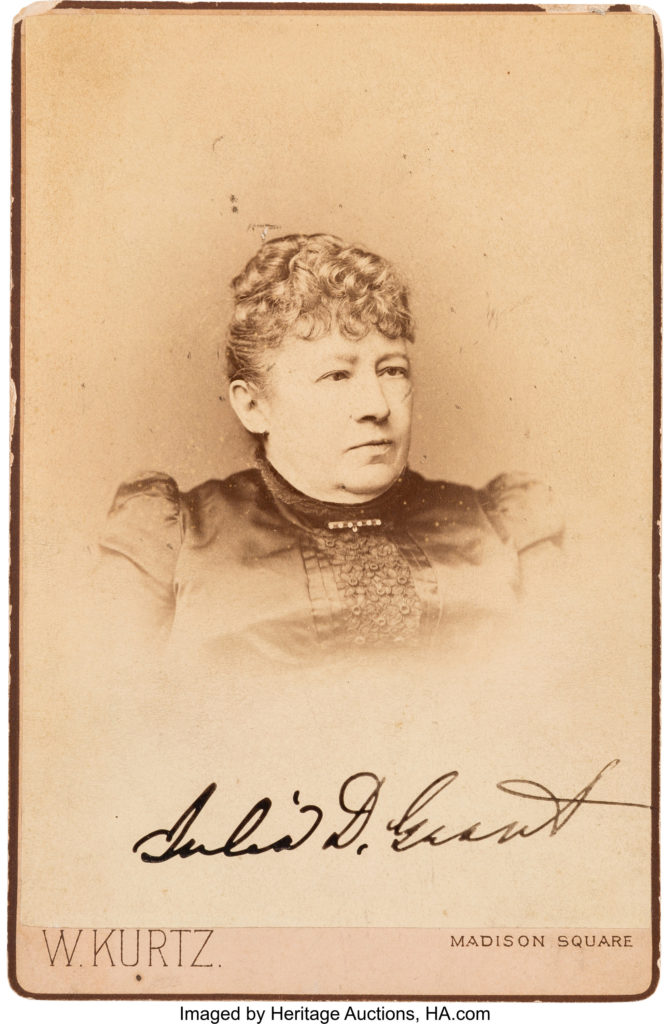
This cabinet card, signed by First Lady Julia D. Grant, went to auction in November 2015.

By Jim O’Neal

In May 1876, President Ulysses S. Grant and his wife Julia traveled to Philadelphia from Washington to open the Centennial Exposition in Fairmount Park. The United States was celebrating its 100th birthday and the signing of the Declaration of Independence. It was also a great opportunity to display the remarkable industrial progress that had occurred during the intervening years, especially in the 19th century. The exhibition was the result of three years of extensive planning and it was an impressive accumulation of American ingenuity.

On May 10, before an excited crowd of 186,672, Grant officially opened the fair following Wagner’s Centennial March. It was difficult to hear his speech due to crowd noise, but a flag raising and cannon volley was followed by a loud chorus of “hallelujah!” This was followed by a march to Machinery Hall, where a switch was thrown to spark the enormous Corliss electrical engine to power up all the machinery. At 50 feet tall, it was the largest in the world and powered more than 100 machines on display.

The First Lady was miffed that she wasn’t chosen to start the festivities and her pique exposed how accustomed she had grown to deference in the White House after eight years of pampering. But that honor went to Empress Teresa Cristina, wife of Emperor Dom Pedro II, the last emperor of the Brazilian empire. He had become emperor at age 5 when his father died and he reigned for an astounding 58 years (1831-1889).

Dom Pedro had visited the United States earlier and had attended one of Alexander Graham Bell’s deaf-mute classes at Boston College. Inspired by Bell’s work, he founded the first deaf-mute school in Rio de Janeiro when he returned home. Coincidently, Bell had been persuaded to exhibit his latest invention at the fair: the Bell telephone. When the affable emperor learned of Bell’s exhibit, he eagerly agreed to try the device in a demonstration for a crowd.

Placing the receiver to his ear, he was treated to Bell’s personal recitation of Hamlet’s “To be or not to be” soliloquy. Delighted and astonished, Dom Pedro exclaimed, “My God, it talks!”

However, the general public proved to be less impressed and hard to sell. As one detractor complained, “It is a scientific toy … for professors of electricity and acoustics.” After convincing his father-in-law, lawyer and financier Gardiner Hubbard, Bell and his assistant Tom Watson set out on a demonstration tour. AGB would sit on a stage, connected to Watson via leased telegraph lines several miles away. After introductory remarks, Watson would sing a repertoire of tunes, including Yankee Doodle.

As an aside, AGB’s first coherent telephone message – “Mr. Watson, come here, I want to see you” – was really a plea for help. He had spilled battery acid on his pants and, instinctively, made the first emergency call in history. We know how that story progressed since we all carry around smartphones that have more computing power (and other functionality) than Apollo 11 when it made its historic manned flight to the moon in 1969.

Although Grant was cheered at the opening of the Centennial Exposition, any thoughts he had about a third term disappeared in a toxic haze of a weak economy and widespread corruption. When the Republican Convention met in Cincinnati in June, the party platform directly criticized Grant, calling the administration “a corrupt centralism … carpetbag tyranny … honeycomb federal government … with incapacity, waste and fraud.” Out of this cesspool stepped the governor of Ohio, Rutherford B. Hayes, an honest, sincere man with a commitment to limiting the presidency to a single term. Democrats picked the governor of New York, Samuel Tilden, with strong credentials having conquered Tammany Hall and the corrupt Boss Tweed ring of rogues.

Hayes won in 1876 after the most controversial presidential election in U.S. history. Grant was actually worried about a coup as Democrats, convinced the election was rigged, rallied under the cry of “Blood or Tilden.” Since March 4, 1877, was a Sunday, there was precedent to avoid having the inauguration on the Sabbath by waiting until the next day, as Presidents Monroe and Taylor had done. Grant was so paranoid about waiting an extra day that he arranged for a private ceremony on Saturday night as part of a routine dinner at the White House. Hayes was sworn in by Chief Justice Morrison Waite before the food was served.

On Monday, March 5, the ceremony was recreated (for show only) before a crowd estimated at 30,000. A teary-eyed Julia Grant was not one of them. She stayed in the White House as long as possible and I suspect she would have welcomed having another four years. She even hosted a luncheon for her successor after the inauguration. She later wrote, “How pretty the house was … in an abandon of grief, I flung myself on the lounge and wept, wept oh so bitterly.”

Intelligent Collector blogger JIM O’NEAL is an avid collector and history buff. He is president and CEO of Frito-Lay International [retired] and earlier served as chair and CEO of PepsiCo Restaurants International [KFC Pizza Hut and Taco Bell].
 

There were no winners or losers in the War of 1812

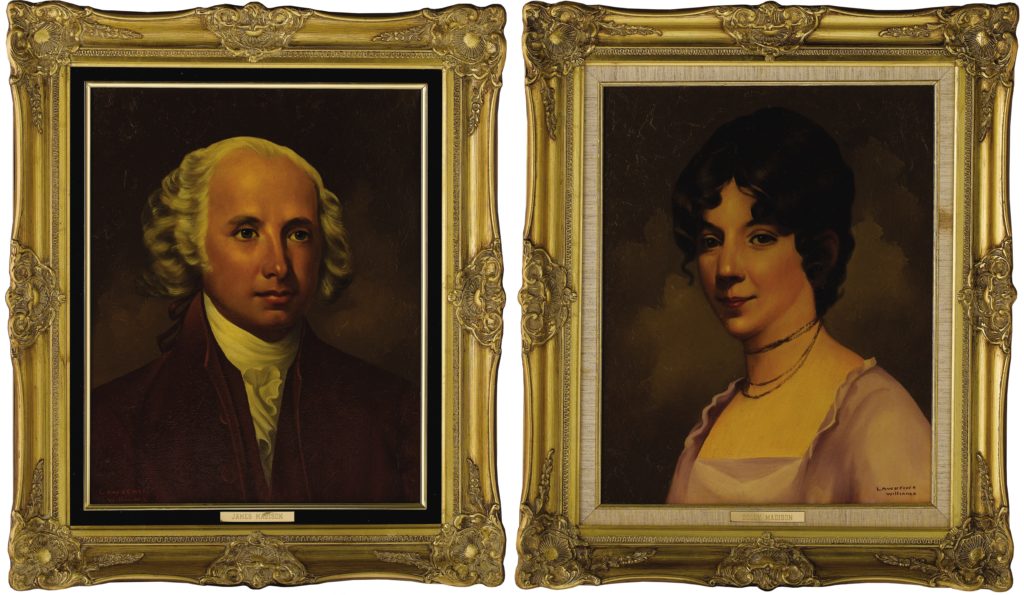
Portraits of James and Dolley Madison by Lawrence Williams went to auction in October 2007.

By Jim O’Neal

The White House was burned to a shell. The previous evening, British soldiers had found the president’s house abandoned and they feasted on the dinner and wine left there untouched due to the hasty exit of Dolley Madison and the entire staff. The date was Aug. 24, 1814, and the War of 1812 came directly to the young country’s capital. There was little doubt about the enemy’s intentions. Public buildings would be destroyed in retribution for the burning of both the legislature and governor’s residence in York (now Toronto), the capital of Upper Canada.

Someone (other than the First Lady) had rescued the Gilbert Stuart painting of George Washington by trimming it from its heavy frame. Executive papers and personal effects, along with silverware, were hurriedly spirited away by carriage for safekeeping. A torrential rain had mercifully helped minimize the damage.

Three days after the British departed, the Madisons returned to the ruins. The torching of the president’s house had mortified the populace, and political enemies accused Madison of cowardice for fleeing days before the incident. Even the press piled on, asserting that Dolley could have saved more, or worse, that the president could have prevented the entire affair. There was malicious gossip that this might finally reduce the excessive social entertaining of the First Lady.

Fortuitously, refuse from the fire had fallen gracefully within the stone walls of the White House and virtually no debris was scattered on the surrounding grounds. The city superintendent commissioned an assessment of all public buildings and the consensus was the White House was damaged more than the Capitol or other executive buildings. Since the blackened shells were shameful symbols of defeat, a debate arose over whether the federal city should be rebuilt. New buildings in a different location could provide an opportunity for a fresh start.

Cincinnati was mentioned as a perfect candidate since it was more central to the country’s westward expansion; the Ohio River and new steamboat connections to St. Louis and New Orleans would facilitate commerce. It would also minimize the need to contend with crossing the mountains, and the re-centering rationale was similar to the arguments used to support the earlier move from Philadelphia to Virginia. Fate intervened just in time with news of victory and the Treaty of Ghent, which ended the War of 1812 between the United States and the United Kingdom.

Congress hastily ratified an appropriation of $500,000 to fund the restoration of all damaged buildings. Jubilant backers of the city implied promises of more money as needed, knowing that once construction was under way, Congress would have no other option than to continue with the restoration. The capital had been saved and that was all that was important.

A few months earlier in September, the formidable British Navy attacked Fort McHenry in Baltimore. The fort’s soldiers were able to withstand 25 hours of bombardment. The next day, they hoisted an enormous American flag, which provided the inspiration of a poem by Francis Scott Key – The Star-Spangled Banner, which became an instant hit and in 1931 became the national anthem of the United States. British forces withdrew from Chesapeake Bay and organized their forces for a campaign against New Orleans. This strategic location would provide access to the Mississippi River and the entire western part of the United States. They still hadn’t abandoned their ambition of establishing a British North America.

Colonel Andrew Jackson was 45 years old when the War of 1812 started – semiretired on his 640-acre plantation the Hermitage – and still with a burning ambition to get involved. His prayers were answered with the assignment to assume command of New Orleans. His ragtag group of free blacks, pirates (including Jean Lafitte) and loyal Tennessee Volunteers cleverly defeated the British. General Jackson was awarded the Congressional Gold Medal and would become a two-term president in 1828.

In a slight twist, the victory at New Orleans occurred a few weeks after the British had already signed the Treaty of Ghent. However, Jackson’s role in the war was absolutely critical to the future expansion of the country. Not only did he spare an almost certain loss of territory in the Southwest, but he also cleared the air over the status of the Gulf Coast. Great Britain did not recognize any American claims about lands included in the Louisiana Purchase. They disputed – correctly – the legality of the treaty. France had no legal right to sell it to the United States since the 1800 Treaty of San Ildefonso between Spain and France specifically stated that France would not sell without offering to return it to Spain. This meant that none of the lower Mississippi or any of the Gulf Coast belonged to the United States.

Their claims were blithely ignored and the Treaty of Ghent was silent on the entire issue. It has been said that there were no winners or losers in the little War of 1812 … except for American Indians. The United States signed 15 different treaties guaranteeing their lands and then proceeded to break every one of them.

Intelligent Collector blogger JIM O’NEAL is an avid collector and history buff. He is president and CEO of Frito-Lay International [retired] and earlier served as chair and CEO of PepsiCo Restaurants International [KFC Pizza Hut and Taco Bell].
How does a prosperous continent mobilize for total war?

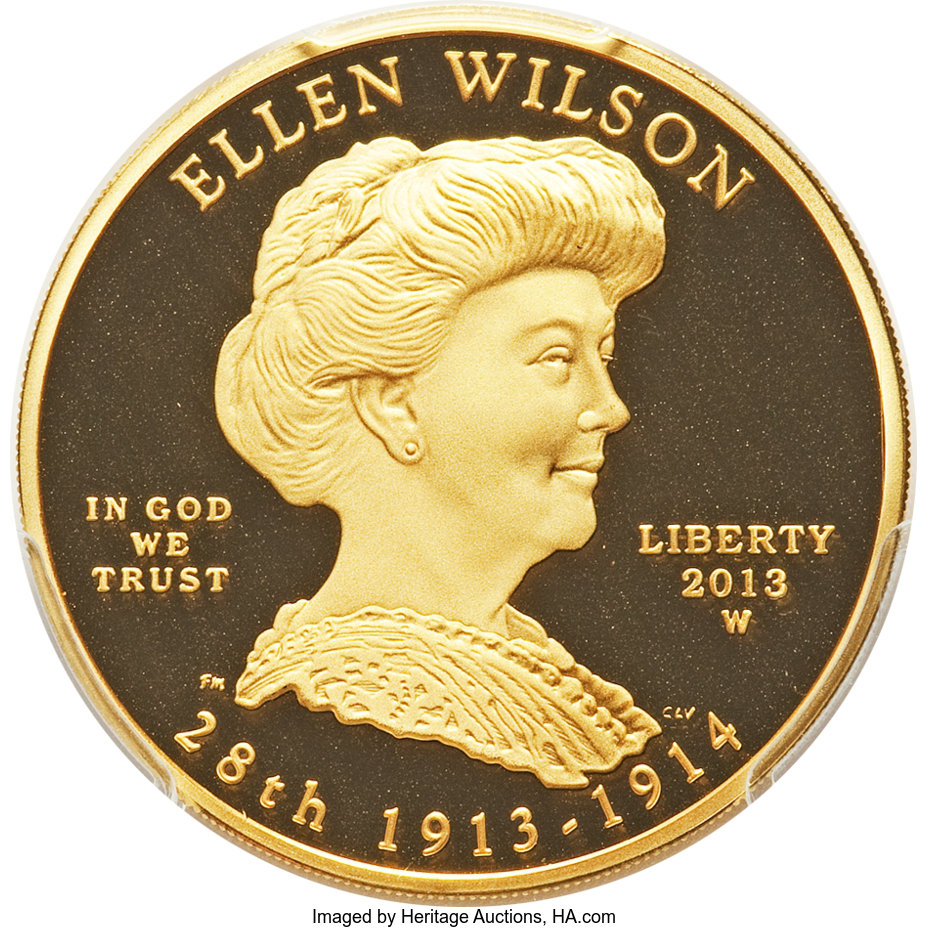
The U.S. Mint in 2013 issued its First Spouse gold coin commemorating Ellen Wilson.

By Jim O’Neal

In 1912, President William Howard Taft and ex-President Theodore Roosevelt managed to divide the Republican Party to the extent that (Thomas) Woodrow Wilson regained the White House for the Democrats. Even Socialist Eugene V. Debs snared nearly a million votes for his policy to replace America’s capitalist system with a socialized economic system. Wilson was the only Democratic Party president elected between 1892 and 1932.

Success in office came easily for Wilson. He was more effective with groups than one-on-one and he broke a tradition that extended back to Thomas Jefferson. He read his State of the Union to Congress rather than submitting a written report. Another change was to keep a sharp line between his public and personal life (a habit developed during his days in academia). Surprisingly, he did not believe in racial equality and some Cabinet organizations were totally racially segregated. His wife Ellen was different. Despite supporting the racial segregation that resulted from the appointment of Southern Senators, she was appalled by the slums that surrounded the White House and became an active crusader to clean up the densely populated, alley blight that was pervasive.

Her failing health was exacerbated when she tripped on a throw rug and fell. She was confined her to bed each day for four hours. In July 1914, she was diagnosed with tuberculosis of the kidneys – a form of Bright’s disease that proved fatal. She died on Aug. 6, 1914. In addition to being stricken with grief, Wilson was dismayed by what would become World War I, when Austria declared war on Serbia after an assassination. The president was grateful that the First Lady was never made aware that the world was crashing into ruin. “It would have broken her heart.”

As the world continued toward a catastrophic war, President Wilson buried himself in work and public appearances were scarce. Newspaper front pages were dominated by the war in Europe and there was a palpable hostility against imperial Germany, despite the president urging for moderation. A European land war did not appear to be a threat to the United States. Our oceans ensured our domestic security.

Occasional positive events punctuated the war clouds, which were growing darker. On Jan. 15, 1915, Wilson hosted a ceremony to inaugurate the first transcontinental telephone call from New York to San Francisco. Ten days later, Germany ominously announced the beginning of submarine warfare around the British Isles. Wilson rushed to mediate (another hopeless gesture), followed by a formal warning reminding Germany of the rights of neutrality for American ships. Sensing a deeper involvement, Secretary of State William Jennings Bryan protested the statement as Wilson remained steadfast.

Sixteen months after Ellen’s death, Wilson remarried and during this interlude the president continued to guide America over the hazardous shoals of neutrality. It was obvious that American involvement could tip the scales of war to either side, but the choice was to avoid war and treat it as rivalry between degenerate political systems. After the Germans sank the RMS Lusitania, the loss of life offended the sense of American justice and extensive war propaganda inflamed it further. The distant war seemed ever so closer.

In the fall of 1916, Wilson produced a message to the warring nations of Europe to lay down their arms, accept American mediation and work together to ensure peace and justice throughout the world. He considered it a masterpiece. “There are some sentences,” he wrote in his diary, “that will live as long as human history.” (Uh, maybe not).

When the United States entered the war, American armies propped up France and England when they were on the brink of collapse. The entire European financial system was crumbling sans U.S. credit.

When Wilson traveled to Paris to pursue his lofty goal of creating a just peace, America’s world prestige and power was at an all-time high. His idealistic 14-point plan was lauded around the world – promising democracy and self-determination for all. Wilson was arguably the most famous man alive. Had he merely presented his plan for a peace framework, his position would have been impregnable. He could have departed and ruled from the safety of the White House. Instead, he stayed and got ensnared by his sharp-elbowed allies, who proceeded to exploit his proximity and inculcate their tribal animosities. Most disastrous was his stubborn inability to compromise.

The ensuing meetings were little short of a disaster and he managed to alienate both his allies and the Germans. Upon his return, he was unable to get even his colleagues to support his plan for a League of Nations; he had a stroke and was unable to govern. It is still a mystery how little was accomplished and how much carnage was suffered. Worse was the planting of seeds guaranteeing a short reprieve followed by a resumption of hostilities.

But then, the First World War was a real mystery … its origins baffling, as were the events that followed. How is it possible for a prosperous continent – a symbol of wealth, global power, at the peak of intellectual and cultural achievement – opt to mobilize for total war, and in the process commit their future to pointless slaughter?

If reincarnated, their first question would likely be, What’s changed?

Intelligent Collector blogger JIM O’NEAL is an avid collector and history buff. He is president and CEO of Frito-Lay International [retired] and earlier served as chair and CEO of PepsiCo Restaurants International [KFC Pizza Hut and Taco Bell].