National Debt on Automatic Pilot to More Growth

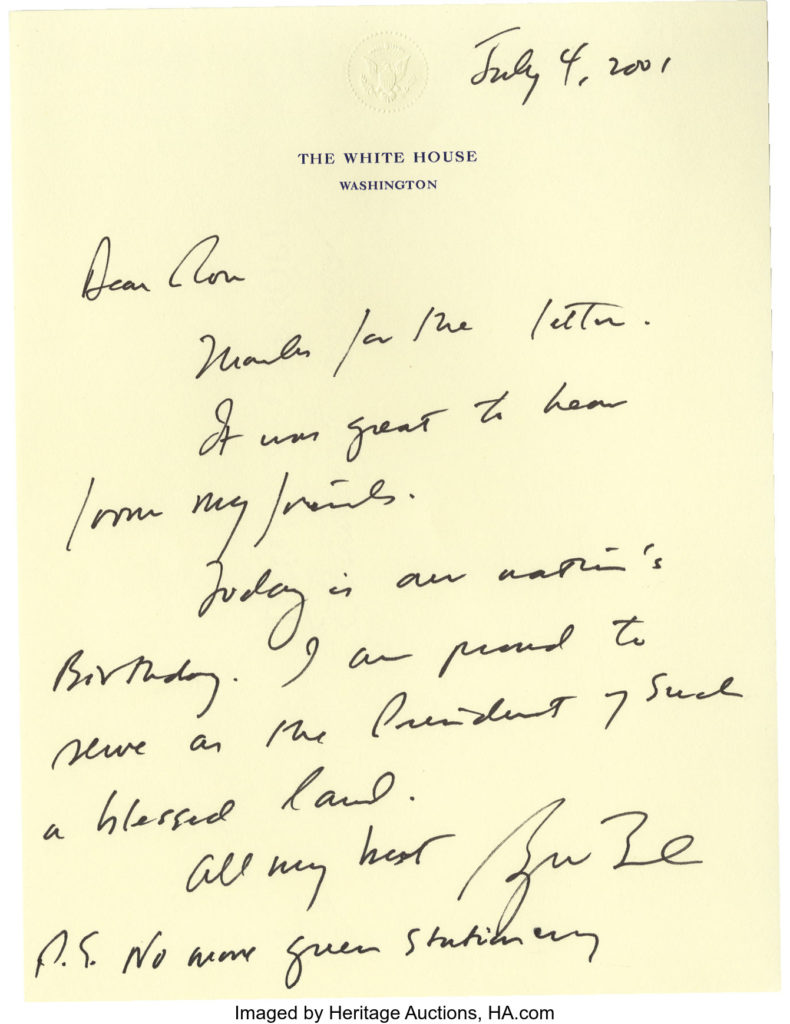
A letter by President George W. Bush, signed and dated July 4, 2001, sold for $16,730 at an April 2007 Heritage auction.

By Jim O’Neal

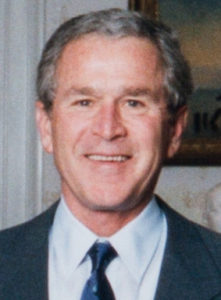
In May 2001 – just 126 days after President George W. Bush took office – Congress passed his massive tax proposal. The Bush tax cuts had been reduced to $1.3 trillion from the $1.65 trillion submitted, but it was still a significant achievement from any historical perspective. It had taken Ronald Reagan two months longer to win approval of his tax cut and that was 20 years earlier.
George W. Bush

Bush was characteristically enthusiastic about this, but it had come with a serious loss in political capital. Senator James Jeffords, a moderate from Vermont, announced his withdrawal from the Republican Party, tipping control of the Senate to the Democrats, the first time in history that had occurred as the result of a senator switching parties. In this instance, it was from Republican to Independent, but the practical effect was the same. Several months later (after the terrorist attacks on the World Trade Center and the Pentagon), there was a loud chorus of calls to reverse the tax cuts to pay for higher anticipated spending.

Bush had a counter-proposal: Cut taxes even more!

Fiscal conservatives were worried that there would be the normal increase in the size and power of the federal government, lamenting that this was a constant instinctive companion of hot wars. James Madison’s warning that “A crisis is the rallying cry of the tyrant” was cited against centralization that would foster liberal ideas about the role of government and even more dependency on the federal system.

Ex-President Bill Clinton chimed in to say that he regretted not using the budget surplus (really only a forecast) to pay off the Social Security trust fund deficit. Neither he nor his former vice president had dispelled the myth about a “lock box” or explained the federal building in Virginia that had been built exclusively to hold government IOUs to Social Security. In reality, they were simply worthless pieces of scrip, stored in unlocked filing cabinets. The only changes that had ever occurred with Social Security funds were whether they were included in a “unified budget” or not. They had never been kept separate from other revenues the federal government received.

But this was Washington, D.C., where, short of a revolution or civil war, change comes in small increments. Past differences, like family arguments, linger in the air like the dust that descends from the attic. All of the huge surpluses totally disappeared with the simple change in the forecast and have never been discussed since.

Back at the Treasury Department of 15th Street, a statue to Alexander Hamilton commemorates the nation’s first Treasury Secretary, a fitting honor to the man who created our fiscal foundation. But on the other side stands Albert Gallatin, President Thomas Jefferson’s Treasury Secretary, who struggled to pay off Hamilton’s debts and shrink the bloated bureaucracy he built.

Hamilton also fared better than his onetime friend and foe, James Madison. The “Father of the Constitution” had no statue, no monument, no lasting tribute until 1981, when the new wing of the Library of Congress was named for him. This was a drought that was only matched by John Adams, the Revolutionary War hero and ardent nationalist. It was only after a laudatory biography by David McCulloch in 2001 that Congress commissioned a memorial to the nation’s second president.

Since the Bush tax cut and the new forecast, the national debt has ballooned to $20 trillion as 9/11, wars in Iraq and Afghanistan, and the 2008 financial meltdown produced a steady stream of budget deficits in both the Bush and Barack Obama administrations. The Donald Trump administration is poised to approve tax reform, amid arguments on the stimulative effect on the economy and who will benefit. In typical Washington fashion, there is no discussion over the fact that the national debt is inexorably on automatic pilot to $25 trillion, irrespective of tax reform. But this is Washington, where your money (and all they can borrow) is spent almost with no effort.

“Just charge it.”
Intelligent Collector blogger JIM O’NEAL is an avid collector and history buff. He is president and CEO of Frito-Lay International [retired] and earlier served as chair and CEO of PepsiCo Restaurants International [KFC Pizza Hut and Taco Bell].
News Reporting Has Come a Long Way, but Kinks Remain

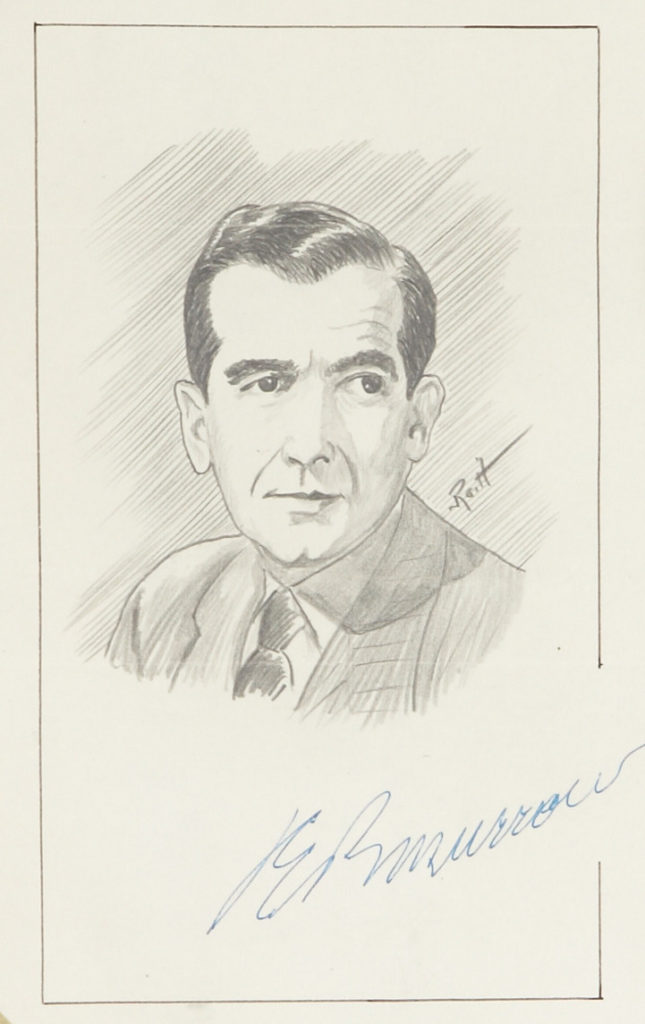
A sketch of Edward R. Murrow, signed, by artist Johnny Raitt is among six sketches of famous newscasters that went to auction in July 2010.

By Jim O’Neal

In the past year, several prominent newspapers and TV networks have corrected or retracted provocative political stories that were factually wrong. Critics are prone to blame the insatiable appetite to feed the 24/7 news-cycle beast and, increasingly, a news organization’s rush to be first. This has been compounded by the steady transition from costly field correspondents to much-less expensive panelists sitting around a table in the TV studio offering personal opinions.

Most of these discussions start with “I think” or “In my opinion,” which by definition blurs facts with subjective comments. Unbiased, factual reporting is mixed into a lethal cocktail that blurs reality and has inexorably led to an environment where charges of “fake news” are routine. Then social media further distort issues and reality. People can now easily shop for any “facts” on TV or the internet that support their opinions. However, the “need for speed” is not a recent phenomenon.

Triggered by the oldest of journalism’s preoccupations – the desire to be first with a dramatic story – Edward R. Murrow, William L. Shirer and their network, the Columbia Broadcasting System (CBS), made broadcast journalism history on March 13, 1938. What set the stage was CBS founder and CEO William S. Paley’s realization that his radio network had just been soundly beaten again by the National Broadcasting Company (NBC) and their reporter “Ubiquitous Max” Jordan, with his eyewitness account of Austria’s fall.

Worse, the fault was Paley’s. Until Jordan’s story and its effect on America, Paley had supported news director Paul White’s decision not to use network employees for hard-news reporting. To their increasing chagrin, men like Murrow and Shirer were forced to cover truly soft stories like concerts instead of Adolf Hitler and the Third Reich’s actions and intentions. Paley had had enough. He asked White to call Shirer and tell him, “We want a European roundup tonight.” The broadcast would cover the European reaction to the Nazis’ Austrian takeover. The players would include Shirer in London with a member of Parliament; Murrow in Vienna; and American newspaper correspondents in Paris, Berlin and Rome.

They had eight hours to put together what had never been done before. As Stanley Cloud and Lynne Olson describe in their book The Murrow Boys: “Never mind that it was five o’clock, London time, on a Sunday afternoon, which meant that all offices were closed and that all technicians and correspondents and members of Parliament they would need were out of town, off in the country or otherwise unreachable. Never mind the seemingly insuperable technical problems of arranging the lines and transmitters, of ensuring the necessity of split-second timing. Never mind any of that. That was what being a foreign correspondent was all about. It was part of the code of the brotherhood. When the bastards asked if you could do something impossible, the only acceptable answer was yes. Shirer reached for the phone and called Murrow in Vienna.”

Beginning at 8 p.m., with announcer Robert Trout’s words, “We take you now to London,” Murrow, Shirer and their comrades proved radio was not only able to report news as it occurred but also able to put it into context, to link it with news from elsewhere – and do it with unprecedented speed and immediacy. They set in motion with that 30-minute broadcast in March 1938 a chain of events that would lead, in only one year, to radio’s emergence as America’s chief news medium and to the beginning of CBS’s decades-long dominance of broadcast journalism. The broadcasts by Murrow and his team during the London blitz and over the entire course of the war set the standard for broadcast reporting style and eloquence.

We have come a long way since then, but it’s not clear to me if we’ve made any progress.

Intelligent Collector blogger JIM O’NEAL is an avid collector and history buff. He is president and CEO of Frito-Lay International [retired] and earlier served as chair and CEO of PepsiCo Restaurants International [KFC Pizza Hut and Taco Bell].
Chester Arthur Surprised His Critics, Overcame Negative Reputation

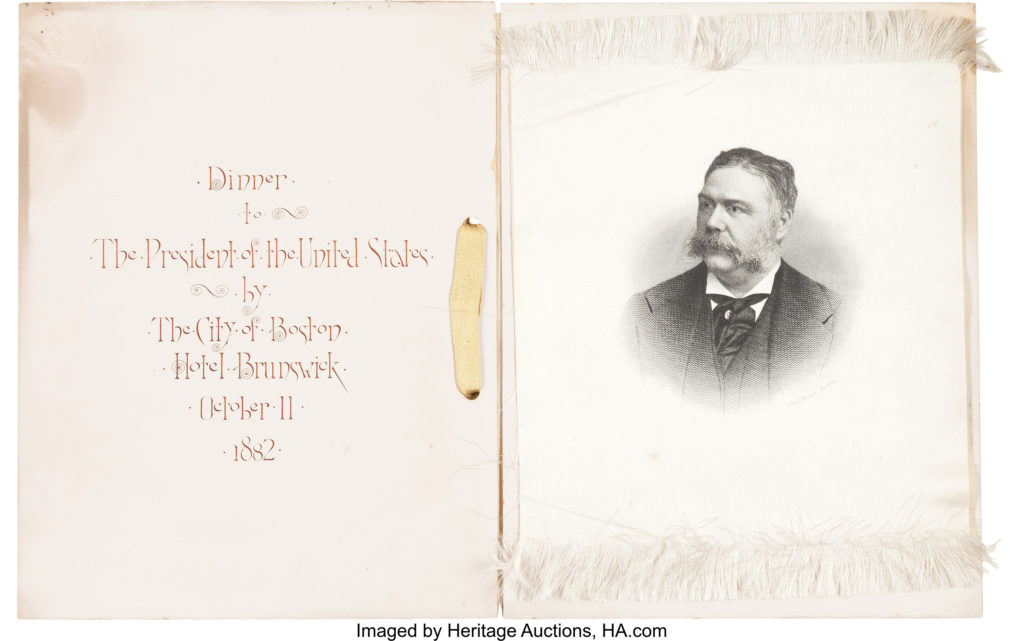
This ribbon with an engraved portrait of Chester Alan Arthur, issued as a souvenir for an Oct. 11, 1882, “Dinner to The President of the United States by The City of Boston,” sold for $437 at a November 2014 auction.

By Jim O’Neal

President Ulysses S. Grant appointed Chester Alan Arthur to the lucrative post of Collector of the Port of New York in 1871. Arthur held the job for seven years, and with an annual gross income of $50,000, was able to accumulate a modest fortune. He was responsible for the collection of about 75 percent of the entire nation’s duties from ships that landed in his jurisdiction, which included the entire coast of New York state, the Hudson River and ports in New Jersey.

In 1872, he raised significant contributions from Custom House employees to support Grant’s successful re-election for a second term. The spoils system was working as designed, despite occasional charges of corruption.

Five years later, the Jay Commission was created to formally investigate corruption in the New York Custom House and (future president) Chester Arthur was the primary witness. The commissioner recommended a thorough housecleaning and President Rutherford B. Hayes fired Arthur and then offered him an appointment as consul general in Paris. Arthur refused and went back to New York law and politics.

At the 1880 Republican National Convention, eventual nominee James Garfield first offered the VP slot to wealthy New York Congressman Levi Morton (later vice president for Benjamin Harrison), who refused. Garfield then turned to Chester Arthur, who, when he accepted, declared, “The office of the vice president is a greater honor than I ever dreamed of attaining.” It would be the only election he would ever win, but it was enough to foist him into the presidency.

The Garfield-Arthur ticket prevailed and after being sworn in on March 4, 1881, the 49-year-old Garfield’s first act was to turn and kiss his aged mother. It was the first time a president’s mother had ever been present at an inauguration. She would outlive her son by almost seven years. President James Polk (1845-1849) also died three years before his mother, the first time that had happened.

On the morning of July 2, President Garfield was entering the Baltimore and Potomac Railroad Station in Washington, D.C., where he was to board a train to attend the 25th reunion of his class at Williams College. A mentally disturbed office seeker, Charles J. Guiteau, shot him twice. He died 80 days later and for the fourth time in history, a man clearly only meant to be vice president ascended to the presidency.”

“CHET ARTHUR PRESIDENT OF THE UNITED STATES! GOOD GOD!”

Although President Arthur’s greatest achievement may have been the complete renovation of the White House, he surprised even some of his harshest critics. Mark Twain may have summed it up best: “I am but one in 55 million, still in the opinion of this one-fifty-five millionth of the country’s population, it would be hard to better President Arthur’s administration.”

Faint praise, yet probably accurate. (First, do no harm.)

Intelligent Collector blogger JIM O’NEAL is an avid collector and history buff. He is president and CEO of Frito-Lay International [retired] and earlier served as chair and CEO of PepsiCo Restaurants International [KFC Pizza Hut and Taco Bell].
‘M*A*S*H’ Showed Us How Far Intelligent TV Can Go

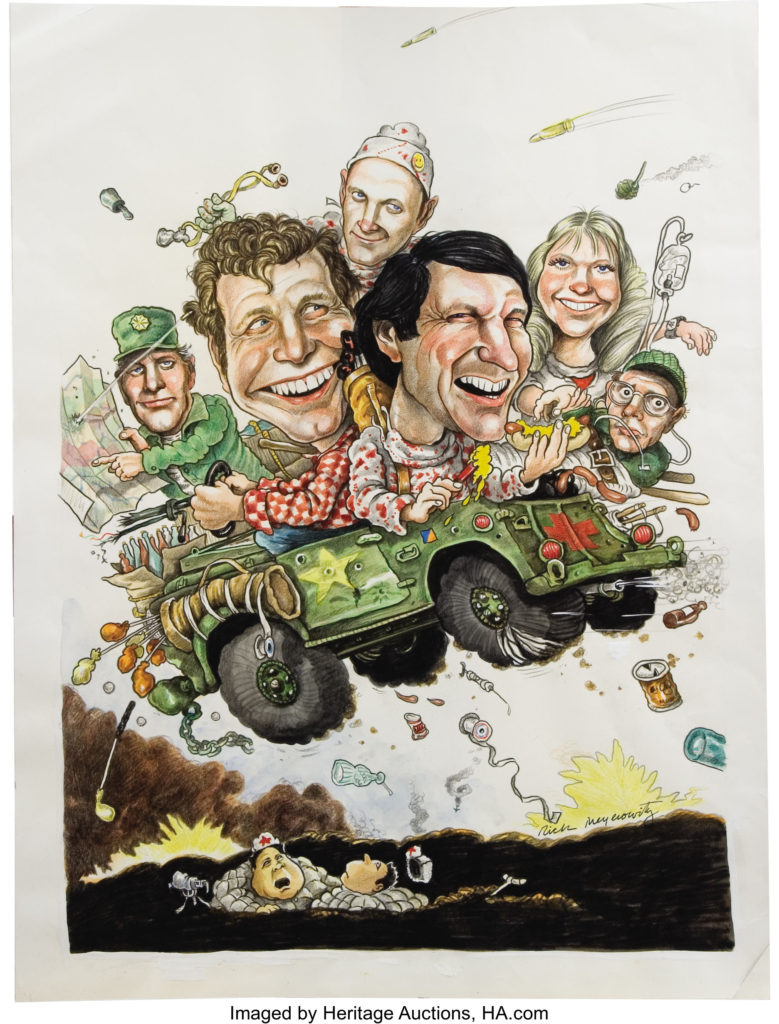
Rick Meyerowitz’s original M*A*S*H art for a 1974 cover of TV Guide sold for $657 at a June 2008 Heritage auction.

By Jim O’Neal

By 1983, the population of the United States had increased to 232 million … and virtually everyone was watching television on a regular basis. On Feb. 23, over 50 percent of them (best estimate is 125 million) tuned in that night to the last episode of one of their all-time favorite shows, M*A*S*H.

For weeks, newspapers had run contests asking readers to suggest how the show should end. “M*A*S*H Bashes” were held in every major city and people donned old army fatigues to watch the show, primarily in bars. Seventy-one percent of viewers watching television that night helped “Goodbye, Farewell and Amen” become the most-watched show in history. (No. 2 is Cheers for its finale “One For The Road.”)

We were saying farewell, not just to beloved television characters, but to an era and anti-war spirit that the show had captured so brilliantly.

M*A*S*H, which ran for 11 years (1972-83), with 251 episodes that snagged nearly 100 Emmy nominations, is still broadcast in reruns and is considered one of network television’s finest efforts. It was based on Richard Hooker’s 1968 bestselling novel Mash: A Novel About Three Army Doctors and the 1970 feature film directed by Robert Altman. (Note: Some nitpickers claim it was really based on the failed film M*A*S*H Goes to Maine, which itself was based on Hooker’s 1972 book sequel.)

The story of a fictional Mobile Army Surgical Hospital near the front lines of the Korean War (technically a U.N. “police action”), the TV show was filled with the high jinks typical of the book and movie, yet it established its own tone of prickly intelligence, wit and sardonic warmth. In tackling the darker aspects of war, the show perfectly echoed a conscience-stricken America, deeply troubled by Vietnam. In reality, and with an exquisite touch of irony, the book’s author was a surgeon from Maine who served in a MASH unit in Korea and actually hated the show for its anti-war message!

M*A*S*H creator, comedy writer Larry Gelbart, put the wise-cracking, womanizing, yet humane Benjamin Franklin “Hawkeye” Pierce (Alan Alda) at the center of the action. Sharing Hawkeye’s flea-bitten tent were fellow surgeons “Trapper” John McIntyre and Frank Burns, who was having an affair with Margaret “Hot Lips” Houlihan, the strong-willed head nurse. A favorite was Max Klinger, a cross-dresser who would try anything to get home. The cast changed over time, and finally even Gelbart left, exhausted from battles with network sensors.

The last episode, “Goodbye, Farewell and Amen,” which ran 2½ hours, was a remarkable culmination of everything the series represented: good, funny television drama that probed the ugly underside of war – in that last case, the savagery of peace in the closing days of Korea.

“What happened on the bus?” psychiatrist Sidney Freedman keeps asking Hawkeye, who in the final episode’s opening is in a mental institution.

Slowly, we learn that on July 4, after a day at the beach, the unit’s bus stopped to pick up refugees and wounded G.I.’s who told them to drive the bus into the bushes to hide from an enemy patrol. Hawkeye keeps hissing at a refugee woman, to keep her rooster on her lap quiet. The woman complies and eventually the repressed memory emerges … the woman has smothered her own child.

Hawkeye shakily returns to the 4077th and on the night of the armistice, one of the worst rounds of casualties is brought in. “Does this look like peace to you?” Margaret asks. Then over the PA system comes a litany of the war’s damage, ending with “2 million killed and 100,000 Korean orphans.” As the unit is broken down, each character gropes toward civilian life.

As Hawkeye lifts off in a helicopter, he sees down below on the deserted 4077, spelled out in stones, a message from his friend B.J. Hunnicutt: GOODBYE.

This last episode, considered the best in television history, was more than a goodbye. It was an example of how far serious and intelligent television can go, and a reminder that it very rarely does.

Intelligent Collector blogger JIM O’NEAL is an avid collector and history buff. He is president and CEO of Frito-Lay International [retired] and earlier served as chair and CEO of PepsiCo Restaurants International [KFC Pizza Hut and Taco Bell].
Carnegie Coveted Crown of Richest Man in the World

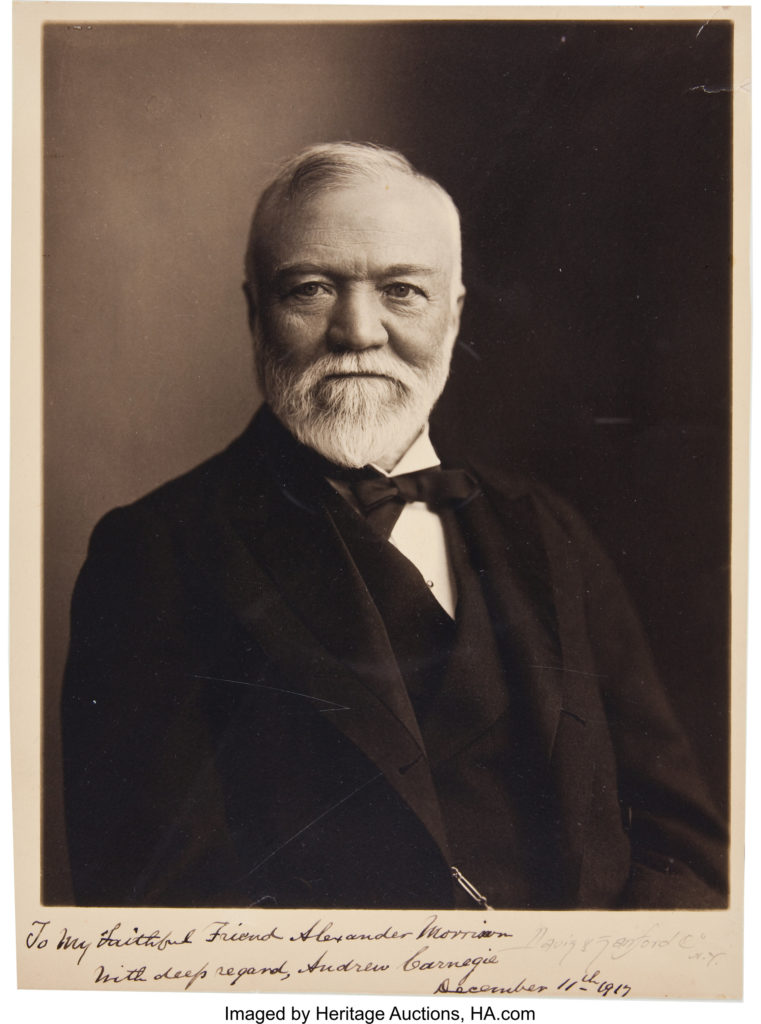
This Andrew Carnegie photograph – inscribed, signed and dated Dec. 11, 1917 – realized $1,015 at a September 2011 Heritage auction.

By Jim O’Neal

Jeff Bezos of Amazon is the world’s richest man, with an estimated net worth of more than $100 billion. A hundred years ago (1916), John D. Rockefeller became America’s first billionaire, which in today’s economy would be two to three times greater than Bezos’ fortune. In the late 19th century, Andrew Carnegie coveted this crown and saw steel as his road to stardom.

In the post-Civil War era, America grew rapidly as railroads crisscrossed the country and extended their reach to all four corners. Electricity arrived to light up buildings and homes, oil supplemented kerosene and coal, iron and steel production grew as demand soared to keep up with rapid economic expansion. Occasional booms/busts occurred since the markets were unregulated and coordination was difficult.

Carnegie had led the growth in the American steel industry and his ambition to snatch Rockefeller’s crown became more acute. One of the key industry developments involved the construction of a steel bridge to connect St. Louis and East St. Louis on opposite banks of the mighty Mississippi River. The Eads Bridge, named for its designer, engineer James B. Eads, relied heavily on steel for its revolutionary design. It was set to become the first significant bridge using steel girders and a cantilever form.

A young Carnegie supplied the financing and the steel, despite skepticism over the sturdiness of the structure after it was completed. A man named John Robinson came up with a clever way to dispel any doubts. Elephants were believed to have good instincts about where they stepped, so Robinson borrowed a fully grown one from a traveling circus. On June 14, 1874, he led the beast across the length of the bridge, with crowds on both ends going wild. Later, a convoy of locomotives were driven back and forth as a further (and final) test of soundness.

On July 4, 1874, the bridge officially opened with General William Tecumseh Sherman driving the last spike as 150,000 people looked on. Demand for steel exploded, forcing Carnegie to develop creative ways to boost production. One was a modified vertical production technique that maximized factory output. But that was still not enough. It became obvious that a 12-hour, six-day workweek was needed. The only problem was that workers’ health couldn’t keep up. Carnegie hired tough managers to impose the onerous schedule and he left for Scotland to escape the critics. Later, his guilty conscience led him to an unprecedented binge of philanthropy after he sold the Carnegie Steel Company to J.P. Morgan for $480 million. It became U.S. Steel, the first billion-dollar corporation in the world.

John D. Rockefeller took an even more devious strategy to his domination of the oil-refining industry. In 1872, he formed a shell corporation: the South Improvement Company (SIC). He then struck an agreement with large railroad companies whereby they sharply raised freight rates for all oil refineries, except those in the SIC (notably Standard Oil), which received substantial rebates – up to 50 percent off crude and refined oil shipments. Then came the most deadly innovation – SIC members also received “drawbacks” on shipments made by rival refineries. So when Standard Oil made shipments from Pennsylvania to Cleveland, they received a 40-cent rebate on every barrel, plus another 40 cents for every barrel of oil shipped by every competitor!

It has been called “an instrument of competitive cruelty unparalleled in industry.” In fact, it was collusion on a scale never equaled in American history. And it was only one of several techniques employed. But it did help Mr. Rockefeller and his investors achieve a 90 percent share of the entire U.S. oil business.

All Bezos has is the internet.

Intelligent Collector blogger JIM O’NEAL is an avid collector and history buff. He is president and CEO of Frito-Lay International [retired] and earlier served as chair and CEO of PepsiCo Restaurants International [KFC Pizza Hut and Taco Bell].
Johnson’s Battles with Congress Strengthened Office of the President

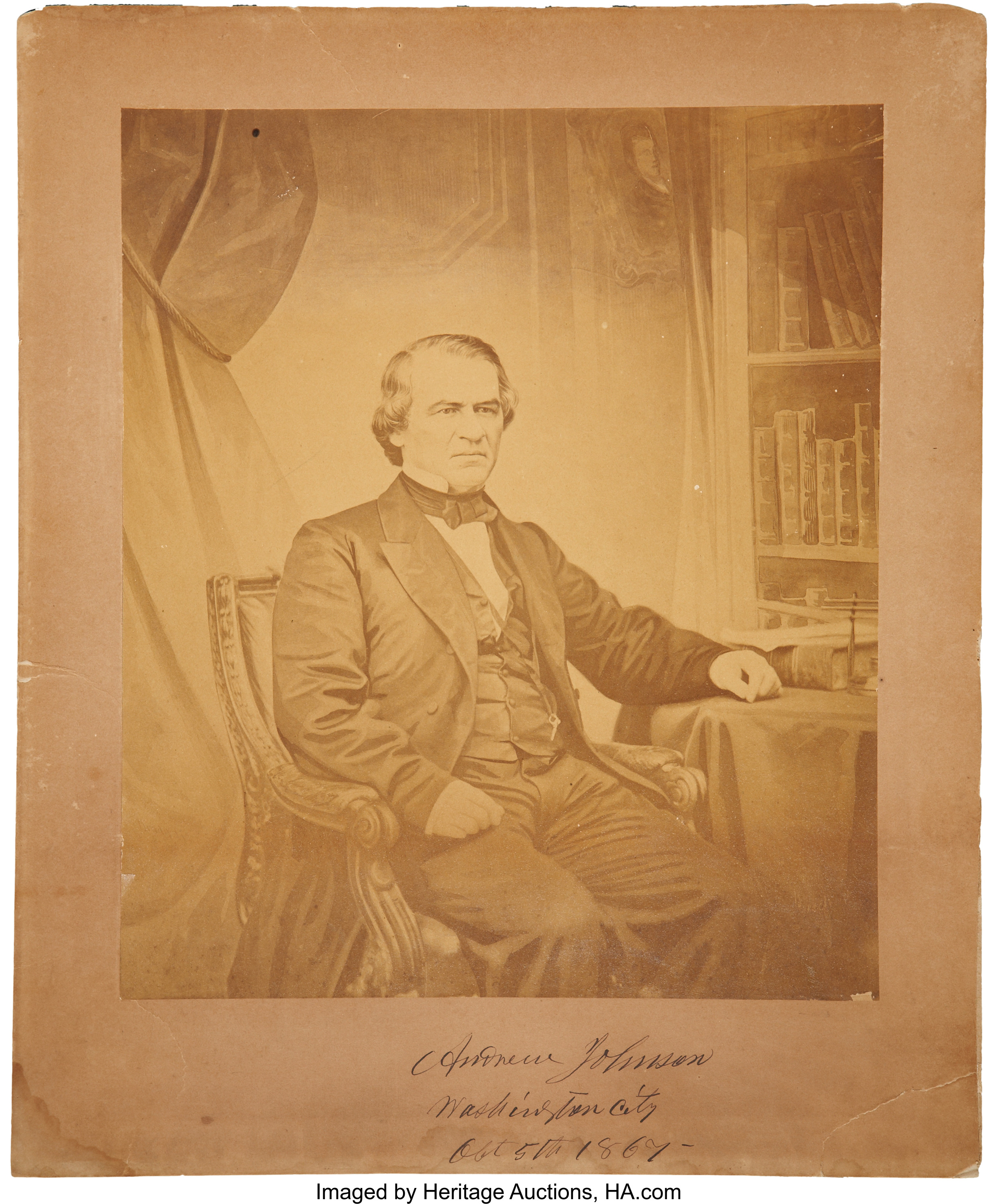
This sepia-toned photograph of Andrew Johnson, signed as president, sold for $3,346 at a June 2010 Heritage auction.

By Jim O’Neal

On the night President Abraham Lincoln was shot, John Wilkes Booth and his little band of assassins had also planned to kill Vice President Andrew Johnson and Secretary of State William Seward. Booth’s fantasy theory was that decapitating the North’s leadership would cause enough chaos to bring the Civil War to an end. Seward survived a brutal stabbing and Johnson’s assigned assassin, George Atzerodt, got cold feet at the last minute. Johnson had gone to bed at the Kirkwood hotel unharmed.

Awakened by a friend, Johnson rushed to Lincoln’s bedside until the president was declared dead. Johnson then returned to the hotel, where he was sworn in as the 17th president by Chief Justice Salmon P. Chase. The members of his Cabinet assembled in the hotel parlor, where he told them: “I feel incompetent to perform duties so important and responsible as those which have been so unexpectedly thrown upon me.”

Despite Johnson’s humble tone, he was actually a fearless, even reckless, fighter for what he believed in. As a result, he became embroiled in the bitterest intra-governmental conflict the nation had ever seen. Like Lincoln, he favored a “mild reconstruction,” in effect turning state governments over to white citizens, with only the main leaders of the Confederacy excluded. However, the Radical Republican leaders demanded “radical reconstruction,” enfranchising former slaves and barring most former Confederates from government.

Initially, Republicans were pleased with Johnson, mistaking him as weak and easier to control than Lincoln. They were confident he would support their plans for severe treatment of the defeated South. “By the Gods! There will be no trouble now in running the government,” declared Senator Benjamin Wade of Ohio. Two years later, this same man, now president pro tempore of the Senate, was so confident the Senate had the votes to evict Johnson from the White House that he had already written an inaugural speech and chosen his Cabinet!

But now, by the time Congress finally met in December 1865, the former states of the Confederacy had elected governors and state legislators. And although they approved the 13th Amendment outlawing slavery, they had also passed “Black Codes” binding ex-slaves to working the land. In his first annual message to Congress, Johnson railed against this situation, warning Congress of the dire consequences. But Northern Republicans had no intention of welcoming back Democrats from states that had seceded. Instead, they passed new legislation to reinstate military governments throughput the South. Then they established the Freedmen’s Bureau to assist the 4 million freed slaves.

Johnson promptly vetoed everything Congress had passed.

Republicans were not strong enough to override a presidential veto until early 1867, when they passed into law even more harsh Reconstruction Acts, with military governments replacing civil governments set up by Southern Democrats. Johnson warned they were fostering hatred and creating a state of permanent unrest. Radical Republicans answered by slashing back at Johnson and passing the Tenure of Office Act. This total rebuke now forbade the president of the United States from removing ANY federal official without the express consent of the U.S. Senate.

This was tantamount to a declaration of war and Johnson answered by firing Secretary of War Edwin Stanton. The House quickly voted to impeach the president on 11 counts. The Senate trial lasted two months and the final tally was 35 guilty and 19 not guilty … one short of conviction. Johnson served out his term, but his political career was over. His fortitude in the face of overwhelming Congressional pressure strengthened the office of the president and helped preserve the separation of powers intended by the framers of the U.S. Constitution.

Not bad for a former illiterate tailor who never spent a single day in a formal schoolroom.

Intelligent Collector blogger JIM O’NEAL is an avid collector and history buff. He is president and CEO of Frito-Lay International [retired] and earlier served as chair and CEO of PepsiCo Restaurants International [KFC Pizza Hut and Taco Bell].
Truman Well Aware that Presidency was a Most Terribly Responsible Job

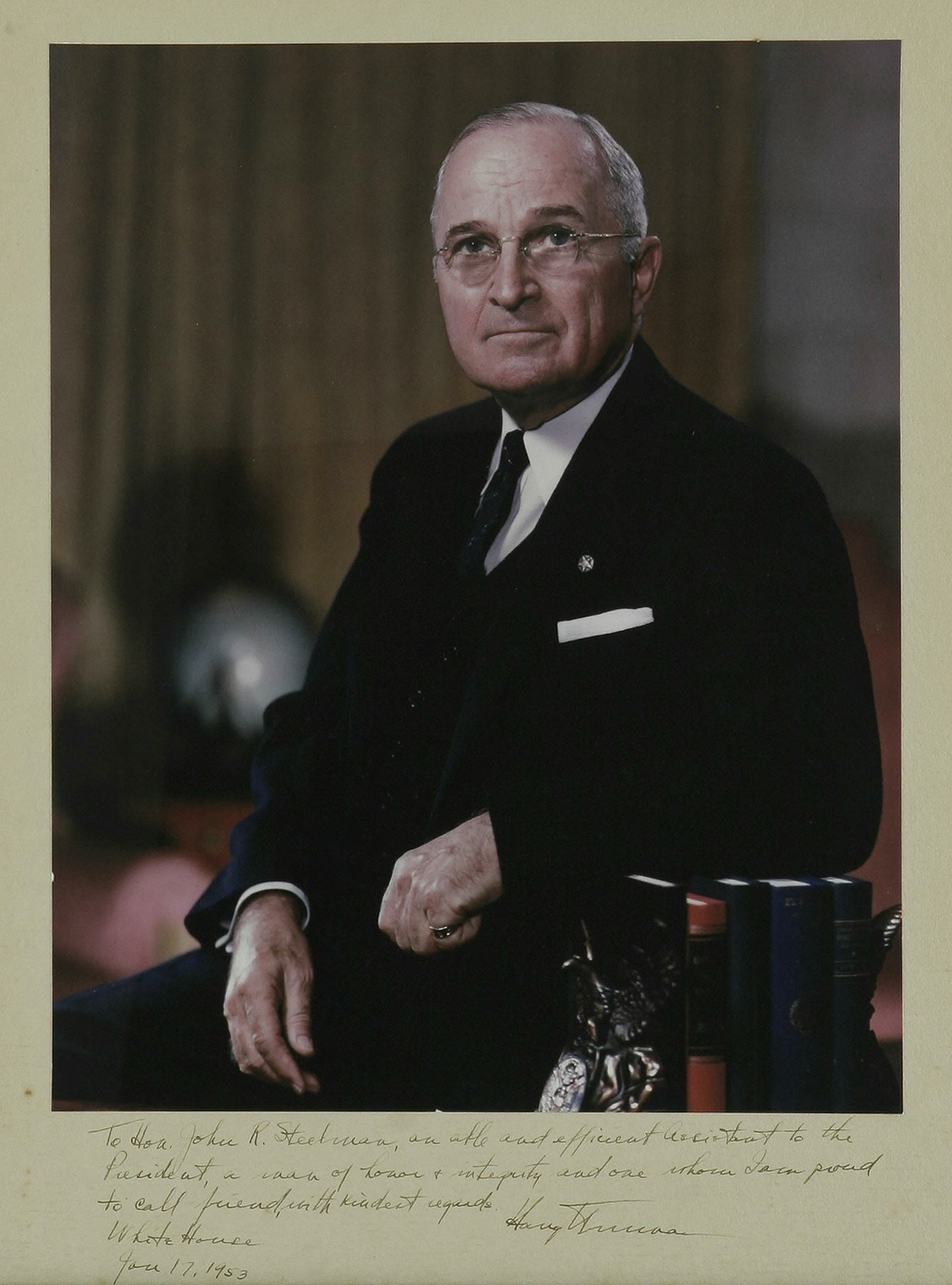
A Harry Truman signed and inscribed photograph, dated Jan. 17, 1953, sold for nearly $3,885 at a February 2006 Heritage auction.

By Jim O’Neal

The news broke shortly before 6 p.m. on April 12, 1945. President Franklin Roosevelt had died of a cerebral hemorrhage in Warm Springs, Ga. Within minutes, the bulletin had reached every part of the country. It was almost midnight in London, but in Berlin, it was already the next day, where it was (ominously) Friday the 13th. However, Joseph Goebbels interpreted it as a lucky turning point when he telephoned Adolf Hitler. He was already devising ways to turn this to Germany’s advantage, even as enemy troops closed in on the Third Reich.

By 7 p.m., Harry Truman, his Cabinet and Bess and Margaret were assembled in the Cabinet Room along with Chief Justice Harlan Stone to administer the oath of office. Within hours of Roosevelt’s death, the country had a new president.

Then the family and the Cabinet were dismissed. Secretary of War Henry Stimson lingered to brief the new president on a matter of extreme urgency. He explained that a new weapon of almost inconceivable power had been developed, but offered no details. Truman had just learned about the existence of the atomic bomb. He canceled a date to play poker and went to bed. It had been a long day.

It was also a long day for America’s top generals: Dwight D. Eisenhower, George S. Patton and Omar Bradley. The shock of losing their trusted commander-in-chief was compounded by genuine concern over Truman’s lack of experience. To make matters worse, they had just seen their first Nazi death camp. All were depressed, but Patton was especially emphatic about his concerns for the future.

The next morning, President Truman arrived at the White House promptly at 9 a.m. It was now April 13, 1945 – 27 years to the day since he had landed at Brest, France (Brittany), as a lowly 1st Lieutenant in the Allied Expeditionary Forces in WWI. Now he was the United States’ commander in chief in the century’s second world war. Everything in the Oval Office was eerily just as FDR had left it. He sat in the chair behind the desk and quietly pondered the challenges he had inherited. Downstairs, the White House staff was frantically coping with the press, the jangle of telephones, and wondering what to do next.

After a routine update on the status of the war, Truman surprised everyone by announcing he was going to the Capitol to “have lunch with some of the boys” … 17 congressmen to be exact. After a few drinks and lunch, he told the group he felt overwhelmed and emphasized he would need their help. Then he stepped out to meet the assembled press and made his now famous remarks: “Boys, if you ever pray, pray for me now. I don’t know whether you fellows ever had a load of hay fall on you, but when they told me yesterday what had happened, I felt like the moon, the stars and all the planets had fallen on me.”

Less than four months later, in August 1945, the man from Independence, Mo., now confident and in control, dropped his own bombshell when he broadcast to the nation:

“Sixteen hours ago, an American airplane dropped one bomb on Hiroshima,” the president said, adding, “We are now prepared to obliterate more rapidly and completely every productive and enterprise the Japanese have above ground in any city. We shall destroy Japan’s power to make war. … If they do not now accept our terms, they may expect a rain of ruin from the air the like of which has never been seen on this earth.”

The buck DID stop here, just as the little sign on his desk promised.

Intelligent Collector blogger JIM O’NEAL is an avid collector and history buff. He is president and CEO of Frito-Lay International [retired] and earlier served as chair and CEO of PepsiCo Restaurants International [KFC Pizza Hut and Taco Bell].
Sanctions Didn’t Stop Germany from Roaring Back After WWI

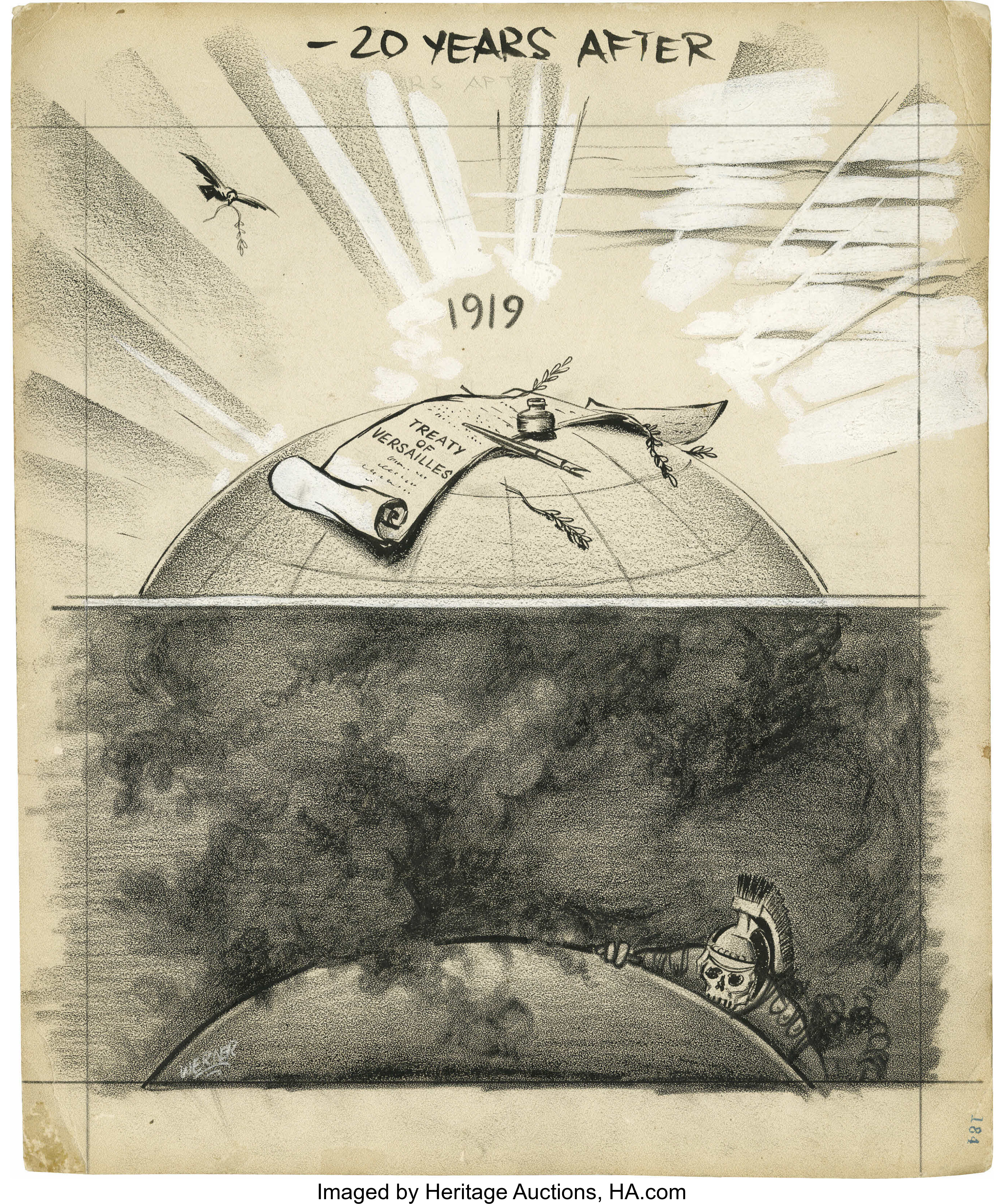
A 1939 political cartoon by Charles Werner (1909-1997) for Time magazine comments on the worldwide mood 20 years after the Treaty of Versailles. The original art sold for $836 at a February 2006 Heritage auction.

By Jim O’Neal

From 1939 to the winter of 1941, the German military won a series of battles rarely equaled in the history of warfare. In rapid succession, Poland, Norway, France, Belgium, Holland, Yugoslavia, Denmark and Greece all fell victim to the armed forces of the Third Reich. In the summer and fall of 1941, the USSR came close to total defeat at the hands of the Wehrmacht, losing millions of soldiers on the battlefield and witnessing the occupation of a large portion of Russia and the Ukraine. The German air force, the Luftwaffe, played a central role in this remarkable string of victories.

It was even more startling to those countries that had participated in WWI and taken draconian anti-war measures when it ended. This was simply something that was NEVER supposed to happen again, much less a mere 20 years later. How was it even possible?

The Allied powers had been so impressed with the combat efficiency of the German Luftwaffe in WWI that they made a concerted effort to eliminate Germany’s capability to wage war in the air. Then they crippled their civilian aviation capability just to be certain. The Allies demanded the immediate surrender of 2,000 aircraft and rapid demobilization of the Luftwaffe. Then in May 1919, the Germans were forced to surrender vast quantities of aviation material, including 17,000 more aircraft and engines. Germany was permanently forbidden from maintaining a military or naval air force.

No aircraft or parts were to be imported, and in a final twist of the knife, Germany was not allowed to control their own airspace. Allied aircraft were granted free passage over Germany and unlimited landing rights. On May 8, 1920, the Luftwaffe was officially disbanded.

Other provisions of the Versailles Treaty dealt with the limits of the army and navy, which were denied tanks, artillery, poison gas, submarines and other modern weapons. Germany was to be effectively disarmed and rendered militarily helpless. An Inter-Allied Control Commission was given broad authority to inspect military and industrial installations throughout Germany to ensure compliance with all restrictions.

However, one critical aspect got overlooked in the zeal to impose such a broad set of sanctions. They left unsupervised one of the most influential military thinkers of the 20th century … former commander-in-chief of the German Army Hans von Seeckt. He was the only one who correctly analyzed the operational lessons of the war, and accurately predicted the direction that future wars would take. Allied generals clung to outdated principles like using overwhelming force to overcome defensive positions, while Von Seeckt saw that maneuvers and mobility would be the primary means for the future. Mass armies would become cannon fodder and trench warfare would not be repeated.

The story of the transformation of the Luftwaffe is a fascinating one. Faced with total aerial disarmament in 1919, it was reborn only 20 years later as the most combat-effective air force in the world. Concepts of future air war along with training and equipment totally trumped the opposition, which was looking backward … always fighting the last war.

Intelligent Collector blogger JIM O’NEAL is an avid collector and history buff. He is president and CEO of Frito-Lay International [retired] and earlier served as chair and CEO of PepsiCo Restaurants International [KFC Pizza Hut and Taco Bell].
Cuban Missile Crisis ‘News’ Gave Us a Preview of the Internet Age

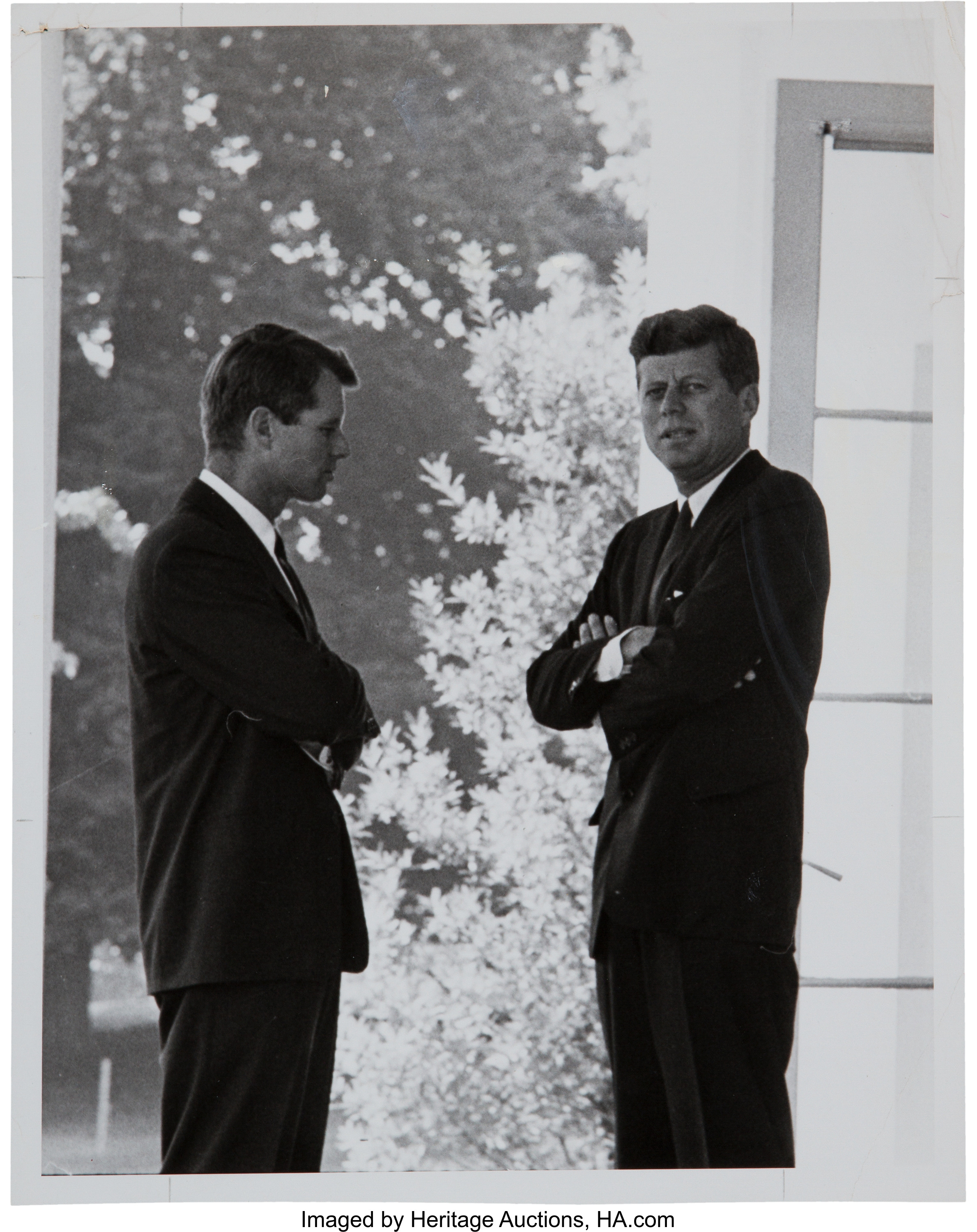
An original October 1962 news photograph of President John F. Kennedy and Robert Kennedy taken as tensions grew during the Cuban Missile Crisis sold for $527 at an August 2015 Heritage auction.

By Jim O’Neal

“I am prepared to wait for my answer until hell freezes over.”

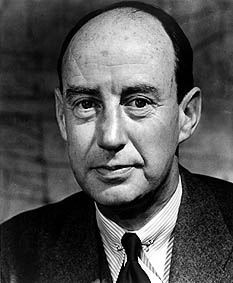
An unusual statement, especially at an emergency session of the somber United States Security Council, and uncharacteristically bellicose for the speaker, U.N. Ambassador Adlai E. Stevenson. It simply was the most dangerous time in the history of the world … the 1962 Cuban Missile Crisis.

Stevenson

Ambassador Stevenson was interrogating Soviet U.N. representative Valerian Zorin while accusing them of having installed nuclear missiles in Cuba, a mere 90 miles from the U.S. coastline. Tensions were sky high. The Joint Chiefs had recommended to President John F. Kennedy an airstrike, followed by an immediate invasion of Cuba using U.S. military troops.

Then with the world’s two superpowers eyeball to eyeball, as Dean Rusk commented, the other guy blinked. Cuba-bound Soviet ships stopped, turned back, and the crisis swiftly eased.

Over much of the world, and especially in Washington and New York, there was relief and rejoicing. With crucial backing from the United Nations and the Organization of American States (OAS), nuclear war was averted. Success in avoiding a war of potential global devastation has gradually clouded the fact that the United States came perilously close to choosing the military option.

The arguments of those who fought for time and political negotiations have been blurred and gradually obscured by widespread euphoria. Even for Ambassador Stevenson, the sweet taste of success soon turned sour. First, there was the death of his dear friend Eleanor Roosevelt, quickly followed by a vicious personal attack on him that he never fully recovered from.

When Mrs. Roosevelt reluctantly entered the hospital, it was thought she was suffering from aplastic anemia. But on Oct. 25, 1962, her condition was diagnosed as rare and incurable bone-marrow tuberculosis. She was prepared and determined to die rather than end up a useless invalid. Her children reluctantly decided Stevenson should be allowed one last visit to his old friend, although daughter Anna warned she might not recognize him.

On Nov. 9, two days after her death, the U.N. General Assembly put aside other business and allowed delegate after delegate to express their personal grief and their country’s sorrow. It was the first time any private citizen had been so honored. Adlai told friends that his speech at the General Assembly and the one he gave at her memorial service were the most difficult and saddest times of his life.

Then a harbinger of a brewing storm started on Nov. 13 when Senator Barry Goldwater issued a sharp attack on Stevenson by implying he had been willing to take national security risks to avoid a showdown with the Soviets. The Saturday Evening Post followed with an article on Cuba that portrayed Stevenson as advocating a “Caribbean Munich.” The headlines at the New York Daily News screamed “ADLAI ON SKIDS OVER PACIFIST STAND ON CUBA.”

For months, Washington was abuzz with rumors that it was all a calculated effort by JFK and Bobby to force Stevenson to resign as U.N. ambassador. It was all innuendo, half-facts and untrue leaks, but it was still reverberating a quarter of a century later when the Sunday New York Times magazine, on Aug. 30, 1987, published a rehash of all the gossip.

In truth, all we were witnessing was a preview of things to come: the internet age of “Breaking News” (thinly veiled opinions parading as facts), 24/7 cable TV loaded with panels of “talking heads,” and a torrent of Twitter gibberish offering a full banquet of tasty goodies for any appetite.

Stevenson, born in Los Angeles in 1900 – the year his grandfather ran for vice president on a losing ticket with William Jennings Bryan – lost his own bid for the presidency twice (1952 and 1956). He died of a heart attack in 1965 in London while walking in Grosvenor Square – finally getting some peace.

The rest of us will have to wait.

Intelligent Collector blogger JIM O’NEAL is an avid collector and history buff. He is president and CEO of Frito-Lay International [retired] and earlier served as chair and CEO of PepsiCo Restaurants International [KFC Pizza Hut and Taco Bell].
Semmes One of Greatest Commerce-Raider Captains in Naval History

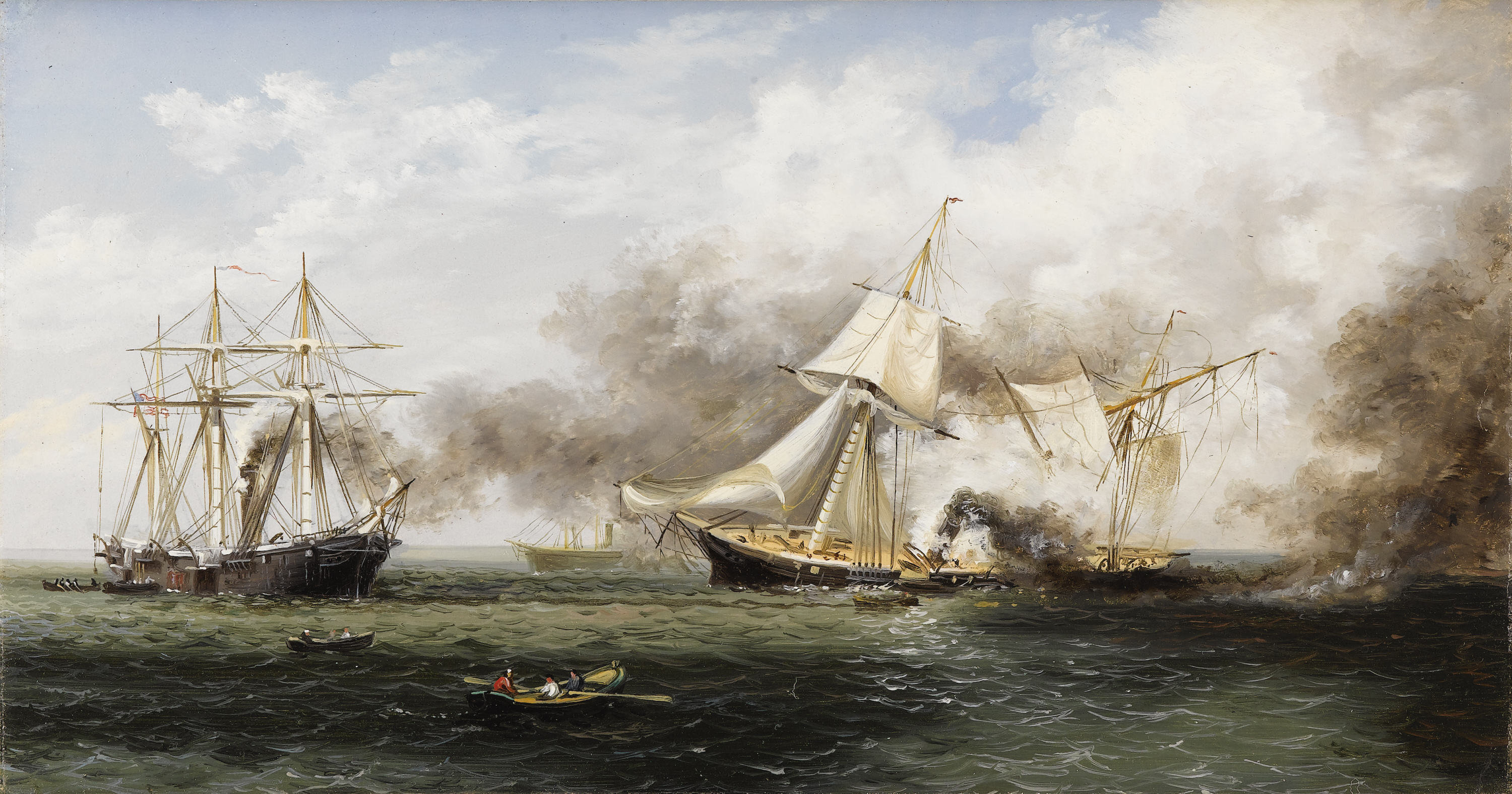
The oil on canvas Sinking of the Alabama, circa 1868, by American marine painter Xanthus Smith (1839-1929) sold for $38,837 at a June 2008 Heritage auction.

By Jim O’Neal

By the time Abraham Lincoln was inaugurated in March 1861, seven of the Southern slaveholding states had seceded from the Union before even hearings his inaugural address. In it, he declared, “I have no purpose, directly or indirectly, to interfere with the institution of slavery in the states where it exists. I believe I have no lawful right to do so, and I have no inclination to do so.”

During the run-up to the 1860 election, Lincoln had chosen not to actively campaign and simply refused to comment on the issue of slavery. However, his Democratic opponent, Stephen A. Douglas (the “Little Giant”) campaigned across the country. In the South, he denounced threats of secession, but warned that Lincoln’s election would inevitably lead to that tragic end.

Capt. Raphael Semmes

I have often wondered if the Civil War could have been averted if Lincoln had taken his inaugural speech to the South before the election or if a civil war was the only alternative to end slavery permanently. I suspect emotions were too high and that many actually hoped for a war, especially after all the heated rhetoric in places like South Carolina.

It became a moot point when barely a month later on April 12, 1861, Confederate forces fired on the Union garrison Fort Sumter and forced it to surrender. Now president, Lincoln announced that part of the United States was in a state of insurrection and issued a call for military volunteers. Four states – Virginia, Tennessee, Arkansas and North Carolina – refused to provide troops and instead joined the Confederacy.

As positions hardened, Lincoln proclaimed a naval blockade against the seceded states, however, this was a futile effort since the Navy only had 42 ships to monitor 3,500 miles of Confederate coastline. They started chartering ships for blockade duty and soon there were 260 warships in service. Their task was made easier since the Confederate “Navy” consisted of 10 river craft armed with a total of 15 guns and not a single ship on the high seas.

Even the South’s military mobilization was devoted almost exclusively to ground forces since this was clearly the most urgent short-term priority.

However, one man was determined to change that. His name was Raphael Semmes (1809-1877) from Mobile, and following Alabama’s secession from the Union, Semmes was offered a Confederate naval appointment. He resigned from the U.S. Navy the next day, Feb. 15, 1861, and set off to the interim Confederate capital of Montgomery. There, he met with Jefferson Davis – the newly inaugurated president of the Confederate States of America – and Stephen R. Mallory, Secretary of the Navy. He outlined his plan to take the war to the enemy … not the federal Navy (that was too large to challenge), but to the U.S. merchant fleet.

In 1861, the U.S. Merchant Marine was the largest in the world. No one surpassed the skill and ingenuity of Yankee shipwrights in the design and construction of wooden vessels. America’s carrying trade had steadily increased in the 1840s-50s, fueled by the discovery of gold in California, treaty ports in Japan and China, and the whaling fleet that operated from the North Atlantic to the Bering Straits.

Semmes theory was that if Confederate cruisers could disrupt the merchant marine, the powerful shipping interests in the North would force the Lincoln administration to reconcile with the South and end the war. After studying naval commander John Paul Jones, the American Revolution, and the War of 1812, Semmes was convinced a weak naval power could neutralize the merchant marine of a more powerful adversary.

President Davis approved the concept and thus launched the career of Raphael Semmes as one of the greatest commerce-raider captains in naval history. Along the way, he traveled 75,000 nautical miles without ever touching a Confederate port and is credited with 64 of the 200-plus Northern merchantmen destroyed by Confederate raiders, many as the commander of the cruiser CSS Alabama. (The warship was eventually sunk in battle with the USS Kearsarge in 1864.)

Fittingly, he is a member of the Alabama Hall of Fame and a monument by sculptor Caspar Buberl (1834-1899) still stands proudly in Mobile … unless, of course, Monument Marauders figure out who he was.

Intelligent Collector blogger JIM O’NEAL is an avid collector and history buff. He is president and CEO of Frito-Lay International [retired] and earlier served as chair and CEO of PepsiCo Restaurants International [KFC Pizza Hut and Taco Bell].