Despite numerous failed examples, socialism still fascinates some people

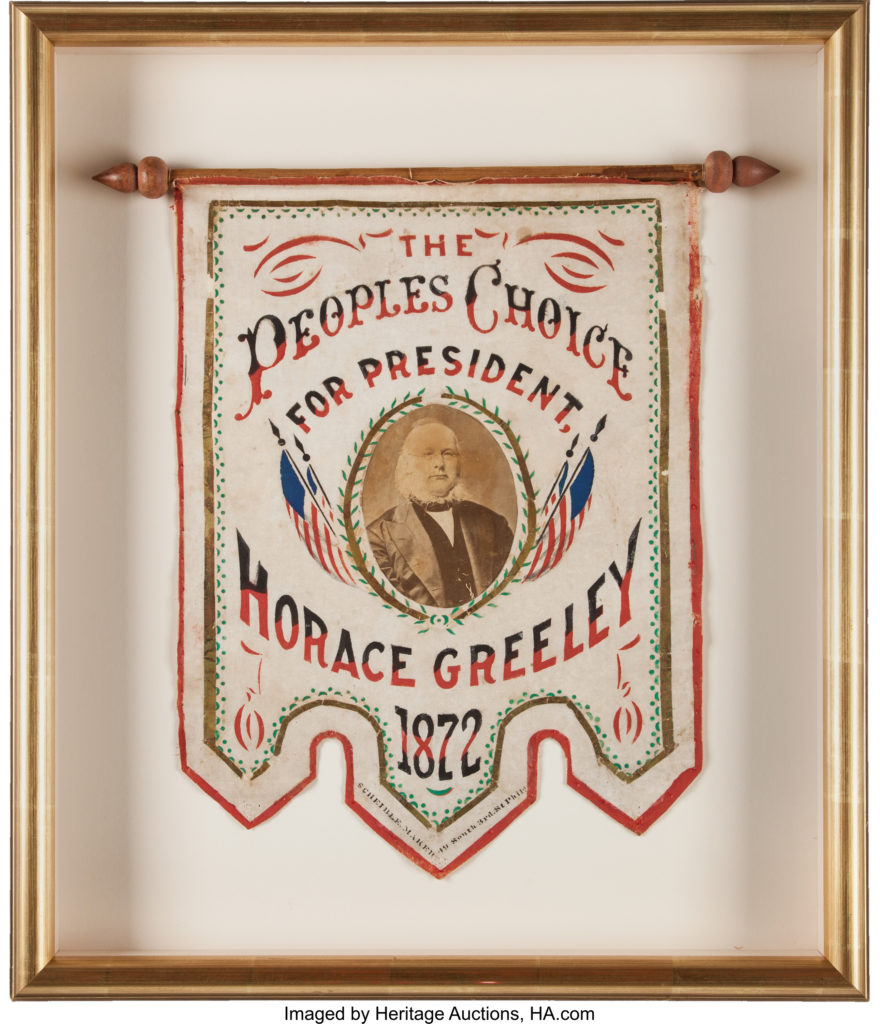
An 1872 presidential campaign banner for Horace Greeley sold for $40,000 at a December 2016 Heritage auction.

By Jim O’Neal

Many credit the famous 19th century motto of “Go West, young man” to newspaperman Horace Greeley for a line in a July 1865 editorial. However, there is still a debate over whether it was first penned by Greeley or the lesser-known John Soule in an 1851 edition of the Terre Haute (Ind.) Express. Either way, the dictum helped fuel the westward movement of Americans in our quest for Manifest Destiny (“From sea to shining sea”). Clearly, Greeley helped more to popularize the concept due to the great influence of his successful newspaper.

Greeley was much less successful as a politician. He was sent to Congress in 1848 in a special election to represent New York. His colleagues groused that the brief three months he spent there were primarily devoted to exposing Congressional corruption in his newspaper rather than passing legislation. He was unable to generate any meaningful support for re-election, which relegated him back to his real interest, which was reporting on news and exposing crooked politicians.

Despite this setback to his political career, Greeley remained a powerful force in American politics throughout the entire Civil War period and beyond. After exposing the corruption in the first term of the Grant presidency (1868-1872), he found himself in the curious position of being the presidential candidate for both the Democratic Party (which he had opposed on every issue for many years) and the Liberal-Republican Party (which was an offshoot that objected to the corruption).

The 1872 presidential election was especially bitter, with both sides resorting to dirty tricks and making wild allegations against each other. Grant won the Republican nomination unanimously and as the incumbent, chose not to actively campaign. Greeley was a virtual whirlwind, traveling widely and making 20 or more speeches every day. A cynic observed that the problem was it was the wrong message to the wrong audience, but fundamentally, the issue was that Greeley was simply a poor campaigner and Grant was still a very popular president/general.

Grant easily won his re-election bid for a second term with 56 percent of the popular vote and Greeley died on Nov. 29 – just 24 days after the election and before the electoral votes were cast or counted. This is the first and only time a nominee for president of a major party has died during the election process. Grant went on to snag a comfortable 56 electoral votes as the others were spread among several candidates, including three for the deceased Greeley (which were later contested).

Thus ended the life of Horace Greeley (1811-1872), who had been founder and editor of the New-York Tribune, arguably in the top tier of great American newspapers. Established in 1841, it was renamed the New-York Daily Tribune (1842-1866) as its daily circulation exploded to 200,000. Greeley was endlessly promoting utopian reforms such as vegetarianism, agrarianism, feminism and socialism. In 1852-62, the paper retained Karl Marx as its London-based European correspondent to elaborate on his basic tenets of Marxism.

Great Britain had just finished its decennial census, which put the population at precisely 20,959,477. This was just 1.6 percent of the world’s population, but nowhere on the planet was there a more rich or productive group of people. The empire produced 50 percent of the world’s iron and coal, controlled two-thirds of the shipping and accounted for one-third of all trade. London’s banks had more money on deposit than all other financial centers … combined! Virtually all the finished cotton in the world was produced in Great Britain on machines built in Britain by British inventors.

The famous British Empire covered 11.5 million square miles and included 25 percent of the world’s population. By whatever measurement, it was the richest, most innovative and skilled nation known to man, and in London – where he was living the good life – primarily on his friend Friedrich Engels’ money – Marx was still churning out socialist propaganda. He made no attempt to explain that for the first time in history, there was a lot of everything in most people’s lives. Victorian London was not only the largest city in the world, but the only place one could buy 500 different kinds of hammers and a dazzling array of nails to pound on.

While Marxism morphed into Bolshevism, communism and socialism – polluting the economic systems of many hopeful utopians like Greeley – capitalism and the market-based theories of Adam Smith (“the father of modern economics”) quietly crept over America almost unnoticed. Despite the numerous failed examples of socialism in the real world, there will always be a new generation of people wanting to try it.
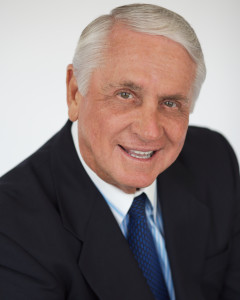
JIM O’NEAL is an avid collector and history buff. He is president and CEO of Frito-Lay International [retired] and earlier served as chair and CEO of PepsiCo Restaurants International [KFC Pizza Hut and Taco Bell].
Peaceful transfer of presidential power is one of our strengths

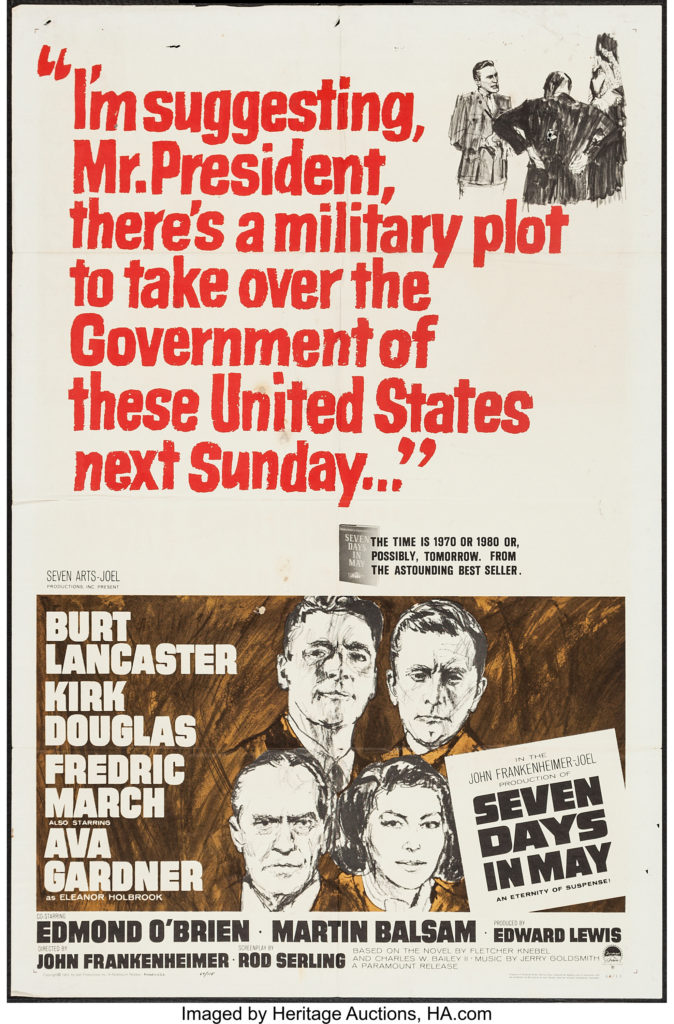
Seven Days in May, starring Burt Lancaster and Kirk Douglas, is a 1964 movie about a military/political cabal’s planned takeover of the U.S. government.

By Jim O’Neal

It seems clear that one of the bedrock fundamentals that contributes to the stability of the U.S. government is the American presidency. Even considering the terrible consequences of the Civil War – 11 states seceding, 620,000 lives lost and widespread destruction – it’s important to remember that the federal government held together surprisingly well. The continuity of unbroken governance is a tribute to a success that is the envy of the world.

Naturally, the Constitution, our system of justice and the rule of law – along with all the other freedoms we cherish – are all critical contributors. But it’s been our leadership at the top that’s made it all possible. In fact, one could argue that having George Washington as the first president for a full eight years is equal in importance to all other factors. His unquestioned integrity and broad admiration, in addition to precedent-setting actions, got us safely on the road to success despite many of the governed being loyal to the British Crown.

Since that first election in 1789, 44 different men have held the office of president (Grover Cleveland for two separate terms), and six of them are alive today. I agree with Henry Adams, who argued, “A president should resemble a captain of a ship at sea. He must have a helm to grasp, a course to steer, a port to seek. Without headway, the ship would arrive nowhere and perpetual calm is as detrimental to purpose as a perpetual hurricane.” The president is the one who must steer the ship, as a CEO leads an organization, be it small or large.

In the 229 intervening years, there have been brief periods of uncertainty, primarily due to vague Constitutional language. The first occurred in 1800, when two Federalists each received 73 electoral votes. It was assumed that Thomas Jefferson would be president and Aaron Burr would be vice president. The wily Burr spotted an opportunity and refused to concede, forcing the decision into the House. Jefferson and Burr remained tied for 35 ballots until Alexander Hamilton (convinced that Jefferson was the lesser of two evils) swayed a few votes to Jefferson, who won on the 36th ballot. This technical glitch was modified by the 12th Amendment in 1804 by requiring an elector to pick both a president and a vice president to avoid any uncertainty.

A second blip occurred after William Henry Harrison and John Tyler defeated incumbent Martin Van Buren. At age 68, Harrison was the oldest to be sworn in as president, a record he held until Ronald Reagan’s inauguration in 1981 at age 69. Harrison died 31 days after his inauguration (also a record), the first time a president had died in office. A controversy arose over the successor. The Presidential Succession Act of 1792 specifically provided for a special election in the event of a double vacancy, but the Constitution was not specific regarding just the presidency.

Vice President Tyler, at age 51, would be the youngest man to assume leadership. He was well educated, intelligent and experienced in governance. However, the Cabinet met and concluded he should bear the title of “Vice President, Acting as President” and addressed him as Mr. Vice President. Ignoring the Cabinet, Tyler was confident that the powers and duties fell to him automatically and immediately as soon as Harrison had died. He moved quickly to make this known, but doubts persisted and many arguments followed until the Senate voted 38 to 8 to recognize Tyler as the president of the United States. (It was not until 1967 that the 25th Amendment formally stipulated that the vice president becomes president, as opposed to acting president, when a president dies, resigns or is removed from office.)

In July 1933, an extraordinary meeting was held by a group of disgruntled financiers and Gen. Smedley Butler, a recently retired, two-time Medal of Honor winner. According to official Congressional testimony, Smedley claimed the group proposed to overthrow President Franklin Roosevelt because of the implications of his socialistic New Deal agenda that would create enormous federal deficits if allowed to proceed.

Smiley Darlington Butler was a U.S. Marine Corps major general – the highest rank authorized and the most decorated Marine in U.S. history. Butler (1881-1940) testified in a closed session that his role in the conspiracy was to issue an ultimatum to the president: FDR was to immediately announce he was incapacitated due to his crippling polio and needed to resign. If the president refused, Butler would march on the White House with 500,000 war veterans and force him out of power. Butler claimed he refused the offer despite being offered $3 million and the backing of J.P. Morgan’s bank and other important financial institutions.

A special committee of the House of Representatives (a forerunner to the Committee on Un-American Activities) headed by John McCormack of Massachusetts heard all the testimony in secret, but no additional investigations or prosecutions were launched. The New York Times thought it was all a hoax, despite supporting evidence. Later, President Kennedy privately mused that he thought a coup d’état might succeed if a future president thwarted the generals too many times, as he had done during the Bay of Pigs crisis. He cited a military plot like the one in the 1962 book Seven Days in May, which was turned into a 1964 movie starring Burt Lancaster and Kirk Douglas.

In reality, the peaceful transfer of power from one president to the next is one of the most resilient features of the American Constitution and we owe a deep debt of gratitude to the framers and the leaders who have served us so well.

JIM O’NEAL is an avid collector and history buff. He is president and CEO of Frito-Lay International [retired] and earlier served as chair and CEO of PepsiCo Restaurants International [KFC Pizza Hut and Taco Bell].
Notorious traitors? Let’s look at Benedict Arnold

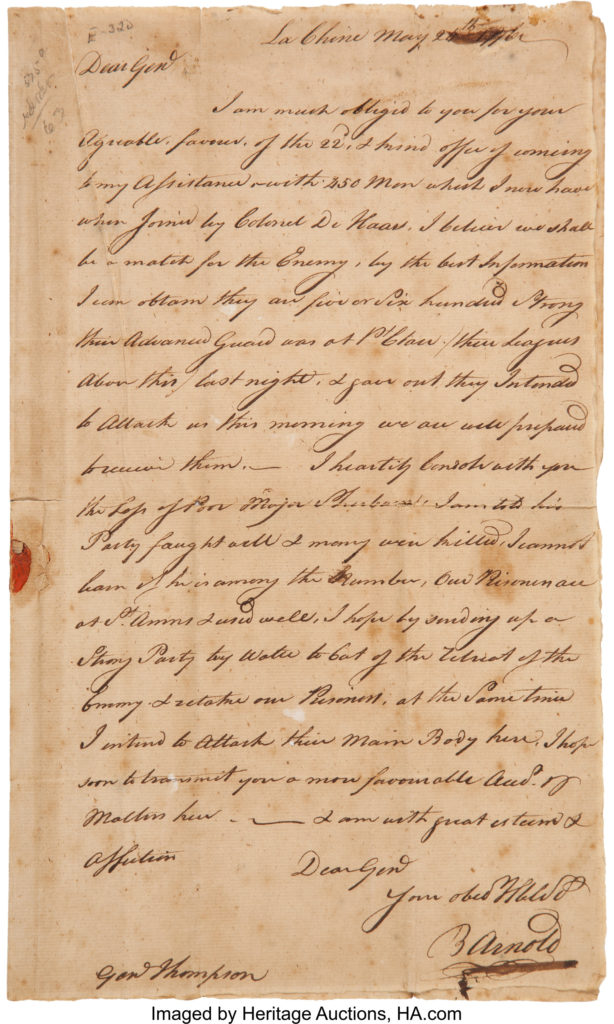
A May 24, 1776, letter by Benedict Arnold, signed, to Gen. William Thompson, realized $23,750 at an April 2016 Heritage auction.

By Jim O’Neal

Vidkun Quisling is an obscure name from World War II. To those unfamiliar with some of the lesser-known details, “Quisling” has become a synonym for a traitor or collaborator. From 1942 to 1945, he was Prime Minister of Norway, heading a pro-Nazi puppet government after Germany invaded. For his role, Quisling was put on trial for high treason and executed by firing squad on Oct. 24, 1945.

Obviously better known are Judas Iscariot of Last Supper fame (30 pieces of silver); Guy Fawkes, who tried to assassinate King James I by blowing up Parliament (the Gunpowder Plot); and Marcus Junius Brutus, who stabbed Julius Caesar (“Et tu, Brute?”). In American history, it’s a close call between John Wilkes Booth and Benedict Arnold.

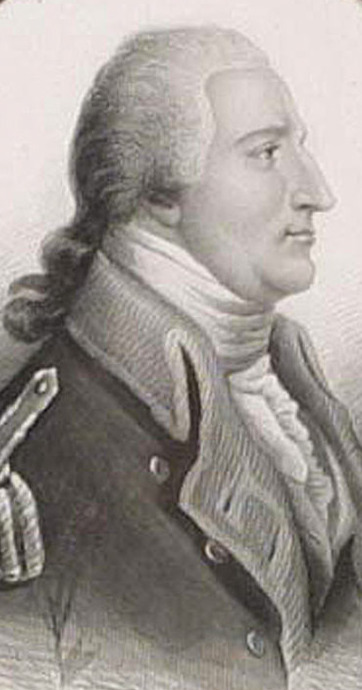
Arnold

The irony concerning Benedict Arnold (1741-1801) is that his early wartime exploits had made him a legendary figure, but Arnold never forgot the sleight he received in February 1777 when Congress bypassed him while naming five new major generals … all of them junior to him. Afterward, George Washington pledged to help Arnold “with opportunities to regain the esteem of your country,” a promise he would live to regret.

Unknown to Washington, Arnold had already agreed to sell secret maps and plans of West Point to the British via British Maj. John André. There have always been honest debates over Arnold’s real motives for this treacherous act, but it seems clear that purely personal gain was the primary objective. Heavily in debt, Arnold had brokered a deal that included having the British pay him 6,000 pound sterling and award him a British Army commission for his treason. There is also little doubt that his wife Peggy was a full accomplice, despite a dramatic performance pretending to have lost her mind rather than her loyalty.

The history of West Point can be traced back to when it was occupied by the Continental Army after the Second Continental Congress (1775-1781) was designated to manage the Colonial war effort. West Point – first known as Fort Arnold and renamed Fort Clinton – was strategically located on high ground overlooking the Hudson River, with panoramic views extending all the way to New York City, ideal for military purposes. Later, in 1801, President Jefferson ordered plans to establish the U.S. Marine Corps there, and West Point has since churned out many distinguished military leaders … first for the Mexican-American War and then for the Civil War, including both Ulysses S. Grant and Robert E. Lee. It is the oldest continuously operating Army post in U.S. history.

To understand this period in American history, it helps to start at the end of the Seven Years’ War (1756-63), which was really a global conflict that included every major European power and spanned five continents. Many historians consider it “World War Zero,” and on the same scale as the two 20th century wars. In North America, the skirmishes started two years earlier in the French and Indian War, with Great Britain an active participant.

The Treaty of Paris in 1763 ended the conflict, with the British winning a stunning series of battles, France surrendering its Canadian holdings, and the Spanish ceding its Florida territories in exchange for Cuba. Consequently, the British Empire emerged as the most powerful political force in the world. The only issue was that these conflicts had nearly doubled England’s debt from 75 million to 130 million sterling.

A young King George III and his Parliament quietly noted that the Colonies were nearly debt free and decided it was time for them to pay for the 8,000-10,000 Redcoat peacetime militia stationed in North America. In April 1864, they passed legislation via the Currency Act and the Sugar Act. This limited inflationary Colonial currency and cut the trade duty on foreign molasses. In 1765, they struck again. Twice. The Quartering Act forced the Colonists to pay for billeting the king’s troops. Then the infamous Stamp Act placed direct taxes on Americans for the first time.

This was one step too far and inevitably led to the Revolutionary War, with armed conflict that involved hot-blooded, tempestuous individuals like Benedict Arnold. A brilliant military leader of uncommon bravery, Arnold poured his life into the Revolutionary cause, sacrificing his family life, health and financial well-being for a conflict that left him physically crippled. Sullied with false accusations, he became profoundly alienated from the American cause for liberty. His bitterness unknown to Washington, on Aug. 3, 1780, the future first president announced Arnold would take command of the garrison at West Point.

The appointed commander calculated that turning West Point over to the British, perhaps along with Washington as well, would end the war in a single stroke by giving the British control over the Hudson River. The conspiracy failed when André was captured with incriminating documents. Arnold fled to a British warship and they refused to trade him for André, who was hanged as a spy after pleading to be shot by a firing squad. Arnold went on to lead British troops in Virginia, survived the war, and eventually settled in London. He quickly became the most vilified figure in American history and remains the symbol of treason yet today.

Gen. Nathanael Greene, often called Washington’s most gifted and dependable officer, summed it up after the war most succinctly: “Since the fall of Lucifer, nothing has equaled the fall of Arnold.”

JIM O’NEAL is an avid collector and history buff. He is president and CEO of Frito-Lay International [retired] and earlier served as chair and CEO of PepsiCo Restaurants International [KFC Pizza Hut and Taco Bell].
Selecting a justice has always been a messy, partisan process

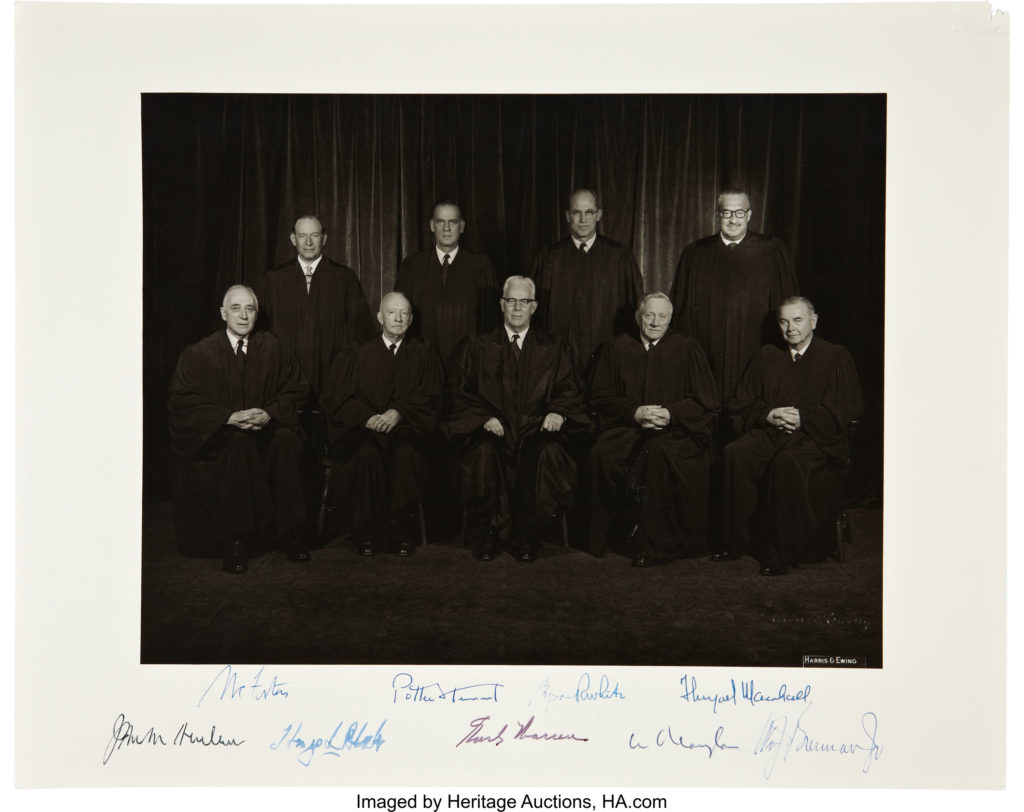
This photograph, circa 1968, autographed by Chief Justice Earl Warren and the eight associate justices, sold for $2,031 at a June 2010 Heritage auction.

By Jim O’Neal

The Senate Judiciary Committee began hearings this week to consider the nomination of Judge Brett Kavanaugh to the Supreme Court in their “advise and consent” role to the president of the United States. Once considered a formality in the justice system, it has devolved into a high-stakes political process and is a vivid example of how partisanship has divided governance, especially in the Senate.

Fifty years ago, President Nixon provided a preview of politics gone awry as he attempted to reshape the Supreme Court to fit his vision of a judiciary. His problems actually started during the final year of Lyndon Johnson’s presidency. On June 26, 1968, LBJ announced that Chief Justice Earl Warren intended to resign the seat he had held since 1953. He also said that he intended to nominate Associate Justice Abe Fortas as his successor.

For the next three months, the Senate engaged in an acrimonious debate over the Fortas nomination. Finally, Justice Fortas asked the president to withdraw his nomination to stop the bitter partisan wrangling. Chief Justice Warren, who had been a keen observer of the Senate’s squabbling, decided to end the controversy in a different way. He withdrew his resignation and in a moment of pique said, “Since they won’t take Abe, they will have me!” True to his promise, Warren served another full term until May 1969.

By then, there was another new president – Richard Nixon – and he picked Warren Burger to be Warren’s replacement. Burger was a 61-year-old judge on the U.S. Court of Appeals with impeccable Republican credentials, just as candidate Nixon had promised during the 1968 presidential election campaign. As expected, Burger’s confirmation was speedy and decisive … 74-3.

Jubilant over his first nomination confirmation to the court, Nixon had also received a surprise bonus earlier in 1969. In May, Justice Fortas had decided to resign his seat on the court. In addition to the bitter debate the prior year, the intense scrutiny of his record had uncovered a dubious relationship with Louis Wolfson, a Wall Street financier sent to prison for securities violations. To avoid another Senate imbroglio over some shady financial dealings, Fortas decided to resign. In stepping down, Fortas became the first Supreme Court justice to resign under threat of impeachment.

So President Nixon had a second opportunity to add a justice. After repeating his criteria for Supreme Court nominees, Nixon chose Judge Clement Haynsworth Jr. of the U.S. Court of Appeals, Fourth Circuit, to replace Fortas. Attorney General John Mitchell had encouraged the nomination since Haynsworth was a Harvard Law alumnus and a Southern jurist with conservative judicial views. He seemed like an ideal candidate since Nixon had a plan to gradually reshape the court.

However, to the president’s anger and embarrassment, Judiciary Committee hearings exposed clear evidence of financial and conflict-of-interest improprieties. There were no actual legal implications, but how could the Senate force Fortas to resign and then essentially just overlook basically the same issues now? Finally, the Judiciary Committee approved Haynsworth 10-7, but on Nov. 21, 1969, the full Senate rejected the nomination 55-45. A livid Nixon blamed anti-Southern, anti-conservative partisans for the defeat.

The president – perhaps in a vengeful mood – quickly countered by nominating Judge G. Harold Carswell of Florida, a little-known undistinguished ex-U.S. District Court judge with only six months experience on the Court of Appeals. The Senate was clearly now hoping to approve him until suspicious reporters discovered a statement in a speech he had made to the American Legion 20-plus years before in 1948: “I yield to no man as a fellow candidate or as a citizen in the firm, vigorous belief in the principles of White Supremacy and I shall always be so governed!”

Oops.

Even allowing for his youth and other small acts of racial bias, the worst was yet to come. It turned out that he was a lousy judge with a poor grasp of the law. His floor manager, U.S. Senator Roman Hruska, a Nebraska Republican, then made a fumbling inept attempt to convert Carswell’s mediocrity into an asset. “Even if he is mediocre, there are lots of mediocre judges, people and lawyers. They are entitled to a little representation aren’t they, and a little chance?” This astonishing assertion was then compounded when it was seconded by Senator Russell Long, a Democrat from Louisiana! When the confirmation vote was taken on April 9, 1970, Judge Carswell’s nomination was defeated 51-45.

A bitter President Nixon, with two nominees rejected in less than six months, continued to blame it on sectional prejudice and philosophical hypocrisy. So he turned to the North and selected Judge Harry Blackmun, a close friend of Chief Justice Burger who urged his nomination. Bingo … he was easily confirmed by a vote of 94-0. At long last, the vacant seat of Abe Fortas was filled.

There would be no further vacancies for 15 months, but in September 1971, justices Hugo Black and John Harlan announced they were terminally ill and compelled to resign from the court. Nixon was finally able to develop a strategy to replace these two distinguished jurors, but it was only after a complicated and convoluted process. It would ultimately take Nixon eight tries to fill four seats, and the process has only become more difficult.

Before Judge Kavanaugh is able to join the court, as is widely predicted, expect the opposing party to throw up every possible roadblock they have in their bag of tricks. This process is now strictly political and dependent on partisan voting advantages. The next big event will probably involve Justice Ruth Bader Ginsburg, a 25-year court member (1993) and only the second woman on the court after Sandra Day O’Connor. At age 85, you can be sure that Democrats are wishing her good health until they regain control of the Oval Office and the Senate. If not, stay tuned for the Battle of the Century!

JIM O’NEAL is an avid collector and history buff. He is president and CEO of Frito-Lay International [retired] and earlier served as chair and CEO of PepsiCo Restaurants International [KFC Pizza Hut and Taco Bell].
Franklin had Faults, but he Remains an Extraordinary American

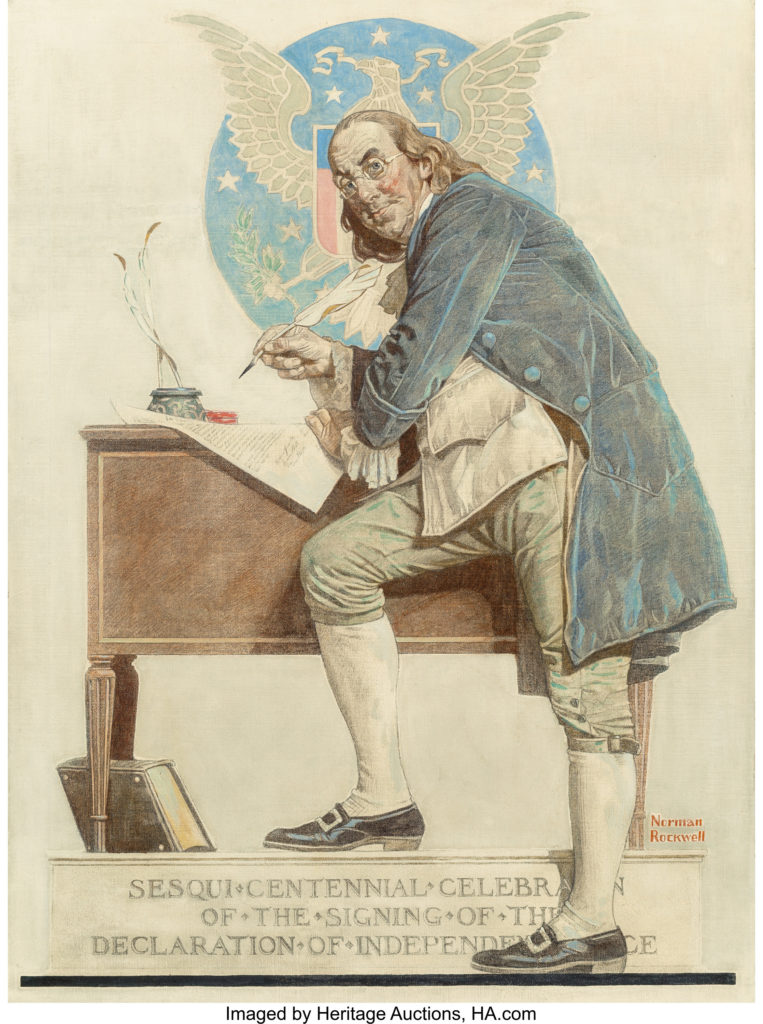
Norman Rockwell’s illustration of Ben Franklin for a 1926 cover of The Saturday Evening Post sold for $762,500 at a May 2018 Heritage auction.

By Jim O’Neal

George Washington was the only United States president who lived his entire life in the 18th century (1732-1799). However, every early vice president – from John Adams on – spent a significant part of their lives in the 19th century. Of the Founding Fathers, Benjamin Franklin (often considered the “grandfather” of the group), was born in 1706 and died in 1790 – nine years earlier than even Washington. In reality, he was actually a member of the previous generation and spent virtually all of his life as a loyal British subject.

As a result, Franklin didn’t have an opportunity to observe the nation he helped create as it struggled to function smoothly. Many were determined not to simply replicate the English monarchy, but to establish a more perfect union for the common man to prosper (women, slaves and non-property owners would have to wait). Franklin was also a man of vast contradictions. He was really a most reluctant revolutionary and discretely wished to preserve the traditions of the British Empire he had grown so familiar with. He secretly mourned the final break, even as he helped lead the fight for America’s independence.

Even while signing the Declaration of Independence and the Constitution, like many other loyalists, he hoped for some sort of reconciliation, a hopeless cause after so many careless British transgressions.

Fortunately, we have a rich history of this remarkable man’s life since he was such a prolific writer and his correspondence was greatly admired, and thus preserved by those lucky enough to receive it. Additionally, his scientific papers were highly respected and covered a vast breadth of topics that generated interest by the brightest minds in the Western world. He knew most of them personally on a first-name basis due to the many years he lived in France and England while traveling the European continent. Government files are replete with the many letters exchanged with heads of state.

Despite his passion for science, Franklin viewed his breakthrough experiments as secondary to his civic duties. He became wealthy as a young man and this provided the freedom to travel and assume important government assignments. Somehow, he was also able to maintain a pleasant marriage despite his extended absences, some for as long 10 years. He rather quickly developed a reputation as a “ladies’ man” and his social life flourished at the highest levels of society.

Some historians consider him the best-known celebrity of the 18th century. Even today, we still see his portrait daily on our $100 bills – colloquially known as “Benjamins” – and earlier on common 50-cent pieces and various denominations of postage stamps. Oddly, he is probably better known today by people of all ages than those 200 years ago. That is true stardom that very few manage to attain.

Every student in America generally knows something about Franklin flying a kite in a thunderstorm. They may not know that he proved the clouds were electrified and that lightning is a form of electricity. Or that Franklin’s work inspired Joseph Priestley to publish a comprehensive work on The History and Present State of Electricity in 1767. And it would be exceedingly rare if they knew the prestigious Royal Society honored him with its first Copley Medal for the advancement of scientific knowledge. But they do know Franklin from any picture.

Others may know of his connection to the post office, unaware that the U.S. postal system was established on July 26, 1775, by the Second Continental Congress when virtually all the mail was sent to Europe, not to themselves. There were no post offices in the Colonies and bars and taverns filled that role nicely. Today, there are 40,000 of them handling 175 billion pieces (six per second) and they have an arrangement with Amazon to deliver their packages, even on Sundays. Mr. Franklin helped create this behemoth as the first Postmaster General.

Franklin was also a racist in an era when the word didn’t even exist. He finally freed his house slaves and later became a staunch opponent of slavery, even sponsoring legislation. But he literally envisioned a White America, most especially for the Western development of the country. He was alarmed about German immigrants flooding Philadelphia and wrote passionately about their not learning English or assimilating into society. He was convinced it would be better if blacks stayed in Africa. His dream was to replicate England since the new nation had so much more room for expansion than that tiny island across the Atlantic. But we are here to examine the extraordinary mind and curiosity that led to so many successful experiments. Franklin always bemoaned the fact that he had been born too early and dreamed about all the new wonderful things that would be 300 years in the future.

Dear Ben, you just wouldn’t believe it!

JIM O’NEAL is an avid collector and history buff. He is president and CEO of Frito-Lay International [retired] and earlier served as chair and CEO of PepsiCo Restaurants International [KFC Pizza Hut and Taco Bell].
Copernicus, Galileo Helped Discover Our True Place in the Universe

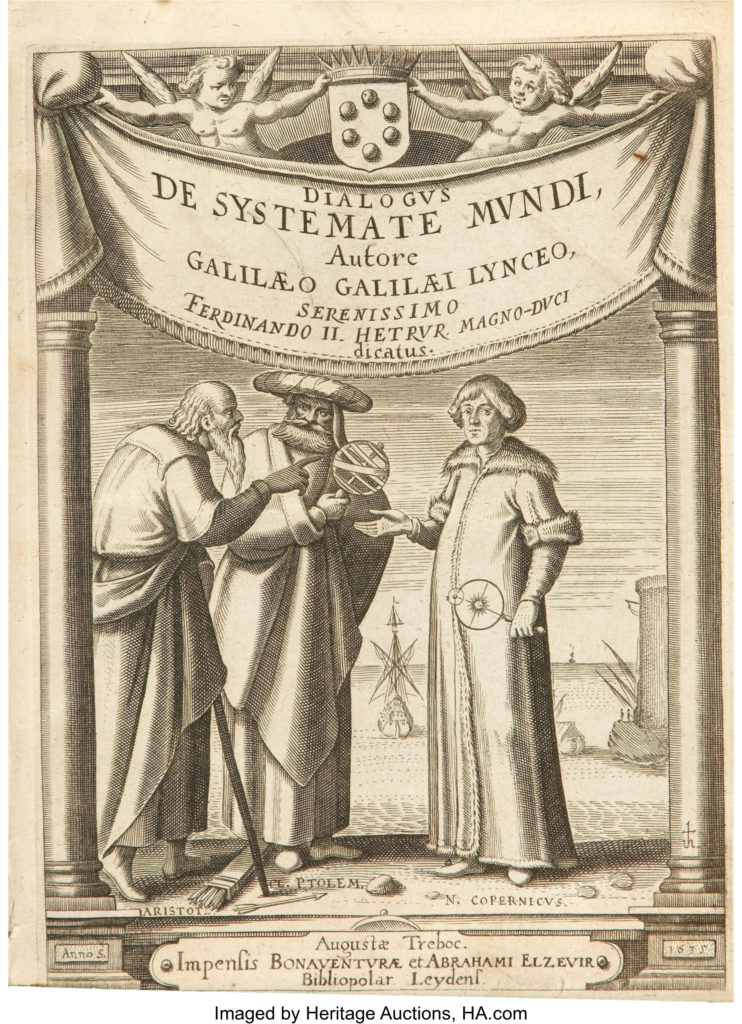
A 1635 copy of Galileo’s Dialogo, containing the argument that Earth revolves around the sun, sold for $31,070 at a February 2010 Heritage auction.

“Then God said, ‘Let there be light,’ and there was light.” – Genesis 1:3

By Jim O’Neal

About 4.6 billion years ago, an enormous swirl of gas and matter started a process of aggregation that ultimately formed our solar system. Nearly all of this mass was transformed into our sun and the remainder eventually coalesced into clumps that became our planetary system. Fortunately for us, one of these clumps became our current home, Earth. Then, a large clump approximately the size of Mars collided with Earth and knocked out enough material to form an object we call the moon.

Several other factors were also in our favor. First was the size of the sun, since if it were larger it may have burned out by now and us with it (we still have about 5 billion years to go). The second was the distance between the sun and Earth. We literally have a “Goldilocks position” – not too close and not too far. If we were 5 percent closer or 15 percent farther away, we would either be fried or trying to live on a large ice ball. The odds of being exactly where we are is not pleasant to contemplate. Then again, if we weren’t exactly here, I assume we wouldn’t be aware of our bad luck. Even our orbit around the sun produces a nice blend of moderate seasons of winter and summer.

However, we are still subject to occasional collisions with other objects, like asteroids and comets. In the past, these have produced mass extinctions like the one that surprised the dinosaurs, who had enjoyed their time here for about 150 million years. Life has managed to adapt through five or six major incidents and countless smaller ones. The modern form of humans (our ancestors) have only been here for about 200,000 years, but we’ve been clever enough to develop weapons that could destroy Earth (a first that we should not be too proud of).

Throughout the early history of our residency, the conventional wisdom was that Earth was the center of everything, with the sun, moon and stars orbiting us. This “geocentric model” seemed logical using common sense, as we don’t feel any motion standing on the ground and there was no observational evidence that our planet was in motion, either. This system was widely accepted and became entrenched in classical philosophy via the combined works of Plato and Aristotle in the fourth century B.C.

However, when the ancient Greeks measured the movements of the planets, it became clear the geocentric model had too many discrepancies. To explain the complications, Greek astronomers introduced the concept of epicycles to reconcile their theories. These sub-orbits were refined by the great Greco-Roman astronomer Ptolemy of Alexandria. Despite competing ideas and debates, the Ptolemaic system prevailed, but with significant implications.

As the Roman Empire dwindled, the Christian Church inherited many long-standing assumptions, including the idea that Earth was the center of everything and, perhaps more importantly, that man was the pinnacle of God’s creation – with determination over Earth, a central tenet that held sway in Europe until the 16th century. However, by this point, the Ptolemaic model was becoming absurdly complicated. By the beginning of the 16th century, things were about to change … dramatically. The twin forces of the Renaissance and the Protestant Reformation challenged the old religious dogmas. Suddenly, a Polish Catholic canon, Nicolaus Copernicus (1473-1543), put forth the first modern heliocentric theory, shifting the center of the universe to the sun.

Fortunately, Copernicus was followed by an Italian polymath from Pisa, Galileo Galilei (1564-1642), who bravely helped transform philosophy to modern science and the scientific Renaissance into a scientific revolution. He championed heliocentrism, despite powerful opposition from astronomers, and was subjected to a formal Roman Inquisition. The body found him “vehemently suspect of heresy” and forced him into house arrest. He spent the remainder of his life basically imprisoned.

Now famous for his work as an astronomer, physicist, engineer, philosopher and mathematician, he received the ultimate honor of being named the “Father of Science” by both Stephen Hawking and Albert Einstein!

Not bad for someone in an ankle bracelet.

JIM O’NEAL is an avid collector and history buff. He is president and CEO of Frito-Lay International [retired] and earlier served as chair and CEO of PepsiCo Restaurants International [KFC Pizza Hut and Taco Bell].
Tension Between Federal, State Governments Lingers Even Today

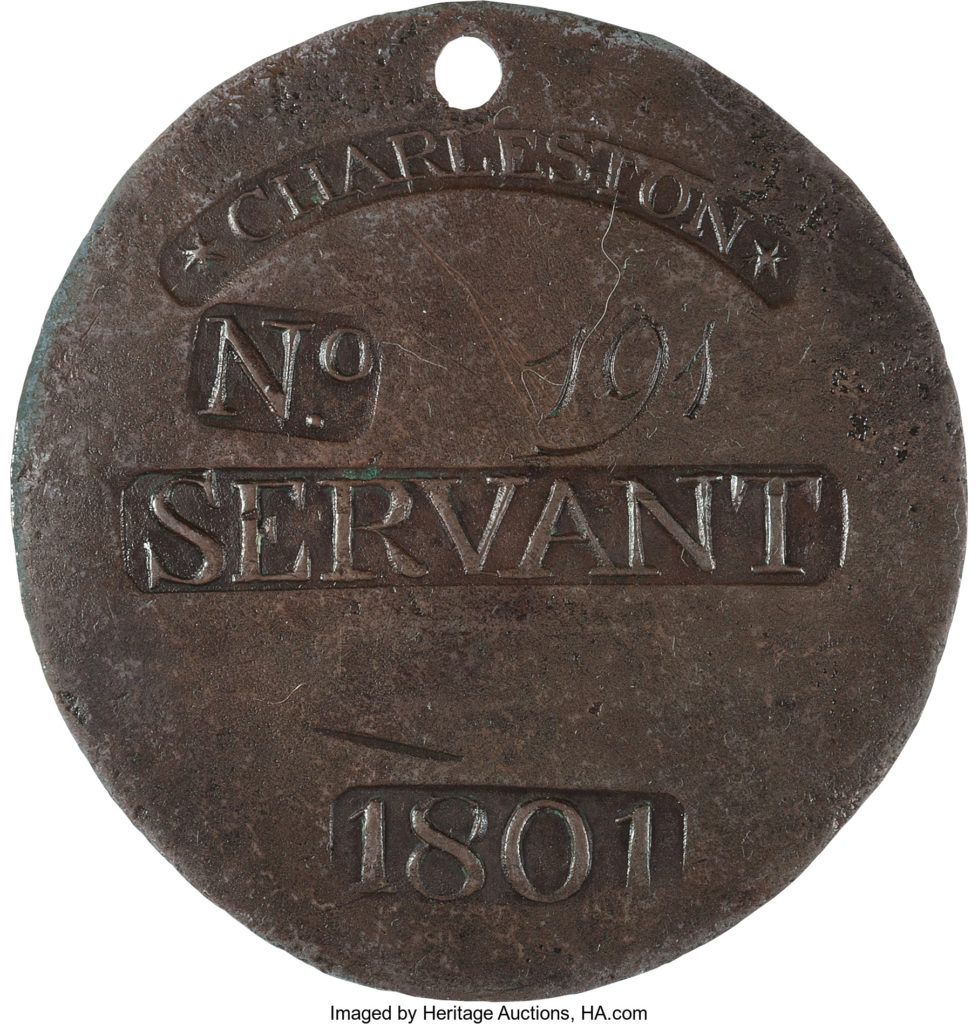
Slave hire badges were likely hung from the necks of slaves who were leased out by their masters for short-term hire. This 1801 Charleston badge sold for $11,875 at a May 2015 Heritage auction.

By Jim O’Neal

There have always been disagreements about the real cause(s) of the American Civil War. One major culprit – the differences between the North and South over the issue of slavery – is seen as a top reason. There are earlier academic arguments that the cause was really about differences over the dividing line between states’ rights and the authority of the federal government. Where did one authority stop or become superseded by the other?

A third reason was the simple motivation to keep our hard-won United States intact and not splinter into states that were merely loosely confederated, as opposed to “One Nation of States United.” President Lincoln added fuel to this logic when he publicly wrote, “My paramount object in this struggle is to save the Union, and is not either to save or to destroy slavery. If I could save the Union without freeing any slave I would do it, and if I could save it by freeing all the slaves I would do it.”

In his historic Emancipation Proclamation, he literally freed only the slaves in the Confederate States, the only ones he had no authority over. Slaves in the so-called border states (slave states that did not declare secession) were unaffected by the Proclamation for fear of having more states secede. Maintaining the Union triumphed over all other objectives.

But what if the Civil War was really about something else, like, say, basic democracy? Sound crazy? Well, maybe, but consider the years after the American Revolution and the framing of the Constitution when the basic tenets of democracy were highly contentious. The Founding Fathers (both Federalists and Jeffersonians) clashed constantly and ferociously over the role of ordinary citizens in a new government of “We the People.” Who were these people and what rights did they have?

Even the ratification of the Constitution was delayed since there was not a specific “Bill of Rights.” Opponents of this argued strenuously that the rights already existed, and adding a special list could call into question other rights that were not specifically included. In the end, it was necessary to compromise and include a special list that was narrowed down to the ones in our current Bill of Rights. However, somewhat ironically, they generally cover what the government could not do, rather than specific rights for individual citizens.

The triumph of Andrew Jackson in 1828 modified this role on the national level, while city Democrats, anti-Masons, fugitive slaves and other Americans worked to carve out their interests on the local level. These cumulative decisions led inexorably to the beginning of a series of regional differences. The free-labor Northern states and the slaveholding South – loosely linked by an evolving federal government – were in reality two distinct political systems with fundamentally antagonist cultures. By the time of Jackson’s second inaugural address on March 4, 1833, he felt compelled to declare, “In the domestic policy of this government, there are two objects which especially deserve the attention of the people and their representatives, and which have been and will continue to be subjects of my increasing solicitude. They are the preservation of the rights of the several states and the integrity of the Union.”

The issue that smoldered and occasionally burst into flame was that of nullification. John Calhoun made himself the leader of the movement that declared that a state had the right to decide which federal laws it wished to observe and which to reject. Calhoun and his followers also felt that a state had the right to secede from the Union. Jackson was adamant and publicly declared, “Our Federal Union, it must be preserved!” National leaders from Martin Van Buren to Henry Clay were partially successful in mitigating the ever-growing chasm between these diametrically opposing views. However, the election of Abraham Lincoln signaled an end to this delicate balance. These two almost alien cultures began to quickly unravel, as the firebrands in the South were convinced the federal government was determined to change their fundamental democratic rights and were gleeful that they could stop the encroachment.

Rebellion in the form of secession led directly to the long-predicted armed conflict. Both sides were convinced they were right and were willing to sacrifice their lives.

Flash forward to today and we see the same fissures that are likely to worsen. We’re seeing battles between the states and the federal government over highly emotionally packed issues like voting rights, immigration, travel bans, free speech, inequality, religion, health care … all seeking redress (nullification) from an overloaded Supreme Court, as a highly partisan Congress has become more impotent.

United States Democracy, Act 2?

JIM O’NEAL is an avid collector and history buff. He is president and CEO of Frito-Lay International [retired] and earlier served as chair and CEO of PepsiCo Restaurants International [KFC Pizza Hut and Taco Bell].
Efforts Under Way (Again) to Divide the Golden State

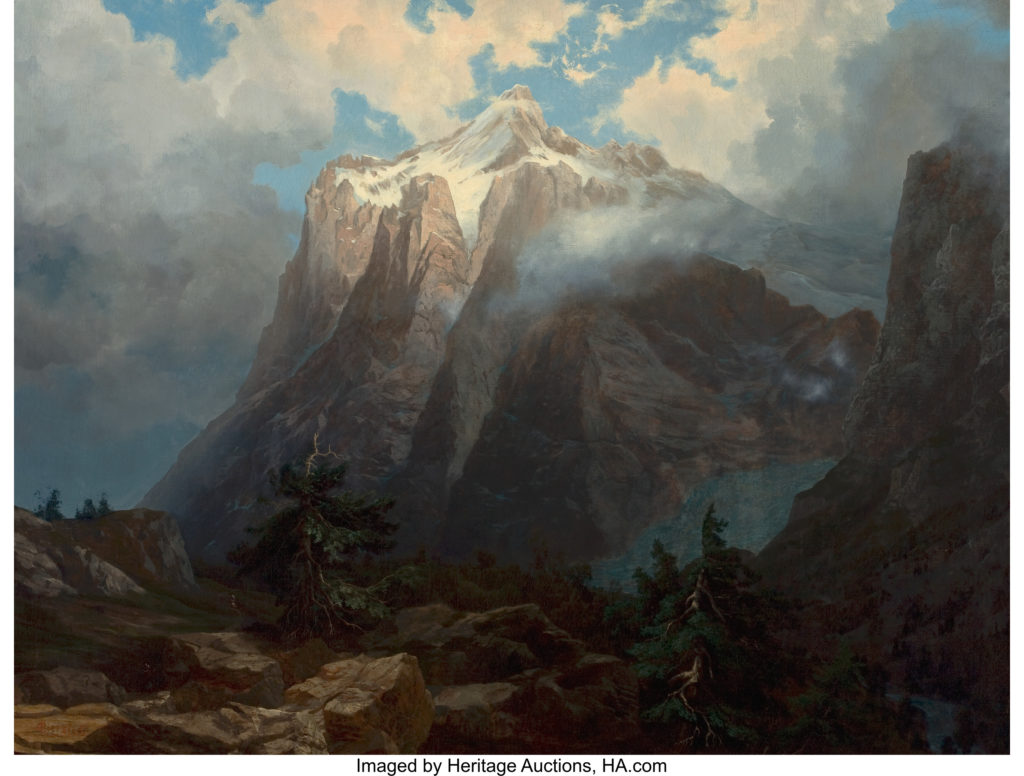
Albert Bierstadt’s 1872 oil on canvas Mount Brewer from King’s River Canyon, California, sold for $602,500 at a November 2012 auction.

By Jim O’Neal

On June 4, 1965, the California State Senate voted 27-12 to divide California into two separate states. To make the proposal effective, it required approval by the State Assembly, followed by both California voters and the U.S. Congress. The plan failed to generate enough support in the State Assembly and did not proceed. In 1992, the State Assembly passed a proposal to allow a referendum vote in each county to partition California into three states: North, South and Central California. In a twist, this time the proposal died in the Senate.

These were not new or even unique legislative actions. Since California became the 31st state to join the United States in 1850, there have been more than 220 similar attempts, obviously none successful. Even while California was under Spanish rule, the province was divided into Alta California (upper) and Baja California (lower). Alta California was the portion that entered the Union, while Baja remained a territory under Mexico rule. It is now one of Mexico’s 31 states … an extremely nice place for turistas to enjoy the sun, sand, fishing and golf.

After Lewis and Clark finished their historic expedition to map out exactly what we actually acquired from France via the Louisiana Purchase, President Jefferson envisioned the Northwest area eventually becoming an independent country … the “Pacific Empire.” He thought it might include a good chunk of Canada, along with what is now Washington, Oregon and Idaho. The war with Mexico trumped that idea when we ended up with the United States expanding into the western Pacific area from San Diego to the Canadian border, followed by the discovery of gold, which ensured dramatic migration from east to west.

One of the more interesting episodes in carving up California in the 20th century is worth re-telling. In October 1941, the mayor of a small town in Oregon announced that four counties in Oregon planned to unite with three counties in Northern California to form the new state of Jefferson, in honor of the late president. On Nov. 27, 1941, a group of armed men stopped all traffic on U.S. Route 99 and handed out copies of their Proclamation of Independence for the State of Jefferson, along with their intent to secede from the Union. On Dec. 4, 1941, they selected local district attorney John Childs to be the governor of Jefferson. Alas, their efforts were foiled by Japanese bombers at Pearl Harbor three days later.

My friend Stan Delaplane won the 1942 Pulitzer Prize for a series of articles on the State of Jefferson that appeared in the San Francisco Chronicle. However, Stan’s bigger claim to fame was convincing the owner of the Buena Vista Café in San Francisco to introduce Irish coffee (after he had it at an airport in Ireland). The café is now one of the “must do” destinations in San Francisco, near the wharf area where the cable cars turn around. The BV claims they sell more Irish whiskey than anywhere in the world: 100 bottles a day, equal to 2,000 special recipes of Irish coffee. It is also a great people-watching place. Everyone you know will end up in the BV (if you are patient).

Stan worked for the Chronicle for 53 years and one of his favorite lines was, “Years ago, someone tilted the United States and all the loose nuts and bolts rolled to California.” What a terrific place for a writer, with new stuff happening every day!

Currently, there is another effort to create a New California as authorized and certified in Article 4, Section 3 of the U.S. Constitution. (The last time it was invoked was on June 20, 1863, when West Virginia detached from Virginia). The current proposal envisions New California (population 15 million) and California (population 25 million), and on Jan. 15, 2018, issued a Declaration of Independence with the intent to form a 51st state. These plans have been revamped to include an “autonomous Native American Nation.” The Calexit proposal (modeled after Brexit) establishes a non-reservation nation for American Indians through retrocession, primarily using federal land.

This form of reparation will see the state sliced down the middle, from Oregon to Mexico, with the coastal half remaining the home for two-thirds of the existing population. All that’s left to get the proposal on the 2021 ballot is 365,000+ signatories.

Let’s hope that what happens in California stays in California!

JIM O’NEAL is an avid collector and history buff. He is president and CEO of Frito-Lay International [retired] and earlier served as chair and CEO of PepsiCo Restaurants International [KFC Pizza Hut and Taco Bell].
Here’s Why Linus Pauling is Among Our Greatest Scientists

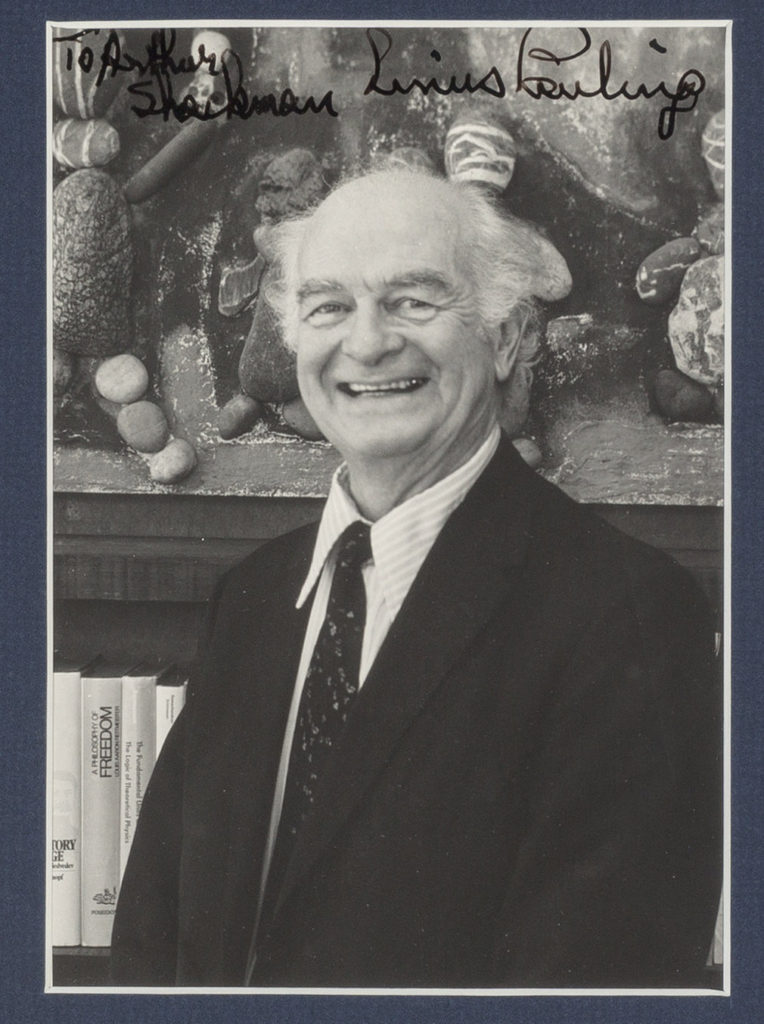
A lot that included Linus Pauling’s signature was offered in January 2017.

By Jim O’Neal

Serious writers about Albert Einstein almost invariably include two episodes in his life. The first is the year 1905, when he published four stunning scientific papers. The first explained how to measure molecules in a liquid; the second explained how to determine their movement. The third was a revolutionary concept that described how light rays come in packets called photons. The fourth merely changed the world!

A second highlight deals with a “fudge factor” Einstein (1879-1955) called a “cosmological constant,” whose only purpose was to cancel out the troublesome cumulative effects of gravity on his masterful general theory of relativity. He would later call it “the biggest blunder of my life.” Personally, I prefer a much more simplistic observation that perfectly captures his nonchalance. The poet Paul Valéry (1871-1945) once asked him if he had a notebook to keep track of all his ideas. A rather amused Einstein quickly replied, “Oh, no. That’s not necessary. It is very seldom I have one.”

History is replete with examples of people who had a good year. It was 1941 for Yankees great Joe DiMaggio when he hit in 56 consecutive games, and Babe Ruth’s 60 home runs in 1927. For Bobby Jones, it was 1930, when he won all four of golf’s major championships. Some people have good days, like Isaac Newton when he observed an apple falling from a tree and instantly conceptualized his theory of gravity.

Linus Pauling was different. His entire life was filled with curiosity, followed by extensive scientific research to understand the factors that had provoked him to wonder why. Pauling was born in 1901. His father died in 1910, leaving his mother to figure out how to support three children. Fortunately, a young school friend got an inexpensive chemistry set as a gift and that was enough to spark Pauling’s passion for research. He was barley 13, but the next 80 years were spent delving into the world of the unknown and finding important answers to civilization’s most complex issues.

He left high school without a diploma (two credits short that a teacher wouldn’t let him make up), but then heard about quantum mechanics and in 1926 won a Guggenheim Fellowship to study the subject under top physicists in Europe. (He was eventually given an honorary high school diploma … after he won his first Nobel Prize.) By the late 1920s and early 1930s, Pauling was busy cranking out a series of landmark scientific papers explaining the quantum-mechanical nature of chemical bonds that dazzled the scientific community.

Eventually, he returned to the California Institute of Technology (with his honorary high school diploma) to teach the best and brightest of that era. Robert Oppenheimer (of the Manhattan Project) unsuccessfully tried to recruit him to build the atomic bomb, but failed (presumably because he also tried to seduce Pauling’s wife). However, Pauling did work on numerous wartime military projects … explosives, rocket propellants and an armor-piercing shell. It’s a small example of how versatile he was. In 1948, President Truman awarded him a Presidential Medal for Merit.

In 1954, he won the Nobel Prize in Chemistry for his research on the chemical bond and its application to the elucidation of the structure of complex substances … which I shall not try to explain. And along the way, he became a passionate pacifist, joining the Emergency Committee of Atomic Scientists, chaired by Einstein, in an effort “to warn the people of the pending dangers of nuclear weapons.” His reward was to be called a communist; he had his passport revoked and his patriotism challenged, along with many others, in the dark days of McCarthyism.

In 1958, he petitioned the United Nations, calling for the cessation of nuclear weapons. In addition to his wife, it was signed by over 11,000 scientists from 50 countries. First ban the bomb, then ban nuclear testing, followed by a global treaty to end war, per se. He received a second Nobel Prize for Peace in 1963, but that was for trying to broker an early peace with Vietnam, making him one of only four people to win more than one prize, including Marie Curie in 1903 (physics) and 1911 (chemistry). His other awards are far too numerous to mention. As an aside, he died in one of my favorite places: Big Sur, Calif., at age 93.

Sadly, in later life, his reputation was damaged by his enthusiasm for alternative medicine. He championed the use of high-dose vitamin C as a defense against the common cold, a treatment that was subsequently shown to be ineffective (though there’s some evidence it may shorten the length of colds). I still take it and see scientific articles more frequently about the benefit of infused vitamin C being tested in several cancer trials.

If he were still working on it, let’s say the smart money would be on Pauling.

Intelligent Collector blogger JIM O’NEAL is an avid collector and history buff. He is president and CEO of Frito-Lay International [retired] and earlier served as chair and CEO of PepsiCo Restaurants International [KFC Pizza Hut and Taco Bell].
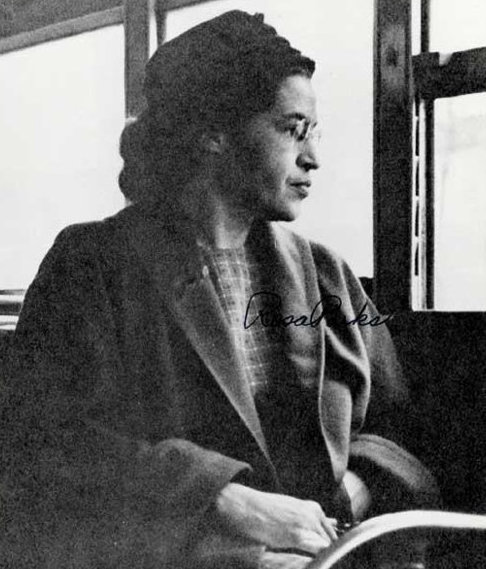
100 Years Before Rosa Parks, There was Octavius Catto

Rosa Parks refused to give up her seat on a segregated bus, sparking the Montgomery, Ala., bus boycott.

By Jim O’Neal

Most Americans are familiar with Rosa Parks and recall the heroic story of a weary black woman on her way home after a hard day at work who refused to give up her seat and “move to the back of the bus” to make room for white people. The date was Dec. 1, 1955, and the city was Montgomery, Ala.

Later, she would be arrested during the ensuing Montgomery bus boycott that lasted 381 days. She was fined $10, but ultimately vindicated by the U.S. Supreme Court, which ruled the segregation law was unconstitutional. After her death, she became the first African-American woman to have her likeness depicted in the National Statuary Hall in the U.S. Capitol.

Parks (1913-2005) earned her way into the pantheon of civil rights leaders, but few remember a remarkable man who preceded her by a century when streetcars were pulled by horses.

Catto

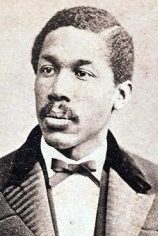
His name was Octavius Valentine Catto (1839-1871) and history was slow in recognizing his astonishing accomplishments. Even the epitaph on his tombstone shouts in bold letters “THE FORGOTTEN HERO.” One episode in his far-too-short but inspiring life is eerily similar to the events in Montgomery, only dramatically more so. Catto was a fierce enemy of the entire Philadelphia trolley car system, which banned black passengers. On May 18, 1865, The New York Times ran a story about an incident involving Catto that occurred the previous afternoon in Philadelphia, “The City of Brotherly Love” (at least for some).

Paraphrasing the story, it describes how a colored man (Catto) had refused all attempts to get him to leave a strictly segregated trolley car. Frustrated and in fear of being fined if he physically ejected him, the conductor cleverly side railed the car, detached the horses and left the defiant passenger in the now-empty stationary car. Apparently, the stubborn man was still on-board after spending the night. It caused a neighborhood sensation that led to even more people challenging the rules.

The following year, there was an important meeting with the Urban League to protest the forcible ejection of several black women from Philadelphia streetcars. The intrepid Catto presented a number of resolutions that highlighted the inequities in segregation, principles of freedom, civil liberty and a heavily biased judicial system. He also boldly solicited support from fellow citizens in his quest for fairness and justice.

He got specific help from Pennsylvania Congressman Thaddeus Stevens, a leader of the “Radical Republicans” who had a fiery passion for desegregation and abolition of slavery, and who criticized President Lincoln for lack of more forceful action. Stevens is a major character in Steven Spielberg’s 2013 Oscar-nominated film Lincoln, with Tommy Lee Jones gaining an Oscar nomination for his portrayal of Stevens. On Feb. 3, 1870, the 15th Amendment to the Constitution guaranteed suffrage to black men (women of all colors would have to wait another 50 years until 1920 to gain the right to vote in all states). It would also lead to Catto’s death. On Election Day, Oct. 10, 1871, Catto was out encouraging black men to vote for Republicans. He was fatally shot by white Democrats who wanted to suppress the black vote.

Blacks continued to vote heavily for Republicans until the early 20th century and were not even allowed to attend Democratic conventions until 1924. This was primarily due to the fact that Southern states had white governors who mostly discouraged equal rights and supported Jim Crow laws that were unfair to blacks. As comedian Dick Gregory (1932-2017) famously joked, he was at a white lunch counter where he was told, “We don’t serve colored people here,” and Gregory replied, “That’s all right. I don’t eat colored people … just bring me a whole fried chicken!”

Octavius Catto, who broke segregation on trolley cars and was an all-star second basemen long before Jackie Robinson, would have to wait until the 20th century to get the recognition he deserved. I suspect he would be surprised that we are still struggling to “start a national conversation” about race when that’s what he sacrificed his life for.

JIM O’NEAL is an avid collector and history buff. He is president and CEO of Frito-Lay International [retired] and earlier served as chair and CEO of PepsiCo Restaurants International [KFC Pizza Hut and Taco Bell].