America Will Never Forget Sacrifices of Heroic Men and Women

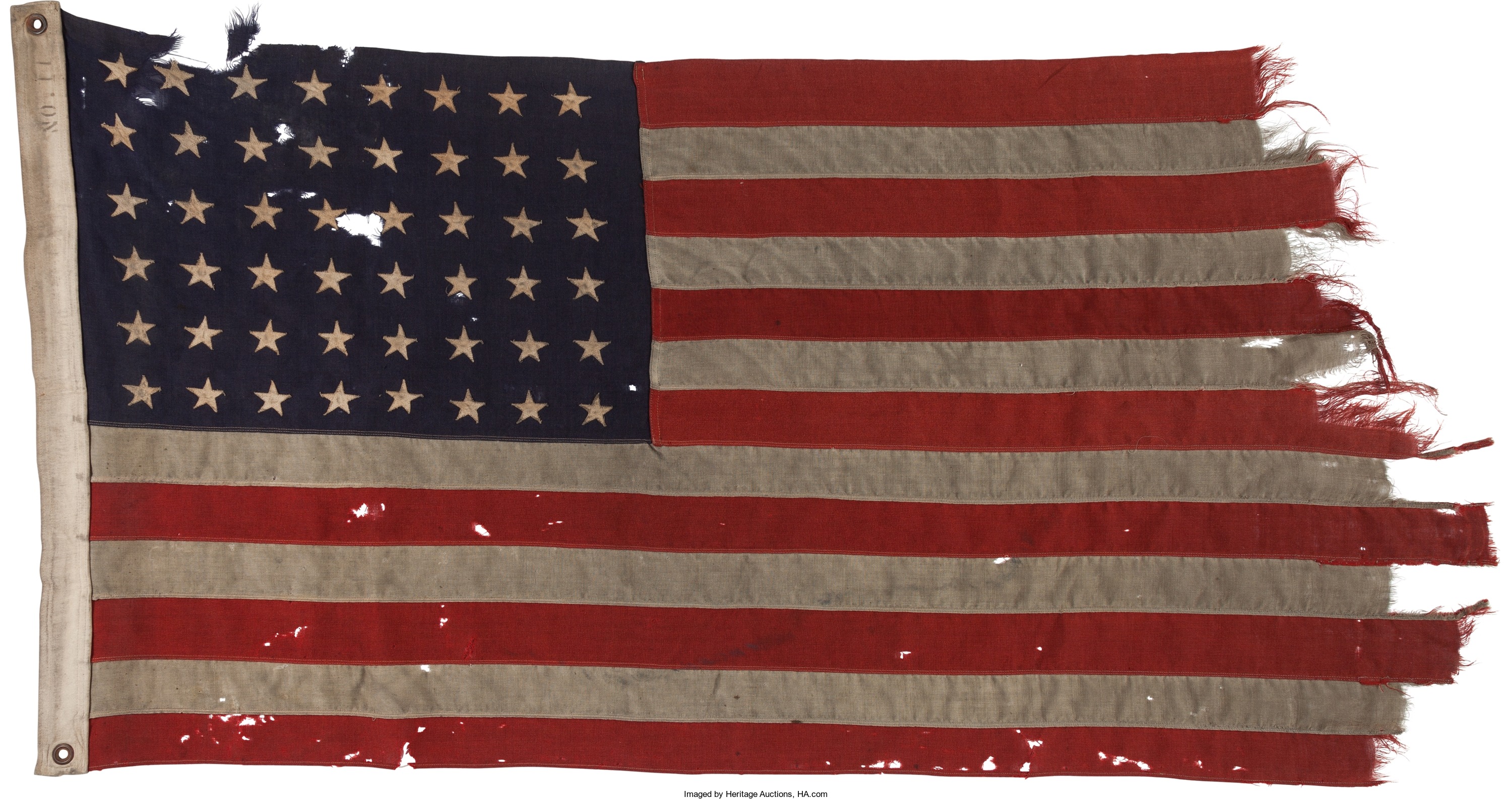
The flag that led the first American troops onto Utah Beach on D-Day, June 6, 1944, sold for $514,000 at a June 2016 Heritage auction.

“When it mattered most, an entire generation of Americans showed the finest qualities of our nation and of humanity. On this day, in their honor, we will raise the American flag over a monument that will stand as long as America itself.” – George W. Bush, May 29, 2004

By Jim O’Neal

Sixteen million Americans served during World War II. Twelve years ago, the National World War II Memorial, honoring their commitment and sacrifices, was dedicated in the nation’s capital. The event featured a four-day celebration with special museum exhibits and services in the National Cathedral.

Almost every feature and detail of the seven-acre memorial in the National Mall are symbolic. A ceremonial entrance is flanked by 24 bronze bas-relief sculpture that provide glimpses into the American experience and on the battlefield. Inside, the memorial is anchored by two pavilions – one proclaiming victory in the Atlantic Theatre, the other success in the Pacific. Fifty-six granite pillars represent the states, federal territories and District of Columbia.

The columns are linked with bronze ropes to reflect the nation’s unity during the war and adorned with two bronze wreaths, one of wheat, representing the United States’ agricultural strength, and one in oak, signifying the might of a nation.

The site also features the Freedom Wall, decorated with 4,048 gold stars, each representing 100 Americans who lost their lives during the war or who remain missing in action. Carved at the bottom are the words “Here we mark the price of freedom.”

Visitors can find hidden treasures in the site, including the famous “Kilroy was here” graffiti familiar to every WW2 veteran. Also carved into the memorial are these words from President Harry S. Truman: “Our debt to the heroic men and valiant women in the service of our country can never be repaid. They have earned our undying gratitude. America will never forget their sacrifices.”

Amen.
Jim O'NielIntelligent Collector blogger JIM O’NEAL is an avid collector and history buff. He is President and CEO of Frito-Lay International [retired] and earlier served as Chairman and CEO of PepsiCo Restaurants International [KFC Pizza Hut and Taco Bell].
Queen Victoria Found Creative, Complicated Ways to Mourn

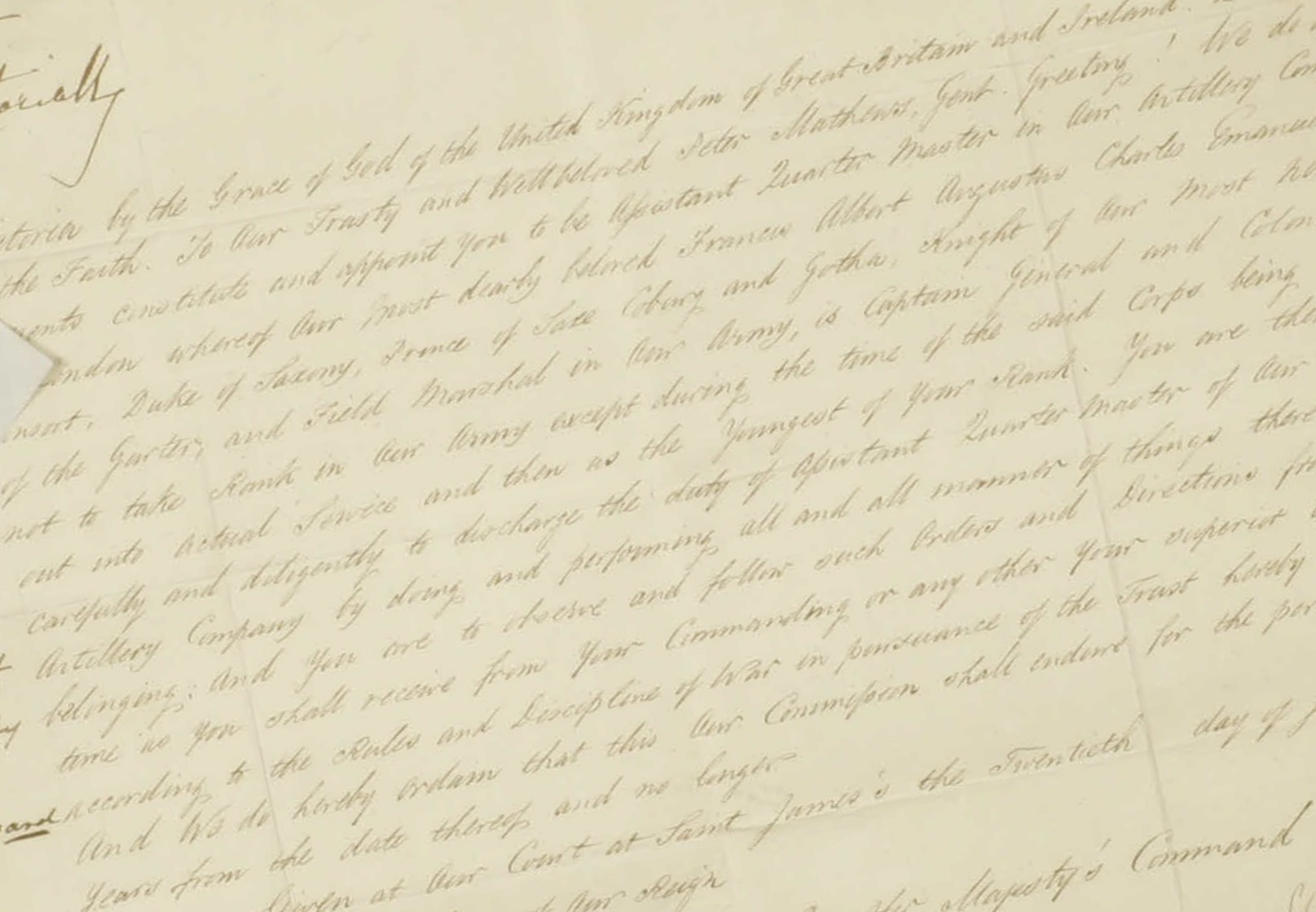
This Queen Victoria military commission document, signed “Victoria RI” and dated Jan. 20, 1860, references her beloved husband Prince Albert – a year before his death of typhoid fever.

By Jim O’Neal

A good friend of mine died recently and the family is naturally in a state of grief and making plans to include others in the mourning process. This is a custom that has undergone many changes over the centuries and is still evolving.

The “Masters of Mourning” surely must have been the Victorians. Rarely have groups of people become more fascinated by death or found so many creative and complicated ways to acknowledge it.

Society, in general, evolved strict mourning rules that were remarkably comprehensive. Every conceivable relationship had specific guidelines. One example was for an uncle by marriage. He was to be mourned for two months if his wife survived him, but only one month if he was a widower or unmarried.

This continued through the entire canon of relationships and, in a quirk, one needn’t have even met the people being mourned. If a woman’s husband had been married before and widowed, the second wife was expected to engage in “complementary mourning” – a type of proxy mourning on behalf of the deceased, earlier spouse.

Even mourning clothes were dependent upon the degree of one’s bereavement. Widows, already burdened by suffocating pounds of broadcloth, had to add black crepe, a type of crimped silk. Crepe was scratchy, noisy and maddeningly difficult to maintain. Even raindrops left whitish blotches and the crepe ran onto the skin underneath, where it was almost impossible to wash off. The amount of crepe was dictated by the passage of time. Just a glance could tell how long a woman had been widowed by the amount of crepe at each sleeve.

Then after two years, a widow moved into a phase of “half mourning” and the crepe could be gray or pale lavender.

Servants were required to mourn when their employers died and a period of national mourning was decreed when a monarch died.

Queen Victoria may have been the most prominent person to conjure up ingenious ways to mourn. Her beloved Prince Albert died in December 1861. Victoria decreed that the clocks in his bedroom be stopped at precisely the minute he died: 10:50 p.m. Then, in another odd ritual, the service to his room was continued as if he were merely on a trip.

A valet carefully laid out fresh clothing for him each day, in addition to hot water, soap and towels for his daily bath, and then removed at an appropriate time later in the day. Of course, his remains were actually interred in a mausoleum on the castle grounds.

Ironically, when Queen Victoria’s reign ended in 1901, after nearly 64 years, no one could agree on how much mourning was appropriate. It had been too long since the last one and there was no precedent for this length of time.

Since then, Queen Elizabeth II has eclipsed her as the longest-lived British monarch, and on Sept. 9, 2015, she became the longest-reigning monarch ever (as Prince Charles knows so well, as he yearns instead of mourns).

Jim O'NielIntelligent Collector blogger JIM O’NEAL is an avid collector and history buff. He is President and CEO of Frito-Lay International [retired] and earlier served as Chairman and CEO of PepsiCo Restaurants International [KFC Pizza Hut and Taco Bell].
Cleveland Believed Public Service was a Public Trust

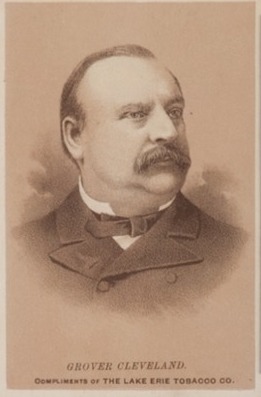
A rare set of Lake Erie “State Governors” cards, circa 1890s and including Grover Cleveland, sold for $11,352.50 at a May 2014 auction.

By Jim O’Neal

When Grover Cleveland was running for president in 1884, Joseph Pulitzer wrote an editorial endorsing him and listed four reasons for wanting him to be president. “One, he is an honest man. Two, he is an honest man. Three, he is an honest man. Four, he is honest.”

Cleveland had been mayor of Buffalo – a Democrat in a Republican city – and his name quickly became “The Veto Mayor.” Any bill that he thought was a raid on the public treasury was quickly vetoed. (He would later veto over 300 bills in his first year as president.)

In 1882, Democrats in New York were looking for someone to run for governor. Someone asked “Why not the mayor of Buffalo?” He was nominated and won in a landslide.

Teddy Roosevelt was then a member of the New York Assembly and formed an alliance with Governor Cleveland on legislation called the Five-Cent Fare Bill. It was intended to force transit companies in NYC to cut their 10-cent fares by 50 percent (this was before Uber). However, when Cleveland read the final bill, he decided it was a violation of the U.S. Constitution. He also firmly believed the state should not get involved in private contracts, so vetoville.

Everyone was stunned, including TR, but then he rethought his position and decided the governor was right. After helping get the veto upheld, TR “The Dude” and Cleveland “The Big One” found other areas of mutual cooperation. (It was an arcane political concept called bipartisan cooperation.)

President Cleveland’s favorite political phrase was “Public service is a public trust.” He believed an executive, whether governor or president, was exactly that – an executive officer whose job was to see that the organization was run efficiently and that shareholder (taxpayer) money was not wasted. He believed fervently that “The people support the government. The government does not support the people.”

A novel concept that JFK would recall more eloquently in 1961 as “Ask not …”

Jim O'NielIntelligent Collector blogger JIM O’NEAL is an avid collector and history buff. He is President and CEO of Frito-Lay International [retired] and earlier served as Chairman and CEO of PepsiCo Restaurants International [KFC Pizza Hut and Taco Bell].
Seventy-one Years Later, U.N. Still Ironing Out the Kinks

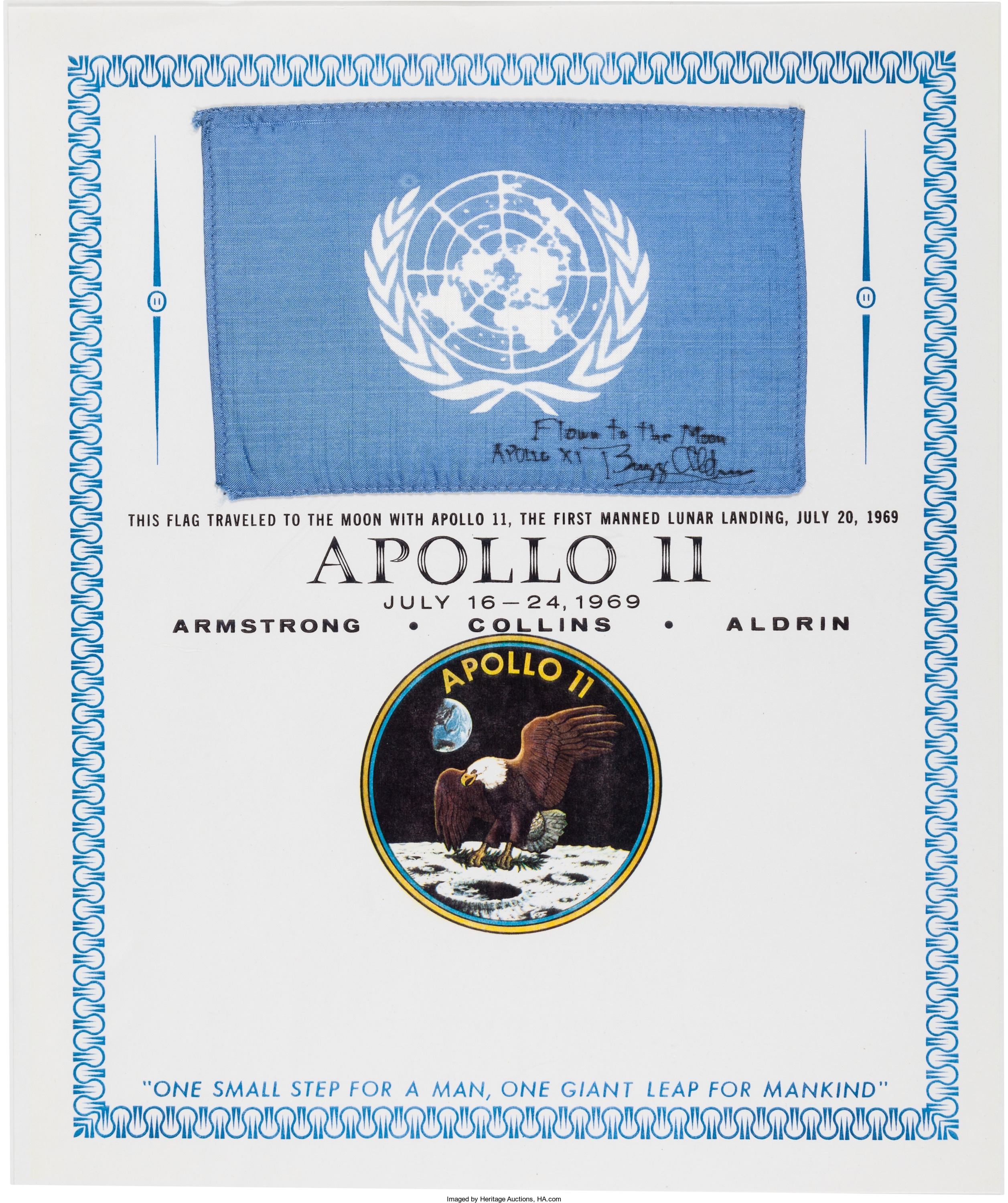
A United Nations flag flown aboard Apollo 11, from the personal collection of Buzz Aldrin, sold for $10,157.50 at an April 2013 Heritage auction.

By Jim O’Neal

After years of conflict, devastation and privation, there was a shared determination to avoid another World War. Gradually, this determination evolved into action. The seeds had been sown in August 1941 when President Franklin D. Roosevelt and British Prime Minister Winston Churchill issued the Atlantic Charter, a statement that listed their postwar goals for international security.

These goals appeared again in January 1942 when the 26 Allied nations signed the United Nations Declaration, which bound them to a common purpose of victory over the Axis powers. It also resolved to protect liberty and human rights and to respect the self-determination of all people.

In April 1945, with the end of the war in sight, representatives of 50 nations met in San Francisco to write a charter for the new organization. The charter established the mission of the United Nations: to prevent war; to affirm fundamental human rights; to facilitate international peace and security; to promote improved living standards; and to support social progress and economic advancements.

Disagreements based on national interests plagued the discussions at the April conference, but they did not prevent the formation of the United Nations. On June 25, the delegates unanimously adopted the charter and the next day they all signed the document. The United Nations was officially established on Oct. 24, 1945.

The world had entered a new period of international collaboration … “to save succeeding generations from the scourge of war … to reaffirm faith in fundamental human rights.”

Seventy-one years later, they are still trying to get some of the kinks worked out.

Jim O'NielIntelligent Collector blogger JIM O’NEAL is an avid collector and history buff. He is President and CEO of Frito-Lay International [retired] and earlier served as Chairman and CEO of PepsiCo Restaurants International [KFC Pizza Hut and Taco Bell].
Lincoln Family Saw Great Success, But Also Seemed Cursed

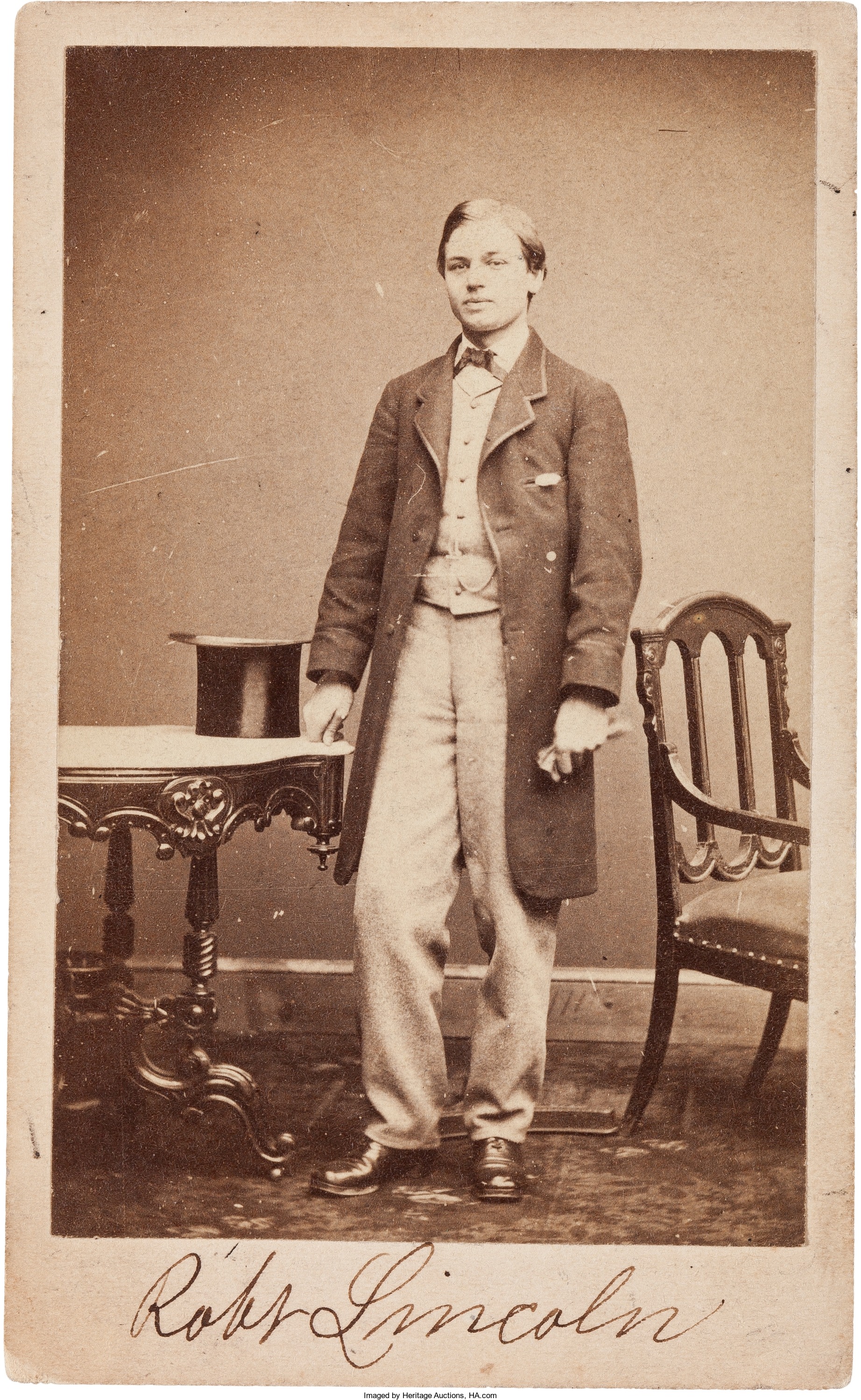
This Robert Todd Lincoln carte de visite dates to 1861, when he was 18 years old.

By Jim O’Neal

Many historians cling to the belief that Robert Todd Lincoln was the most successful of all presidential children, including those who also became president. He was one of the best businessmen of his generation, a powerful and celebrated figure in society and a public servant. He was a cabinet member in two different administrations and a superb diplomat in another.

He was also present at many famous events.

As a late entrant into the Civil War, he was a member of Major General U.S. Grant’s personal staff and was there when Robert E. Lee surrendered at the McLean House near Appomattox. He actually witnessed the formal signing. Three months later, he was at his father’s side when he died and then accompanied his mother back to the White House. She was too bereaved to attend the funeral or to accompany the body back to Springfield.

Robert performed both of these tasks with poise and dignity. Later, he would be close by when both presidents James A. Garfield and William McKinley were assassinated.

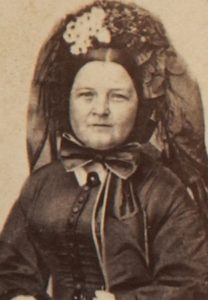
But the Lincoln family almost seemed cursed. Mary Todd Lincoln grew more erratic and confused. In the spring of 1875, distraught and humiliated by her behavior, Robert Lincoln decided to have his mother committed to an insane asylum. He had her followed by Pinkerton agency detectives to record her activities, enlisted six of Chicago’s finest doctors to testify (none of whom examined her), hired her an attorney, and then conspired with the prosecutor to ensure a consistent story for the court.

After her husband’s assassination, Mary Todd Lincoln returned to Illinois, where she lived with her sons.

On May 9, 1875, Mary Lincoln was taken to a public courtroom where she was confronted by this cabal. Her attorney cross-examined no witnesses and called none of his own, including Mary Lincoln. The final witness was Robert Lincoln, who provided the coup de grace. “I have no doubt my mother is insane. She has been a source of great anxiety to me.”

The only example of Mary Lincoln’s sanity occurred when she devised a clever scheme to get a release from the Bellevue asylum in Batavia, Ill., where she had been confined. She then made it to her sister’s house in Springfield and then on to Europe, fearful that Robert would strike again.

Mary Todd Lincoln spent her final years in anonymity and loneliness in the trendy resort village of Pau, France, near the Spanish border. Referring to Robert, her only remaining son, as a “wicked monster,” she insisted in her letters that even his father had always disliked him. Dismissed by the public as “crazy,” she subsisted for many years as an exile in a foreign country, relying on her presidential widow’s pension and fluent French.

Finally, in 1882, Mrs. Abraham Lincoln returned home to Springfield, but even her death was not an easy affair. At the end, she was covered with boils, almost completely paralyzed and blind. She died on July 16, 1882, after a severe stroke. She was 63 years old.

An autopsy revealed a cerebral disease she had for years and her entire estate was inherited by her surviving son, the “wicked monster” Robert Todd Lincoln.

Historians have a wide array of criteria to judge greatness. Obviously, family harmony is not one of them.

Jim O'NielIntelligent Collector blogger JIM O’NEAL is an avid collector and history buff. He is President and CEO of Frito-Lay International [retired] and earlier served as Chairman and CEO of PepsiCo Restaurants International [KFC Pizza Hut and Taco Bell].
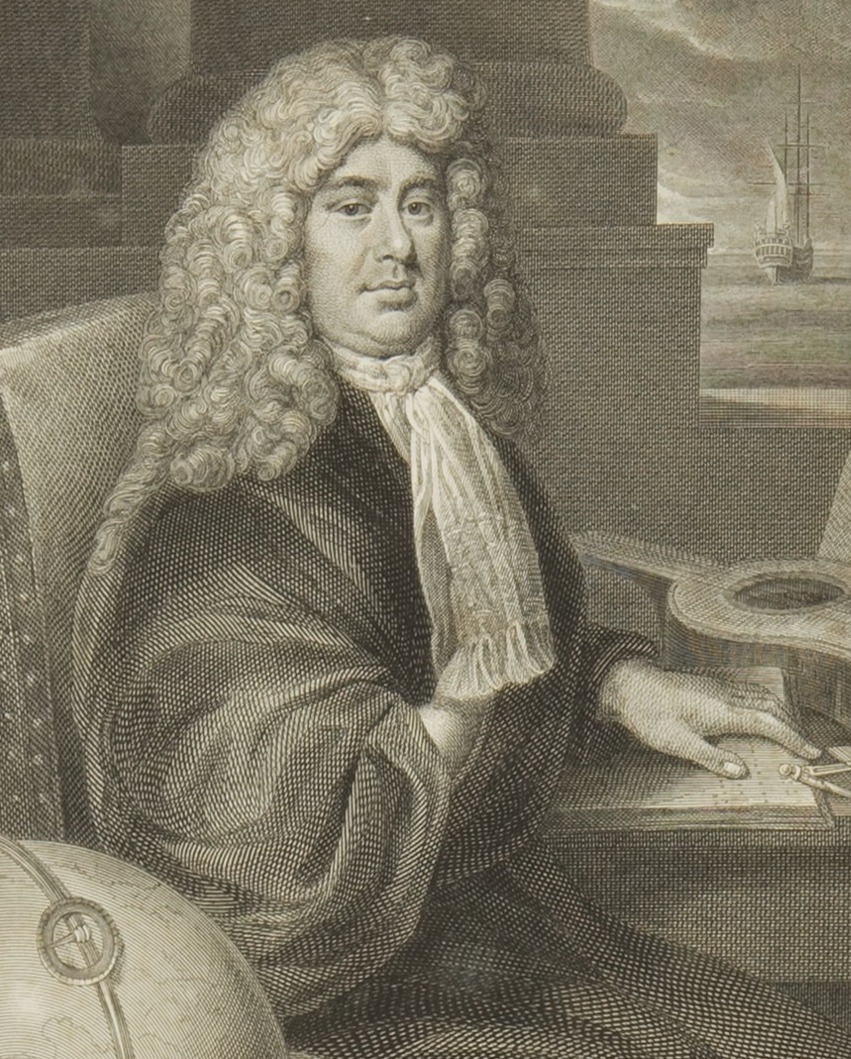
It’s a Long Journey From Sensible Footwear to Curly Wigs for Men

English naval administrator Samuel Pepys (1633-1703) initially scoffed at the idea of wigs for men – but ultimately came around.

By Jim O’Neal

In September 1991, two German hikers were on a glacier in the Italian Alps when they spotted a body protruding from the ice. It was an unusual discovery since glaciers tend to grind up everything in their path. But this body was protected from contact and oxygen (saponification) and the flesh transmuted into a waxy substance called adipocere, similar to soap.

Radiocarbon dating confirmed the body (a male) was 5,000 years old and in this degree of preservation, anthropologists literally had a time-traveler body to study, along with his possessions. His “shoes” were of interest since they were less slippery on ice, less likely to cause blisters and more protective against cold than modern footwear.

At some later time, humans became more concerned about fashion than function. Many times they chose style or pricey alternatives over utility. That is even more true today as we strive to exaggerate our status in curious ways.

Some of the more amusing examples include the magnificent collar ruffs known as piccadills in the 16th century. As they grew larger and larger, they made eating more impossible and necessitated the fashioning of special long-handled spoons so diners could get food to their lips.

When buttons arrived in 1650, people could not get enough of them as they were arrayed in decorative profusion on the backs, collars and sleeves of coats. Relics of this are the pointless buttons on jacket sleeves near the cuff. (While in London, I had bespoke suits made on Savile Row and the tailor was adamant that four buttons and button holes on each sleeve was de rigueur.)

But perhaps the most egregious example was the 150 years of men wearing wigs. Old faithful Samuel Pepys duly recorded his initial apprehension, but then was proud of being in the vanguard of men’s fashion, despite worrying about the plague if human hair was used. In addition to being hot, scratchy and uncomfortable, wigs required weekly maintenance. They were sent to have their buckles (French bouclés, meaning curls) reshaped on heated rollers and possibly baked in an oven (fluxing).

This evolved into a daily snowfall of white powder, primarily from simple flour, and then into colors, followed by scenting and even multi-colors.

When the wheat harvest failed in France in the 1770s, there were riots when starving people learned that flour was being diverted to wigs instead of baked into bread. “Let them eat …?”

And then suddenly wigs went out of style faster than belted polyester suits in the 1970s. Wigmakers petitioned George III to make wig-wearing by men mandatory. The king refused, so it must have been on one of the days he was not “mad” in the literal sense.

Women continued to wear even more extravagant wigs and added elaborate artificial moles (mouches). I predict that someday, high-heeled shoes will join the corset, but it will not be before the craze for collector purses, stored in air-conditioned cubicles, subsides or Jimmy Choo starts discounting to match Amazon.

Jim O'NielIntelligent Collector blogger JIM O’NEAL is an avid collector and history buff. He is President and CEO of Frito-Lay International [retired] and earlier served as Chairman and CEO of PepsiCo Restaurants International [KFC Pizza Hut and Taco Bell].
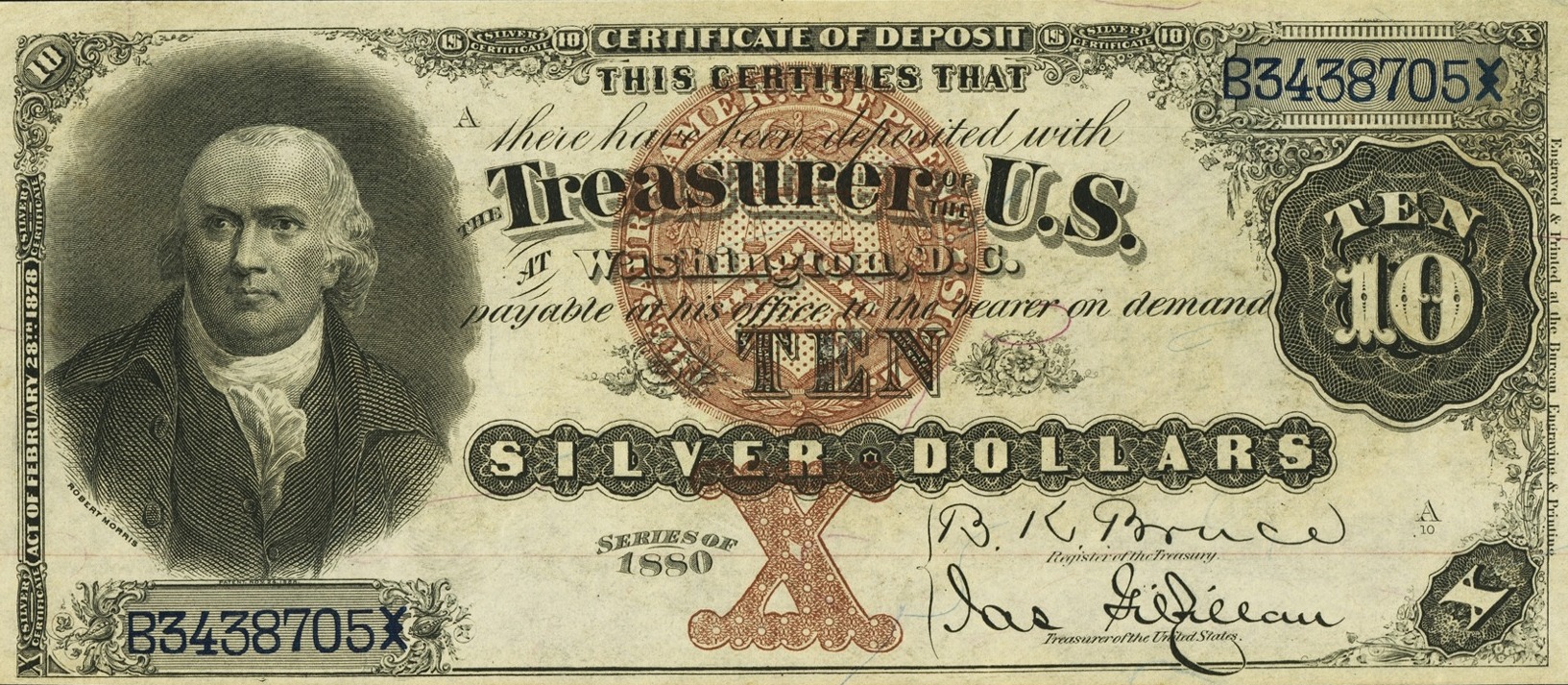
Robert Morris the Financier who was Almost Alexander Hamilton

This Fr. 288 $10 1880 Silver Certificate, PCGS Choice New 63PPQ, featuring Robert Morris realized $19,975 at a January 2014 auction.

By Jim O’Neal

During the Revolutionary War, one of the more frustrating issues facing General George Washington and his officers was the inconsistent supply of guns, ammunition and basics like shoes, coats, uniforms and food. Then, of course, there was the issue of money to pay the troops.

The Continental Congress struggled to perform the basic functions of a “treasury,” but without the power to tax, they had to rely on loans from foreign governments and domestic support (less than 50 percent of the people were in favor of war). Their FICO scores were low and the paper money printed was “Not worth a Continental!”

By 1781, the United States was in a fiscal crisis. The national debt was $25 million, public credit markets had collapsed and the British were firmly in control of the sea and coastline. Congress decided to act by abandoning their ineffectual committees in favor of an executive structure.

Robert Morris was unanimously elected Superintendent of Finance.

Morris was truly one of the Founding Fathers and was one of two men (Roger Sherman) to have signed the Declaration of Independence, Articles of Confederation, and the U.S. Constitution. Next to George Washington, he was considered the “most powerful man in America” and used his personal fortune to shore up the country’s finances.

Later, caught in the Panic of 1796-97, Morris was cast into debtors’ prison after he speculated on millions of acres of land and could not pay taxes or interest on his leveraged loans. The financial wizard of the Revolution was cast into debtors’ prison for three years until Congress passed a special bankruptcy law in 1800, primarily to free him.

The Department of Treasury was established by an Act of Congress in 1789. When George Washington decided to add a Treasury Secretary to his cabinet, his first choice was Robert Morris. However, Morris convinced him to pick Alexander Hamilton, despite his polarizing personality.

It is interesting to speculate whether biographer Ron Chernow and composer Lin-Manuel Miranda would be the spectacular toasts of Broadway with a character named “Morris.”

P.S. The bust of Robert Morris is featured prominently on the $10 Silver Certificate and the ultra-rare $1,000 Legal Tender note of 1863. There are only two or three in existence and the only one I’ve seen was in the Frank Levitan Collection auction in 1998. I suspect it would bring several million dollars in today’s market. It is a beautiful design.

Jim O'NielIntelligent Collector blogger JIM O’NEAL is an avid collector and history buff. He is President and CEO of Frito-Lay International [retired] and earlier served as Chairman and CEO of PepsiCo Restaurants International [KFC Pizza Hut and Taco Bell].
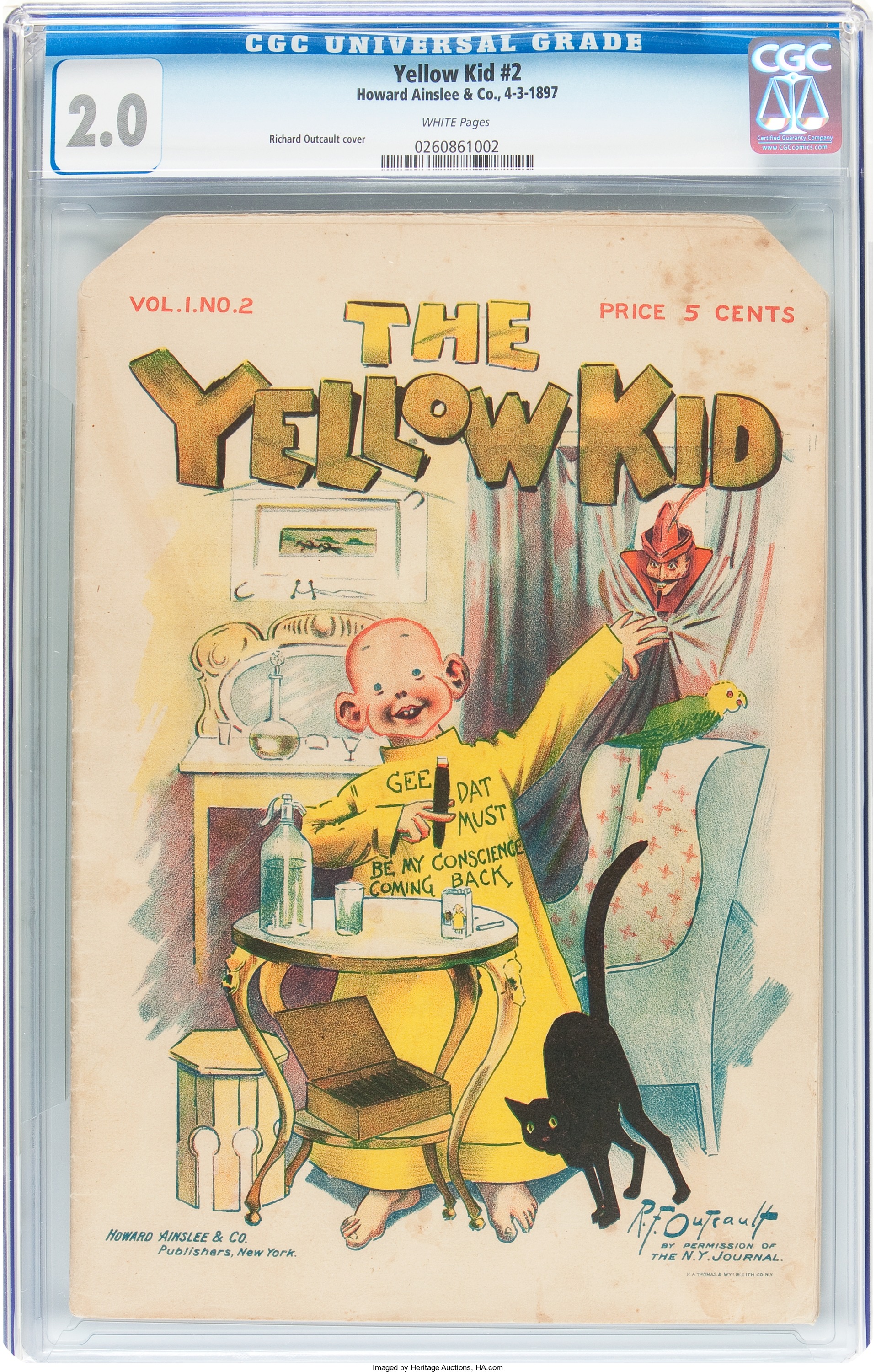
Hearst Built an Empire that Included Newspapers, Magazines, Comics

A rare nine-issue, complete run of Richard Outcault’s The Yellow Kid humor magazine, 1897, sold for $20,315 at an August 2015 Heritage auction.

By Jim O’Neal

The first multi-page newspaper published in the British North American colonies was Publick Occurrences Both Forreign and Domestick, printed on Sept. 25, 1690 in Boston. After a single issue, it was suppressed because it was unlicensed and criticized public policy. The British tried to find and destroy every copy, but one is believed to be in the British Library.

Two centuries later, the newspaper industry was thriving. The 1880 census recorded 11,314 different papers and soon, the first circulations of a million copies were recorded. One of them was the New York Journal, which William Randolph Hearst purchased to have a presence in this important market. His first newspaper was The San Francisco Examiner, courtesy of his wealthy father.

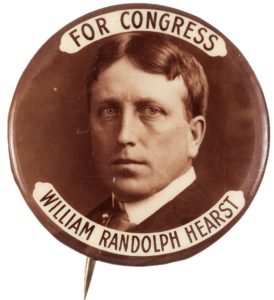
William Randolph Hearst (1863-1951) became a powerful figure as he built a communications empire that included newspapers, magazines, radio stations and motion picture syndicates. He influenced both domestic and foreign policy and believed he had pressured the United States to free the Cuban people from Spanish colonization via the Spanish-American War. At one point, he owned eight newspapers in five of the largest cities, with a combined circulation of 3 million. Ultimately, this would grow to 28 newspapers.

In New York City, he enticed cartoonist Richard Outcault to join the New York Journal and this triggered a war with Joseph Pulitzer and his New York World. Outcault’s The Yellow Kid comic fueled a daily war of words as both newspapers featured bold headlines, fake stories and salacious comments about prominent individuals. Perhaps if the strip had been printed using purple ink, we may have adopted “purple journalism” as the pejorative for sleazy stories.

Hearst’s political career included two stints in the House of Representatives and failed bids for both senator and governor of New York. No doubt a run for the White House would have followed if he had been successful.

Hearst was elected to Congress in 1902 and 1904.

WRH also had an insatiable appetite to acquire. It extended to art objects, mansions and women. He owned at least eight houses, each stocked with priceless antiques and works of art. There were also warehouses filled with acquisitions from Europe. His favorite was Hearst Castle in San Simeon, just north of Santa Barbara, where he hosted parties with Hollywood stars and other important people. It is now an official U.S. National Historic Landmark.

Orson Welles’ movie Citizen Kane is a thinly veiled parody/drama of Hearst, his castle and other aspects of his life. Hearst had so much power he was able to drive it into a box-office failure and relative obscurity for over 20 years. However, by 1998, the American Film Institute ranked it No. 1 on the list of greatest movies … ever.

Hearst Castle is now a popular tourist attraction and open for paid tours all year. George Bernard Shaw once commented, “San Simeon was the place God would have built … if he had the money.”

Jim O'NielIntelligent Collector blogger JIM O’NEAL is an avid collector and history buff. He is President and CEO of Frito-Lay International [retired] and earlier served as Chairman and CEO of PepsiCo Restaurants International [KFC Pizza Hut and Taco Bell].
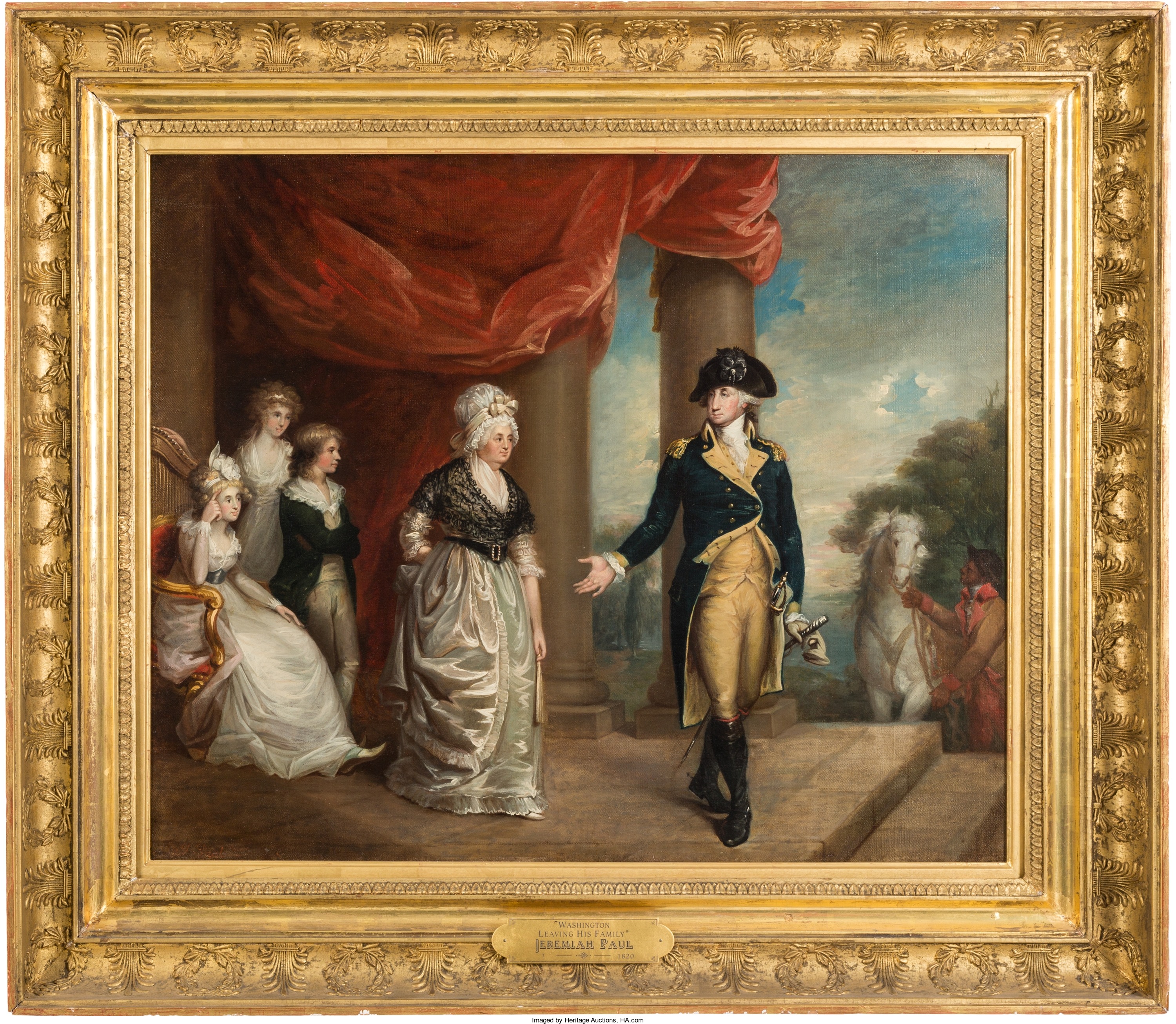
Today’s Political Schisms Would Not Surprise George Washington

A painting by Jeremiah Paul Jr. (d. 1820) depicting George Washington taking leave of his family as he assumes command of U.S. forces during the “quasi-war” with France in 1798, realized $47,500 at a May 2015 Heritage auction.

By Jim O’Neal

George Washington was a staunch opponent of political parties due to the corrosive effect he (strongly) believed they would have on all levels of government.

As president, Washington worked hard to maintain a non-partisan political agenda, despite significant differences that existed right in his cabinet.

His 1796 farewell address was replete with advice to the country, and by extension, to future leaders. One prominent warning was to avoid the formation of political factions that would pose a danger to the effectiveness of government (think gridlock in Washington, D.C.). A second peril was entanglements with foreign governments, since they inevitably lead to war. The examples here start with the War of 1812, two World Wars, Korea, Vietnam and end with the Russian threats to NATO, the China Sea and the remarkably complex situation in the Middle East and North Korea.

After Washington’s retirement, John Adams and Alexander Hamilton ignored his sage advice and wasted little time confronting the Democratic-Republicans, headed by Thomas Jefferson and James Madison. Adams became the first (and last) Federalist president. He was easily defeated in 1800, after one term, by Jefferson and Aaron Burr. Adams finished a dismal third and the Federalists gradually faded into irrelevance.

The Democratic-Republicans put together a nice run of three Virginia presidents – Jefferson, Madison and James Monroe – however, the party lacked a strong center and split four ways. Next was an alliance between John Quincy Adams and Henry Clay of the National Republican Party, which only won a single election in 1824 that required the House to settle. When Andrew Jackson defeated Clay in 1832, the party was absorbed into the Whigs … a diverse group of anti-Jackson politicos.

Then the Whig Party fell apart in the 1850s over the issue of the expansion of slavery in the new territories. In fact, after the 1854 election, the largest party in the House of Representatives was the Opposition Party, with 100 members, followed by 83 Democrats and 51 American Party members (the Know Nothings).

These parties never seem to last long (thankfully).

Next it was the New Republican Party’s turn (the Party of Lincoln) until another major kerfuffle occurred in 1912 when Teddy Roosevelt and President William Howard Taft managed to divide the Republican Party enough to let Democrat Woodrow Wilson win the White House … until he had a stroke and his wife took over.

A century later, we appear to be in another political schism, with a socialist, Senator Bernie Sanders, on the Democrat Party side and on the other, Donald “The Wall” Trump, who claims to have part of the Republican Party supporting him. It is not clear which part.

Only one thing seems certain. Thanks to President Washington, we were warned!

P.S. As history teaches … this too shall pass.

Jim O'NielIntelligent Collector blogger JIM O’NEAL is an avid collector and history buff. He is President and CEO of Frito-Lay International [retired] and earlier served as Chairman and CEO of PepsiCo Restaurants International [KFC Pizza Hut and Taco Bell].
We Should Let Geniuses Do What Geniuses Do

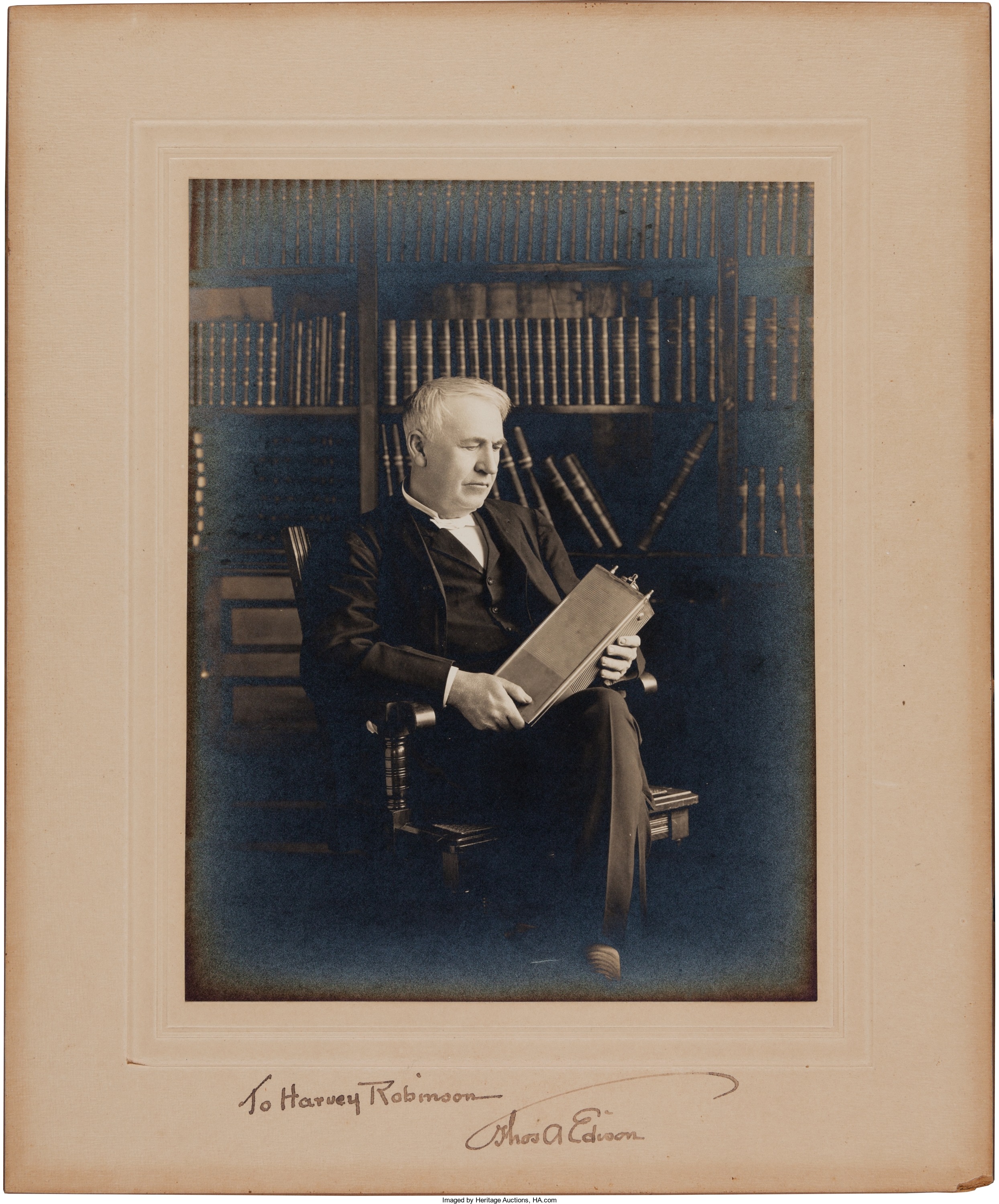
This signed photograph of Thomas Alva Edison, taken sometime around 1910, realized nearly $3,900 at an April 2013 Heritage auction.

By Jim O’Neal

Thomas Alva Edison was awarded about 1,100 patents in the United States and more than double that worldwide.

They are generally grouped into categories that include electric power, telegraphy/telephony, recorded sounds, batteries, cement and motion pictures. His practice of keeping meticulous records to protect his intellectual property became the “gold standard” for future scientists, engineers and inventors in general.

Naturally, he made a lot of money, which proved useful when some of his ideas turned out to be expensive commercial failures. At times, he appeared to lack practical sense or perhaps he lacked the “Steve Jobs gene” when it involved customer preference. Another more plausible explanation is that he simply did not care, period.

One of the more interesting examples is his refusal to adopt the concept of movie theaters (people might sneak in without paying), so he held out for hand-crank, peep-show boxes. In 1908, he confidently predicted that airplanes had no viable future (the Wright brothers disagreed).

Then he became mesmerized by the possibilities for concrete and formed the Edison Portland Cement Company and built a huge factory. By 1907, Edison was the fifth-largest cement producer in the world and had four dozen patents to make a better cement, some of which was used to build Yankee Stadium.

But his abiding passion was to fill the world with cement houses.

The concept was to pour concrete into giant molds to form walls and floors, followed by baths, sinks, cabinets, toilets and even picture frames. A four-man team could build a new house every two days for $1,200 (one-third the cost of traditional structures).

The concept was scheduled to be showcased at a cement industry convention in 1912 in New York. However, when the show opened, the Edison exhibit was empty and Thomas Edison never discussed the issue publicly. There was also no word on the fate of the cement piano that was scheduled to be exhibited.

He was now interested in modernizing war and casually predicted he would be able to induce comas in enemy troops through the use of “electrically charged atomizers.” It is not clear how this idea was abandoned. He also worked on a plan to build giant electromagnets to catch enemy bullets in flight and then “return to sender.” It was another mysterious project that was abandoned.

One last example was a heavy investment in an automated general store where customers would insert coins into slots and then bags of coal, onions, nails or potatoes would come sliding down the chute. The system never worked. It never came close to working.

If you believe in reincarnation, then there is a good chance Thomas Edison is back. This time his name is Jeff Bezos, who had a nutty idea about selling books over the internet and now owns a major print newspaper and is in a race to conquer outer space, since NASA has scaled back. Elon Musk has managed to find time to enter the rocket business, too, while he tinkers with electric cars and batteries.

Our country seems to be blessed when it comes to producing geniuses. Let’s hope the government doesn’t put up too many regulations or red tape as we go hurtling into the future.

Jim O'NielIntelligent Collector blogger JIM O’NEAL is an avid collector and history buff. He is President and CEO of Frito-Lay International [retired] and earlier served as Chairman and CEO of PepsiCo Restaurants International [KFC Pizza Hut and Taco Bell].