As Civil War Loomed, Buchanan Failed to Act, Assumed the Worst

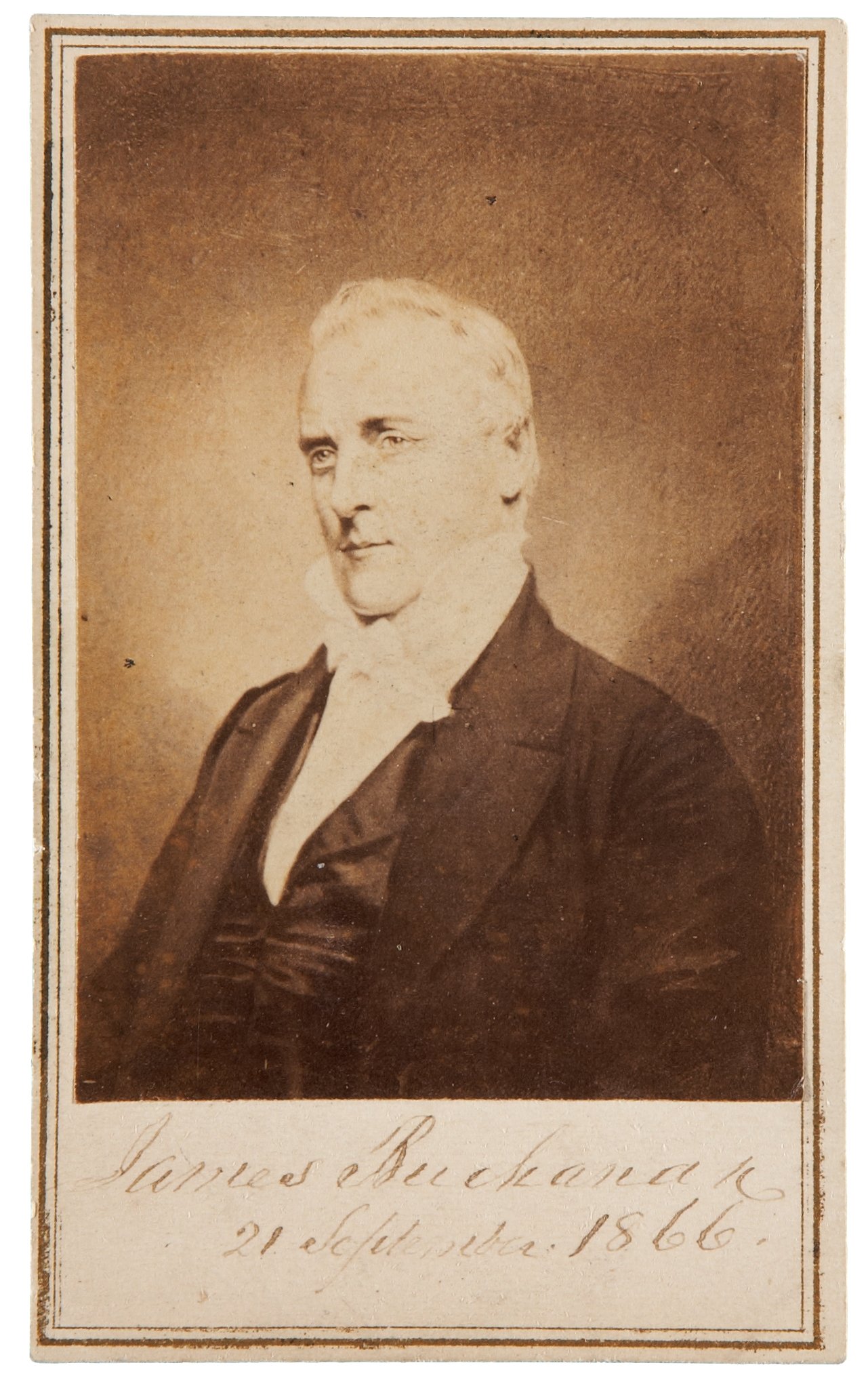
James Buchanan Carte de Visite Signed
This James Buchanan carte de visite, signed and dated September 1866, sold for $6,572.50 at a February 2010 Heritage auction.

By Jim O’Neal

James Buchanan was elected to the U.S. Senate in 1834 and represented Pennsylvania for 11 years during the administrations of presidents Jackson, Van Buren, Harrison and Tyler. He turned down offers to serve as U.S. attorney general for Van Buren and an appointment to the Supreme Court by Tyler. After campaigning for Polk in the election of 1844, he finally accepted the position of secretary of state, since it seemed like a clear path to the presidency.

This was a bad decision and when he and President Polk could not agree on major issues, Buchanan would complain to a friend, “My life is that of a galley slave.”

Buchanan then failed to win the Democratic nomination in 1848 and 1852, but at the age of 62, was given the post of U.S. Minister to Great Britain. There, he gained unexpected notoriety when he secretly joined with other ministers (Pierre Soulé in Spain and John Mason in France) to draft the infamous “Ostend Manifesto,” which proposed to buy Cuba from Spain. If Spain refused, then “we shall be justified in wresting” the island from its owners … a strong inference of war.

Cuba was especially important to Southern Democrats since it was primarily a plantation-slave economy based on sugar and having it as a state would add two senators and nine members to the House of Representatives. However, anti-slave Northerners were not about to go to war with Spain to add more slave states to the Union and the effort was easily defeated.

At the Democratic National Convention in Cincinnati in June 1856, Buchanan bounced back, winning the nomination and then the election.

Two days after Buchanan was sworn in as president, the Supreme Court handed down the Dred Scott decision, which affirmed the right of slave owners to take their slaves into Western territories. This bolstered Buchanan’s belief that slavery was rooted in the Constitution and could not be legislated out of existence; it was an issue for each state to decide.

Then came the Panic of 1857, which was caused by the failure of Ohio Life Insurance Company of Cincinnati. The sudden demise of a once-solid institution touched off a wave of bank runs across the nation that plunged the nation into a deep economic depression. Many railroads failed due to over-expansion as did many state banks that were operating under flimsy regulations. The only areas that were unaffected were the cotton-growers exporting to England (and they needed more slaves to expand production).

It was clear that the slavery issue would lead directly to a civil war and James Buchanan was too inept or unwilling to provide leadership to avoid one. He just assumed the worst and declared that he “would be the last president of a United States.”

Fortunately, he was wrong, but it would take four long years and 620,000 dead Americans to prevent it.
Jim O'NielIntelligent Collector blogger JIM O’NEAL is an avid collector and history buff. He is President and CEO of Frito-Lay International [retired] and earlier served as Chairman and CEO of PepsiCo Restaurants International [KFC Pizza Hut and Taco Bell].
Van Buren’s ‘Palatial’ White House Not Popular with Voters

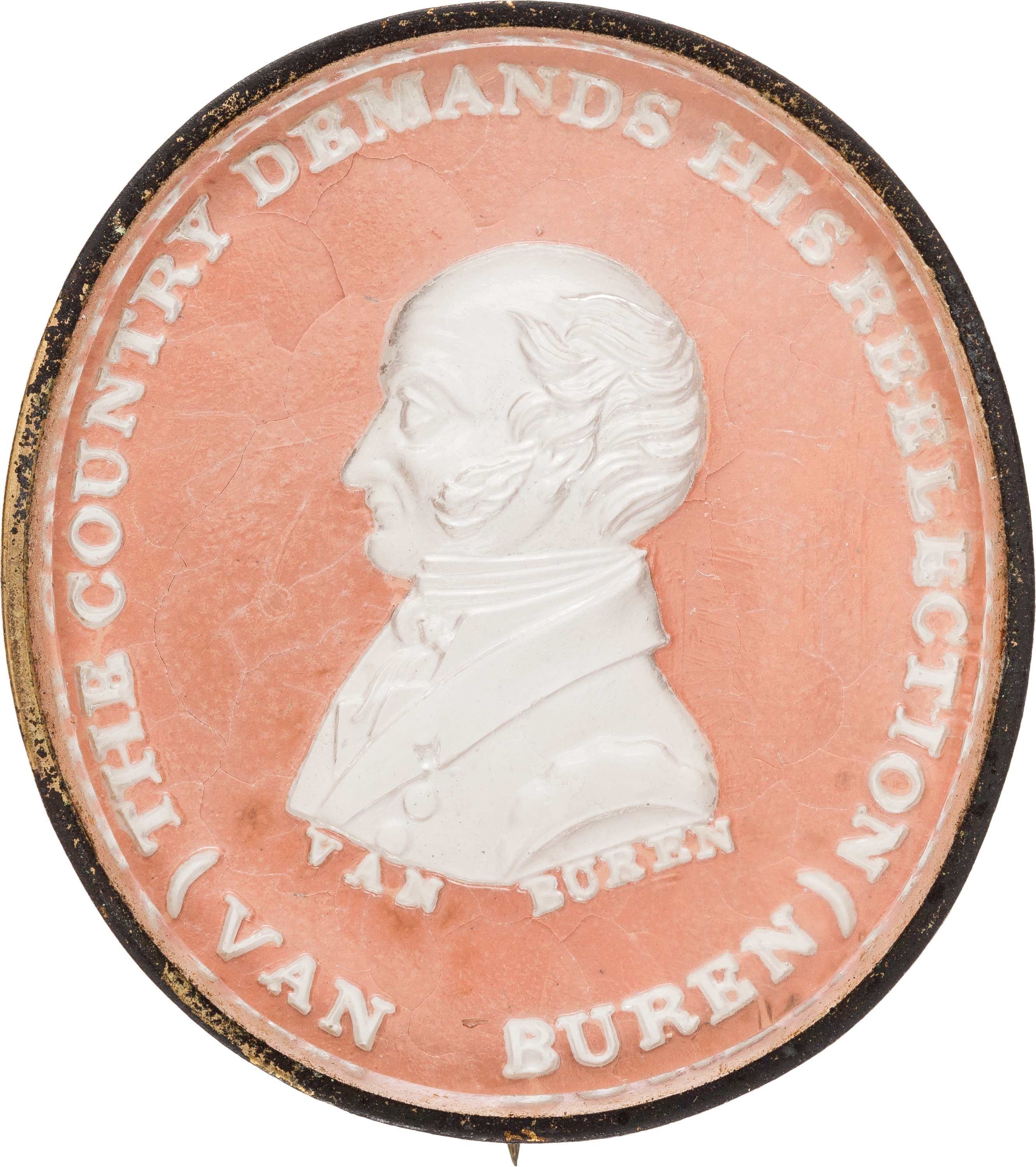
martin-van-buren-large-oval-sulfide-brooch
This Martin Van Buren oval sulfide brooch with the slogan “The Country Demands his Re-election,” sold for $12,500 at a September 2015 Heritage auction.

By Jim O’Neal

Martin Van Buren achieved the unique distinction of holding the offices of state senator and attorney general of New York, U.S. senator, governor of New York, U.S. secretary of state, vice president and then president.

However, he was never able to win popular support for himself or his policies at the national level.

The nation’s first major economic depression, the Panic of 1837, was undoubtedly the primary cause for undermining his popularity, although he was not responsible for the causation. Nearly a century later, another president, Herbert Hoover, would suffer nearly the same unfortunate fate.

Van Buren was the first president to be born an American citizen (1782) and he became adroit at behind-the-scenes political maneuvers. Yet, the general impression of him was that he was snobbish, autocratic and a conniver (“The Fox”). Van Buren became an obvious target for the poison darts of the Whigs as they characterized him as the antithesis of Andrew Jackson’s common-man philosophy.

Van Buren did little to combat criticism of this kind and in some respects even seemed to encourage it in his use of the White House. Adverse comments on the high style of living and aristocratic pretension in the WH increased each year of his presidency. By 1840, newspaper slurs on Van Buren as a princely pretender escalated and the continuing agony of the Panic made good copy in the Whig press.

On the afternoon of April 14, 1840, the House of Representatives sat as a committee to hear a prepared address by Charles Ogle, a Whig from Somerset, Pa., on the subject of President Van Buren and his “palatial” White House. One of the president’s supporters refuted the allegation, but then Ogle unleashed a dramatic rebuttal. This time he kept the house floor for three days and by the second day, the galleries were packed with spectators. This highly unusual attack made Ogle famous and printed copies of his remarks were circulated, first around the Capitol and then nationally by most newspapers. It was a devastating indictment of a president.

Martin Van Buren was too seasoned a politician to lose his temper, but his detachment from the storm of protest against him by the Whigs surprised even his closest friends.

When it came time for the 1840 election, the Whigs took a cue from the Jacksonians of 1828 and drafted a common-man hero – General William Henry Harrison. By then, sentiment had turned against Van Buren and he was defeated. A record number of citizens voted, 2.5 million, with Van Buren losing by 150,000. In the Electoral College, it was worse, with Harrison capturing 19 of the 26 states.

For all the bitterness of the campaign, Van Buren was determined not to be a poor loser. He not only witnessed Harrison’s oath-taking, but was among the first to shake his hand. The “Little Magician” offered every courtesy, gaining the admiration of a skeptical press. He left Washington by train. However, it was not his intention to be gone forever. He would try to regain the presidency in the next two elections.

Despite his efforts, he would never live in the White House again.

Jim O'NielIntelligent Collector blogger JIM O’NEAL is an avid collector and history buff. He is President and CEO of Frito-Lay International [retired] and earlier served as Chairman and CEO of PepsiCo Restaurants International [KFC Pizza Hut and Taco Bell].
Zachary Taylor was First President Elected With No Political Experience

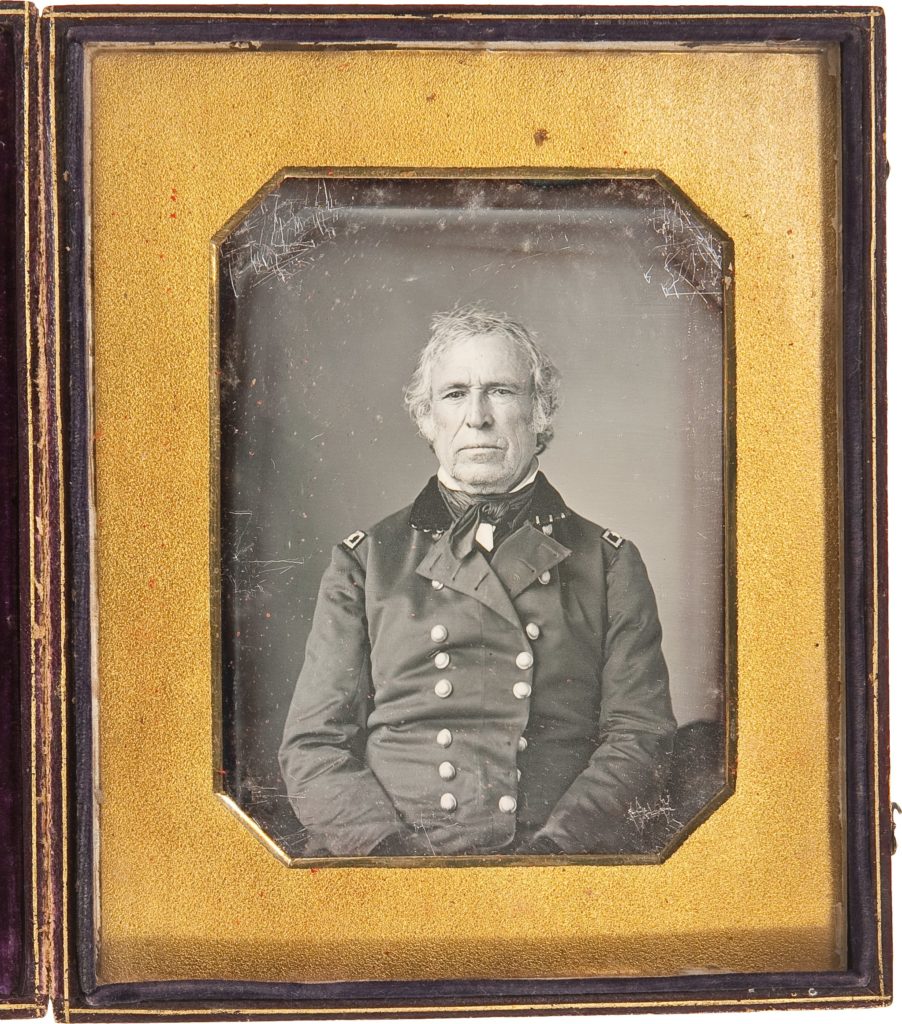
zachary-taylor-half-plate-daguerreotype-from-the-taylor-family
A half-plate daguerreotype of Zachary Taylor circa 1844, once owned by the Taylor family, sold for $47,800 at a November 2010 Heritage auction.

By Jim O’Neal

The Washington, D.C., that said farewell to James Polk in 1849 and greeted General Zachary Taylor was similar to many American cities with a combination of town and pasture. However, even after 50 years, it still looked unfinished. Pennsylvania Avenue was the principal commercial street, lined with buildings from the Capitol to the White House. But beyond, it was a town of monotonous red brick houses interspersed with seas of grass.

There were schemes for improving public lands in various places, but only one was significant to the White House. The marshy expanse to the south was believed to give off vapors, especially in the summer. In 1849, the most feared disease was cholera – particularly from May to November when the first frost quelled it. Those who could afford it left town for the summer and President Polk’s insistence on staying probably contributed to his early demise.

Taylor was the first president elected to office with no political experience. He was ill-prepared for the politics and problems involved. Like William Henry Harrison, Taylor was chosen by the Whigs as their presidential candidate solely because he was a war hero. Taylor spent 40 years in the Army, fighting Indians and winning glory in the war with Mexico. He was called “Old Rough and Ready” by his men. He preferred civilian clothes to military uniforms, even in battle. Short and plump, he had none of the appearance of a military hero and had to be given a leg-up when he mounted a horse.

Taylor was inaugurated in March 1849 and as he moved from the Capitol to the WH, the police had trouble holding back the throngs. Nodding and smiling, he waved his hat and seemed approachable, if not particularly presidential. Those who got a close look found him heavy and scruffy, his face deeply wrinkled, gray hair tousled. After four years of the dour Polk, the public was eager to idolize someone friendly.

But Taylor was an odd hero. Lacking the presence of General Jackson or General Harrison, he looked more the Louisiana planter he was in private life. The general had become president at age 64 and was considered an old man. The hope was that he would prevail through the sheer force of his prestige. Plus, Taylor’s greatest asset was his integrity, which he wore like a medal. Voters seem to have willingly accepted that he would allow his advisers to run the government. It seemed logical to have a chain of command with an honest, experienced general at the head.

The strategy failed since their hero-president provided little leadership and Democrats controlled Congress. The Taylor family circle included few intimates with one notable exception: Senator Jefferson Davis of Mississippi. He had been their son-in-law after he married the second-eldest Taylor daughter in 1835, but she died three months later of cholera.

Then it was suddenly 1850, a most pivotal year and possibly the last chance to prevent a civil war. The slavery issue came to a boil and debates raged in Congress over allowing the people of California and New Mexico to determine their own status. Perhaps with a different president, a workable solution could have held the Union together, but Taylor scorned compromises.

On July 4, 1850, at the laying of the cornerstone of the Washington Monument, President Taylor remained in the hot sun for many hours and became ill. He died five days later. The winds of war only became fiercer and there was nobody on either side who could temper them.

Next stop: an all-out Civil War that would come close to permanent disunion.

Jim O'NielIntelligent Collector blogger JIM O’NEAL is an avid collector and history buff. He is President and CEO of Frito-Lay International [retired] and earlier served as Chairman and CEO of PepsiCo Restaurants International [KFC Pizza Hut and Taco Bell].
President Taft Often Bypassed Journalists to Speak Directly to American People

lf9gqa02u2
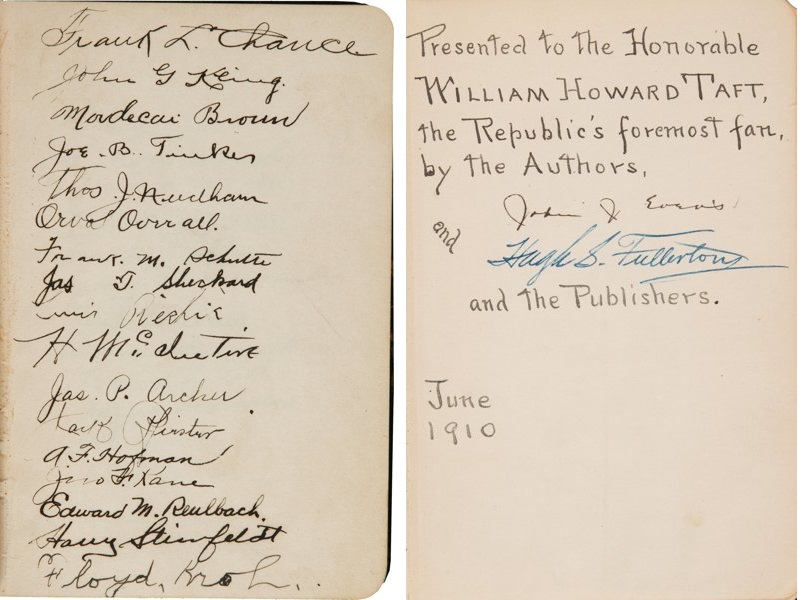
A 1910 Chicago Cubs team-signed book presented to President Taft sold for $43,020 at an August 2016 Heritage auction. Two months earlier, Taft launched the “Presidential first pitch” tradition at an opening-day game in Washington, D.C.

By Jim O’Neal

It took William Howard Taft time to actually realize he was president of the United States. He told close friends that anytime someone said “Mr. President,” he would look around expecting to see Teddy Roosevelt. Or when he read headlines that the president and a senator had a meeting, his first thought was, “I wonder what they talked about.”

Of course, anyone who succeeded TR would inevitably seem dull and uninspired, but the 6-foot-2 Taft, with his walrus moustache and 300-pound girth, was so ponderous, it exaggerated the differences. Although Roosevelt had retired, his presence hovered beyond the door of every room, and he was the unseen figure at the conference table when Taft sat in council with his political associates.

During Roosevelt’s years in the White House, the American people had come to expect the president to be in every edition of the daily newspapers. Taft made little effort to promote himself, virtually ignoring the press. When they complained, Taft dismissed it, saying he had been elected by the people, not the press. He intended to give his news in speeches directly to the people, not in releases to journalists. (He would have loved Twitter, like you know who).

That was not the only difference between the presidential styles.

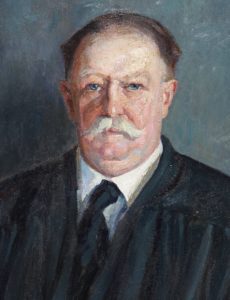
william-howard-taft-oil-portrait-by-emily-burling-waite
William Howard Taft oil portrait by Emily Burling Waite.

Taft was slow and soft-spoken and believed the time had come to work behind the scenes for “affirmative legislation.” Taft also held the law sacred, while Roosevelt had not hesitated to stretch it if necessary. Roosevelt used diplomacy to strengthen national power, while Taft viewed national power as an asset to be used in diplomacy. The “Big Stick” of Roosevelt yielded to Taft’s “Dollar Diplomacy” to help American commerce worldwide.

Suddenly, it was no longer the Roosevelt White House.

Even Mrs. Taft made her mark in a hurry. Helen Herron Taft, born in the first year of the Civil War, was 47 at the time of the election. Quick-witted and energetic, she was less a charmer than him and more of a pusher when it came to having her way. Unlike most other first ladies, she was politically savvy and influenced her husband’s activities in all major decisions.

Mrs. Taft had spent time observing the White House during the Roosevelt years, and knew how to make needed changes. During Taft’s governorship of the Philippines, she had learned at Malacañan Palace, with its 125 servants, that a strong administrative structure would free her from daily household obligations. No previous first lady brought experience of that sort to the White House. She had unlimited personal freedom and used it liberally.

Alas, time zipped by and Taft proved ill-equipped to cope with the political patronage. Worse, he committed the error of angering Roosevelt – the man who had literally put him in the job – and TR wrecked the Republican Party to prevent “Big Bill” Taft from having a second term. Upon leaving the White House, the 55-year-old Taft accepted an appointment as a law professor at Yale and then finally was granted his lifelong dream of being on the Supreme Court (appointed by Warren G. Harding). When Chief Justice Edward White died, Taft was swiftly appointed Chief Justice.

“All’s well the ends well.”

Jim O'NielIntelligent Collector blogger JIM O’NEAL is an avid collector and history buff. He is President and CEO of Frito-Lay International [retired] and earlier served as Chairman and CEO of PepsiCo Restaurants International [KFC Pizza Hut and Taco Bell].
Despite Being a Talented Diplomat, President Adams was Abrupt, Stuffy, ‘Kingly’

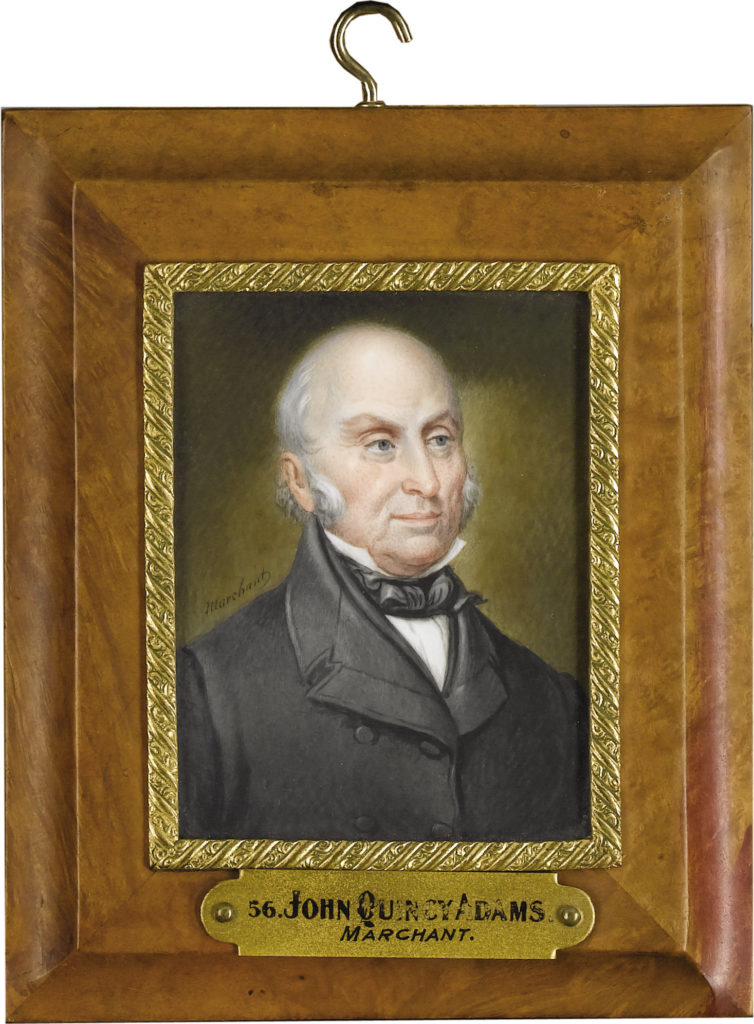
john-quincy-adams-important-miniature-portrait-on-ivory-by-noted-artist-edward-dalton-marchant
This miniature portrait of John Quincy Adams (measuring 2.25 x 3 inches) by Edward Dalton Marchant sold for $8,365 at a March 2008 Heritage auction.

By Jim O’Neal

In the 1820s, the American people felt more independent than ever before. Although Europe’s monarchical systems had been reintroduced, democracy prevailed in the United States. The war had loosened most of the chains that had bound the ideology and economy to England.

War had also turned American businessmen from importing to domestic production. It helped limit foreign competition, and now manufacturing was a conspicuous special interest group, wielding power to seek government protection and special allowances. One acute need was for transportation and this put extra pressure on the government for roads and canals.

These circumstances helped to put Washington in the national focus. The spirit of nationalism was nearly universal and the challenge was to strengthen the country so that independence would be perpetual. Virtually all political factions were in agreement.

President James Monroe’s successor was John Quincy Adams, a member of the second generation of leadership, son of a Founding Father. However, many deep hatreds grew out of the election of 1824 and JQA could only hope they would be temporary. He shared Monroe’s belief that the party system would never return to plague the political system. His daily diary entries reveal much uncertainty, but he nevertheless believed it was possible to heal the divisions. He knew his duty was to foster nationalist goals and create institutions that would ensure a continuation of the “Era of Good Feelings.”

In reality, the majority probably did favor him at first, but he lost his hold very soon, failing in his policies and public performance. Despite being a talented diplomat, his manner was abrupt, stuffy and chilly, leading to deadly epithets by his enemies as “kingly” and “monarchical.” This reputation was exacerbated by his patrician wife, Louisa, who remains the only first lady born on foreign soil.

The result was a failed one-term presidency, just as his father experienced, and neither of their lives were particularly happy during their time as president. Without attending the inauguration of his successor, Andrew Jackson, he returned home for an expected retirement. However, politics was in Adams’ DNA and he was soon back in Washington in the House of Representatives, the only former president to do so. He had a remarkable career in the House that lasted 17 years.

On Nov. 20, 1846, he suffered a mild stroke, recovered and resumed his Congressional duties. On Feb. 21, 1848, in the middle of a heated debate, he had a massive cerebral hemorrhage and slumped over his desk. He was carried to a sofa in the Speaker’s Room, slipped into a coma and died two days later.

He was 80 years old.

Jim O'NielIntelligent Collector blogger JIM O’NEAL is an avid collector and history buff. He is President and CEO of Frito-Lay International [retired] and earlier served as Chairman and CEO of PepsiCo Restaurants International [KFC Pizza Hut and Taco Bell].
Truman’s Time in Office Was Tumultuous, but He Still Ranks Among Best

harry-s-truman-inscribed-photo-signed
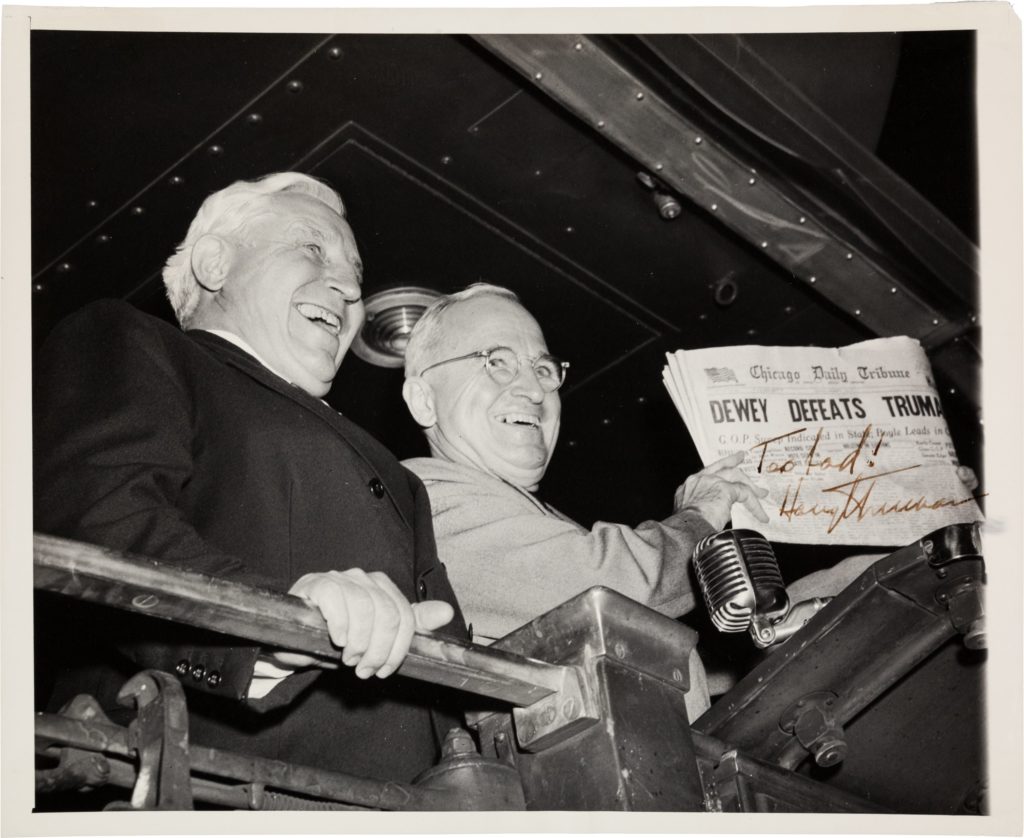
Virtually every prediction indicated that Harry S. Truman would be defeated by Thomas E. Dewey in the 1948 election. A copy of the famous “Dewey Defeats Truman” photograph, inscribed by Truman, sold for $10,157.50 at an April 2013 Heritage auction.

By Jim O’Neal

Harry S. Truman moved back into the newly rebuilt White House in March 1952 and he had already decided not to seek reelection.

Since Truman had only served one full term as an elected president (having filled a partial term after Franklin D. Roosevelt died in office), he was eligible to run for president a second time. This was the same dilemma that had confronted two of his predecessors: Teddy Roosevelt and Calvin Coolidge, both of whom had decided not to run a second time. Truman was well aware of their personal deliberations; the first Roosevelt had lived to regret not running, while Coolidge had never looked back.

In 1951, after four years of debate, Congress ratified the 22nd Amendment of the Constitution, which limited an elected president to two terms. This was a reaction to FDR’s long tenure, and it specifically exempted Truman. But, he had made up his mind.

He addressed the Democratic Party’s historic Jefferson-Jackson dinner at the D.C. National Guard Armory. “I shall not be a candidate for reelection. I have served my country long and I think efficiently and honestly. I shall not accept a re-nomination.” He added in an ironic tone not typical of him, “I do not think that it is my duty to spend another four years in the White House.”

Although he was a tough-skinned politician, he resented the negative public opinion that had risen around him. His time in office, eight years less about two months, had been tumultuous, filled with achievements that had not been easy. His call for liberal change had been rooted philosophically in the New Deal, but in the wake of World War I and increased prosperity, his call fell on deaf ears.

The American public was turning elsewhere, particularly after he vetoed an ardent Republican crusade to turn coastal tidelands mineral rights over to the states, and it was viewed as a lame-duck president lashing out. It was actually one of the few vetoes that stuck (12 of his vetoes were overridden by Congress) and it created an energy that would result in a Republican victory in the upcoming election.

At about the same time, the Treasury Department announced that the federal deficit would be double than the previous year and in the last months of his presidency, his popularity and spirits were low. He was ready to go home.

History has been kind to Truman. Every year, his standing on the Best Presidents list seems to improve. He was a small man in stature who assumed a big job at a crucial time and did his very best. Who could expect more?

Jim O'NielIntelligent Collector blogger JIM O’NEAL is an avid collector and history buff. He is President and CEO of Frito-Lay International [retired] and earlier served as Chairman and CEO of PepsiCo Restaurants International [KFC Pizza Hut and Taco Bell].
Grant was Popular, But Unable to Deal with Political Complexities

ulysses-s-grant-magnificent-silk-1868-campaign-flag-banner
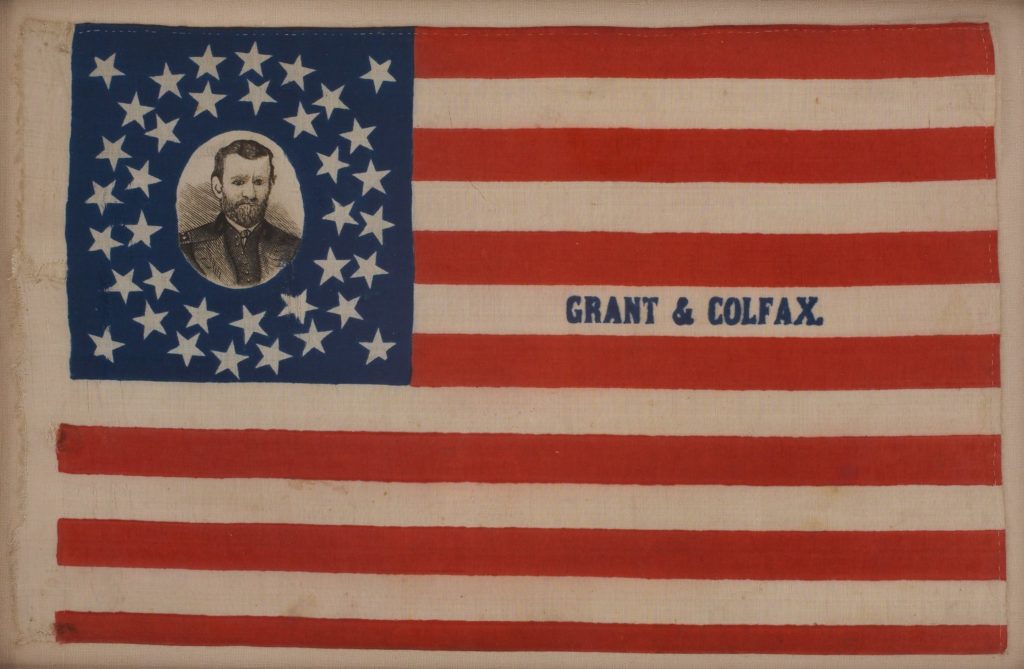
A Ulysses S. Grant 1868 silk campaign flag banner sold for $14,340 at a May 2010 Heritage auction.

By Jim O’Neal

As the departing carriages occupied by Andrew Johnson and his party passed out of the White House gate, the roar of voices heralded the approach of the incoming president’s inaugural parade.

It traversed 15th Street and turned west on Pennsylvania Avenue, where the vanguard of soldiers came into view. Ulysses S. Grant and several others rode in the first carriage, an open barouche. At 1 p.m., the procession stopped and Grant’s carriage rolled through the gates leaving everyone else in the street.

At 46, the idol of the nation assumed the position of commander-in-chief in 1869. There are few important events in the affairs of men brought about by their own choice, Grant observed philosophically in his memoirs. A mere 10 years earlier, he had been an obscure citizen of Galena, Ill., an Army veteran retired early and a businessman struggling to support a young family. He had been considered a failure, but the Civil War had dramatically bettered his life.

Grant had a simple and uncomplicated view of himself as the administrative officer of the nation, drawing a strong analogy between his role as president and his former one as commanding general of the U.S. Army. He believed that the people’s will was expressed through Congress and that the job of president was to manage the machinery of government and obey Congress. His acknowledgment of the superior authority of the legislative branch was appreciated by a people exhausted by the long duel between Andrew Johnson and Congress.

Grant would call the White House home for eight years, the longest time he had lived anywhere. He would be the first two-term president since Andrew Jackson (10 different men had held the job after “Old Hickory” departed). Where those before him sought to achieve their objectives through their conduct as president, Grant’s motivation was neither intellectual nor imaginative, with only a touch of originality. He simply used his prestige to bring stability to the nation by representing the popular image of the “good life” in an era that would be called the Gilded Age.

However, his military background was not enough to equip him for the complexities of governing a large and swiftly growing nation, and historians have largely judged him a failure as president. The common-sense approach that worked so well on the battlefield proved naïve in a world of shrewd politicians and intrigue that permitted shady self-dealing and the aura of corruption.

One thing is certain. He was one hell of a general and knew exactly how to win wars, irrespective of the carnage and loss of life involved. He certainly deserves a lot of credit for ensuring Abraham Lincoln’s legacy.

Jim O'NielIntelligent Collector blogger JIM O’NEAL is an avid collector and history buff. He is President and CEO of Frito-Lay International [retired] and earlier served as Chairman and CEO of PepsiCo Restaurants International [KFC Pizza Hut and Taco Bell].
For President Johnson, Goal was Reached with ‘Great Society’ Legislation

lyndon-b-johnson-great-society-bill-signing-pens-from-1965
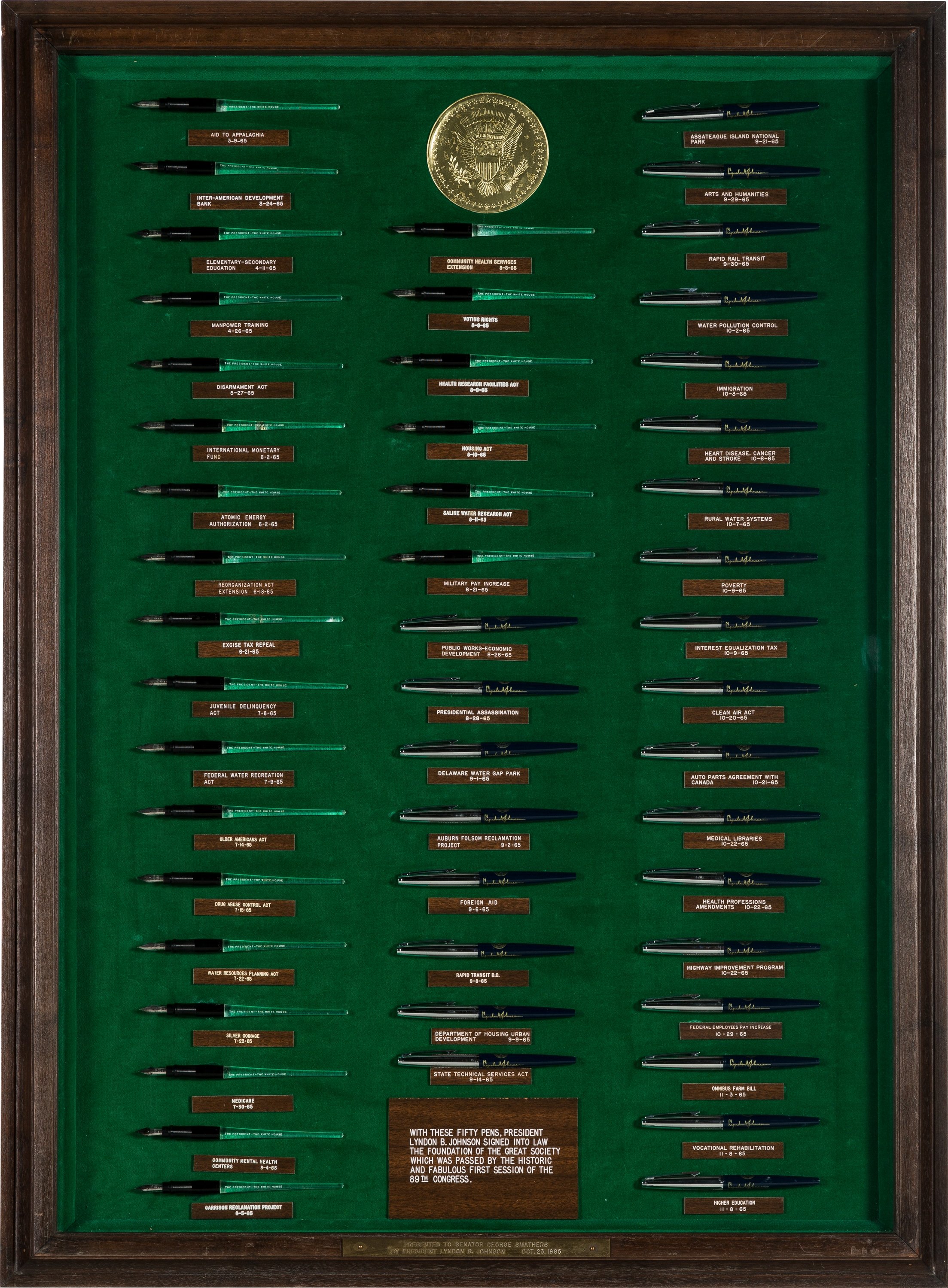
A complete set of 50 pens President Johnson used to sign “Great Society” legislation in 1965 sold for $18,750 at a November 2015 Heritage auction.

By Jim O’Neal

Whether Lyndon B. Johnson intended to run a second time for the presidency (after his 1964 election) is uncertain. Many of his predecessors had made it clear that one elected term was enough.

Theodore Roosevelt made a campaign promise not to run again for president and regretted it so much that he later ran anyway (in 1912). Rutherford B. Hayes never intended to run more than once (and was happy he hadn’t), and neither did Harry Truman or Calvin Coolidge. Except for TR, these men were no longer popular by the end of their first elected term, and it most likely would have been a waste of time.

So it was with LBJ. On March 31, 1968, he took the nation by surprise when he announced abruptly in a televised address from his office, “I shall not seek, and I will not accept, the nomination of my party for another term as your president.”

Johnson had even spoken of resigning, but if anything deterred him, it was the fear of losing his “Great Society” programs in Congress. Even the media-fueled support for Robert Kennedy was threatening, because Johnson never trusted him and was leery of his lack of power with Congress to be sure the programs got enacted. Johnson cared more about his agenda than the presidency.

lf
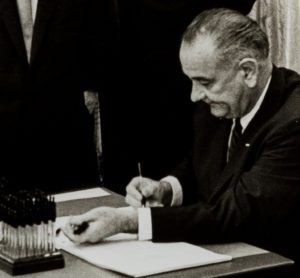
President Johnson signs legislation.

Then, shortly after his retirement speech, came the assassinations of Dr. Martin Luther King Jr. (April) and Kennedy (June), which stirred even more violence in the streets. The military was on stand-by and ready to pour into Washington if rioting was too much for the police. For the man in the White House, the outside world was a horror show and the idea of returning to his ranch grew more appealing. A long-time colleague from the old days, Congressman Jack Brooks, said the president did not seek reelection because he “kind of wanted to get back home,” adding for those who might not understand, “It’s not so bad out on the ranch, you know.”

Some presidents depart the White House invigorated, but most leave exhausted. For LBJ, the office had drained his vigor and confidence. He also believed that history would never give him credit for achieving the most powerful social agenda since Roosevelt’s New Deal. It was Johnson’s political skill that made it happen, not JFK, but Johnson believed that somehow the applause would inevitably go to his more popular predecessor. Sadly, he was right, but in recent years, a more balanced narrative has evolved.

Republicans nominated Richard Nixon in August 1968 and the Democrats chose VP Hubert Humphrey. LBJ did not attend the convention to share Humphrey’s triumph since he didn’t want to add any Vietnam War baggage to the ticket. During the campaign, the war flared on and LBJ was still impassioned to end it. On Oct. 31, just days before the election, he even announced a halt to the bombing, but it was too late.

On Jan. 14, 1969, President Johnson delivered his final State of the Union to Congress. It was strong, pragmatic and well-received by his old Senate colleagues – and in a venue where he was very comfortable.

Then it was time to pack up and head back to Texas.

Jim O'NielIntelligent Collector blogger JIM O’NEAL is an avid collector and history buff. He is President and CEO of Frito-Lay International [retired] and earlier served as Chairman and CEO of PepsiCo Restaurants International [KFC Pizza Hut and Taco Bell].
Reagan’s Last Christmas in Office Marked by Memorable Snowy Fairyland

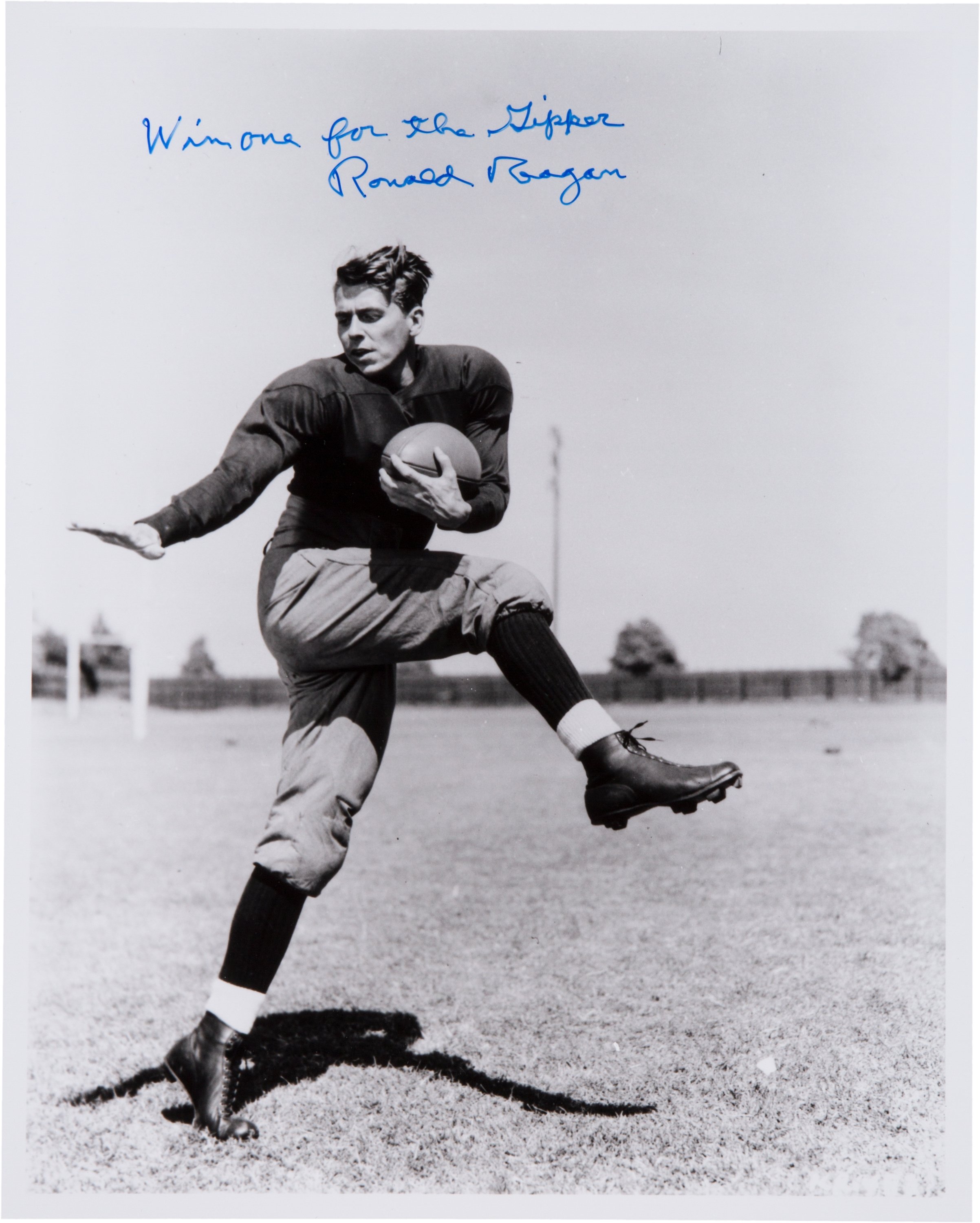
1980s-ronald-reagan-win-one-for-the-gipper-signed-photograph
A photograph signed by Ronald Reagan with the inscription “Win one for the Gipper” sold for $8,365 at a November 2014 Heritage auction. It’s considered the most famous line Reagan spoke on the silver screen, in 1940’s Knute Rockne, All American.

By Jim O’Neal

In 1980, Ronald Wilson Reagan became the oldest man (69) to be elected president. He extended his record in 1984 when he was reelected at age 73. For their last Christmas in the White House, the Reagans wanted to make a splash. The East Room was transformed into a snowy fairyland, with full-size trees and a gift-filled sleigh occupied by carolers and drawn by lifelike horses, all powdered with glittery “snow.” It was a vintage Hollywood image.

Thousands of visitors filed by and looked on in both delight and amazement at the dazzling scene. Nothing remotely like this had ever been seen in the White House. It was a playful farewell by two whose roots were as firmly planted in Hollywood as John F. Kennedy’s were in Boston or Lyndon B. Johnson’s on the banks of the Pedernales River.

On his final day in office, Jan. 20, 1989, President Reagan went to the Oval Office early and met with his Chief-of-Staff Ken Duberstein and General Colin Powell, the National Security Advisor. Both of them said reassuringly, “Mr. President, the world is quiet today.” After they left, Reagan also left the office, stopping at the door for one last look. George and Barbara Bush were arriving in the entrance hall below.

On the route from the Capitol to the White House, the incoming President George H.W. Bush and first lady took a cue from the Carters, leaving their car from time to time to walk along Pennsylvania Avenue to greet the crowds. They walked up the driveway on the same path all their predecessors had followed since James Monroe’s second term, 168 years before.

History linked the inauguration of George H.W. Bush and George Washington. It had been exactly 200 years since the first president began serving his first term.

President Bush had an extensive background that included two terms in Congress, ambassador to the United Nations, director of the CIA, liaison to China, and eight full years as vice president. He had easily defeated Michael Dukakis to win the presidency, but in the process famously declared “Read my lips. No new taxes!” – words that would haunt him.

Although favored for reelection in 1992, he got caught in a buzz saw when third-party candidate Ross Perot siphoned off nearly 19 percent of the popular vote and a young governor from Arkansas won with a plurality of 43 percent. William Jefferson Clinton and Al Gore Jr. became the youngest president and vice president in history.

George H.W. Bush became the 10th incumbent president to lose in a bid for reelection after becoming the first sitting vice president to be elected president since Martin Van Buren in 1836.

The strange world of presidential politics. We love it.

Jim O'NielIntelligent Collector blogger JIM O’NEAL is an avid collector and history buff. He is President and CEO of Frito-Lay International [retired] and earlier served as Chairman and CEO of PepsiCo Restaurants International [KFC Pizza Hut and Taco Bell].
 

With Discovery of Gold, President Polk Opened Massive Migration West

half-plate-daguerreotype-of-california-gold-rush-mining-scene-ca-1850s
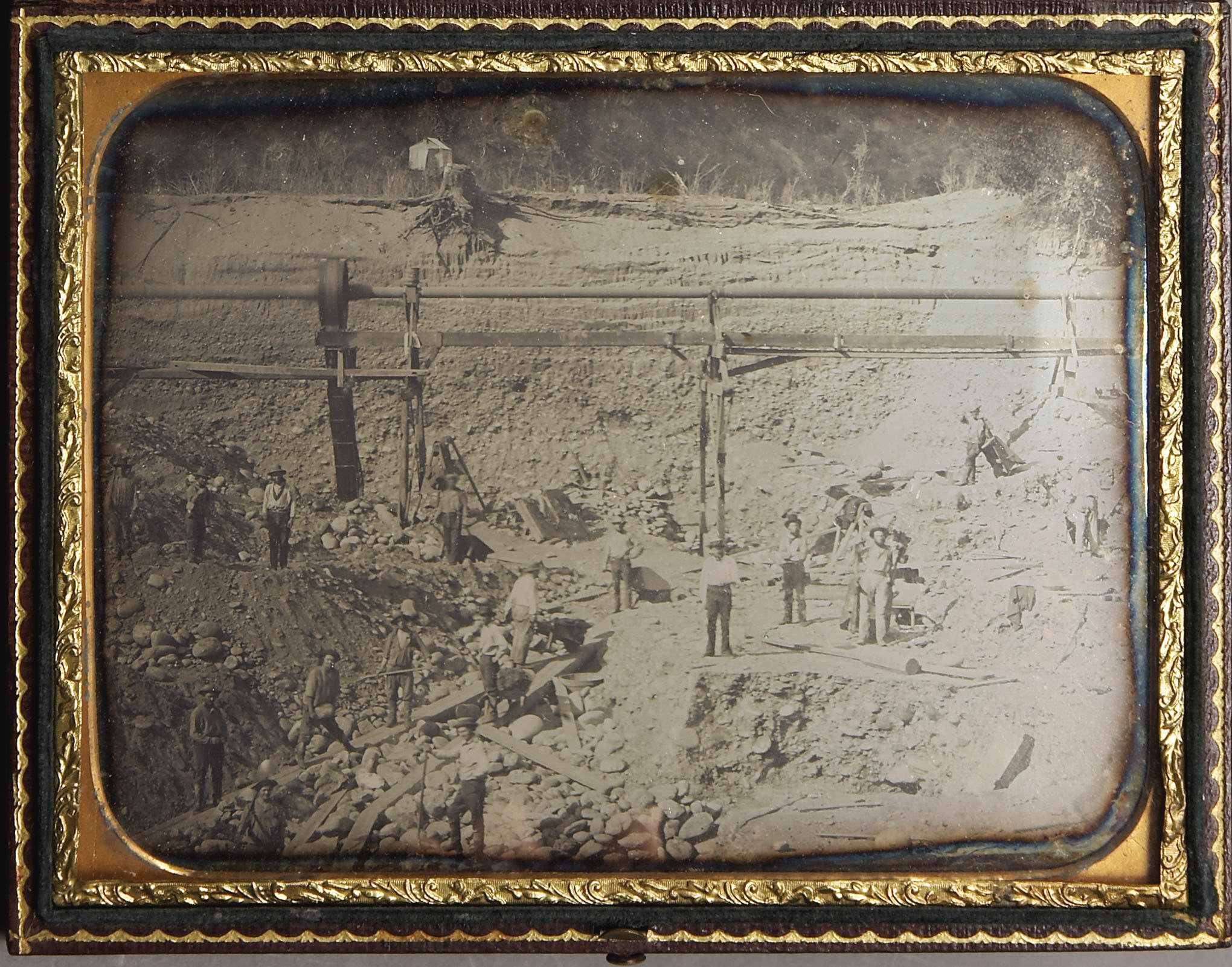
This half plate daguerreotype of a California gold rush mining scene, circa 1850, sold for $28,680 at a June 2008 Heritage auction.

By Jim O’Neal

Reports of gold in California came to the president as early as June 1848. Part of the talk was idle speculation; part was based on tales of settlers and soldiers plus myths of Spanish treasure troves. A succession of adventurers, spies and famous Western characters like Kit Carson had slipped quietly up the stairs into President James Polk’s office to tell of the vast domain far to the west.

The lost mines of El Dorado had long fascinated nearly everyone.

The first official report on “gold diggings” came to Polk in August 1848. Navy Lieutenant Edward Fitzgerald Beale showed the president some actual gold nuggets. Authoritative and “eyewitness” accounts of California gold started popping up in various newspapers. In a message to Congress on Dec. 5, 1848, Polk outlined the possible scope of the precious metal mines and the extraordinary potential that had been corroborated by authentic reports.

Two days later, a courier from California arrived at the War Department with a mysterious package and more dramatic evidence of western riches. As soon as Secretary of War William Marcy unwrapped the parcel, he took it directly to President Polk. It contained a tea caddy crammed full of gold nuggets and dust that weighed over 230 ounces.

They quickly decided to send the largest “lump” to Philadelphia to be minted into coins and put the rest on display in the War Office. Visitors of every class stood in long lines just to see it and it became the dominant subject everywhere. On Dec. 12, Polk predicted the coming 12 months would witness “a large population … attracted to California by its mineral wealth.”

In his History of California, historian Hubert Bancroft wrote of Polk’s prophecy. “The interest in California became all-absorbing, creating a restlessness which finally poured a human tide into San Francisco Bay, and sent hundreds of caravans over the plains and mountains.”

However, the Polks moved out of the White House on Saturday, March 3, 1849, to 10 rooms prepared for them at the Willard Hotel. He had promised to only serve one term and his time in the WH had taken an enormous toll on his health. He had the shortest retirement of any president and died of cholera 103 days after leaving office. Along with George Washington, Andrew Johnson, Chester Arthur, Calvin Coolidge and LBJ, he was one of six presidents to die while their direct successor was in office.

He totally missed the Gold Rush and the massive migration west he was responsible for.

Jim O'NielIntelligent Collector blogger JIM O’NEAL is an avid collector and history buff. He is President and CEO of Frito-Lay International [retired] and earlier served as Chairman and CEO of PepsiCo Restaurants International [KFC Pizza Hut and Taco Bell].