St. Louis World’s Fair Striking in its Arrogance of America’s Place in Humanity

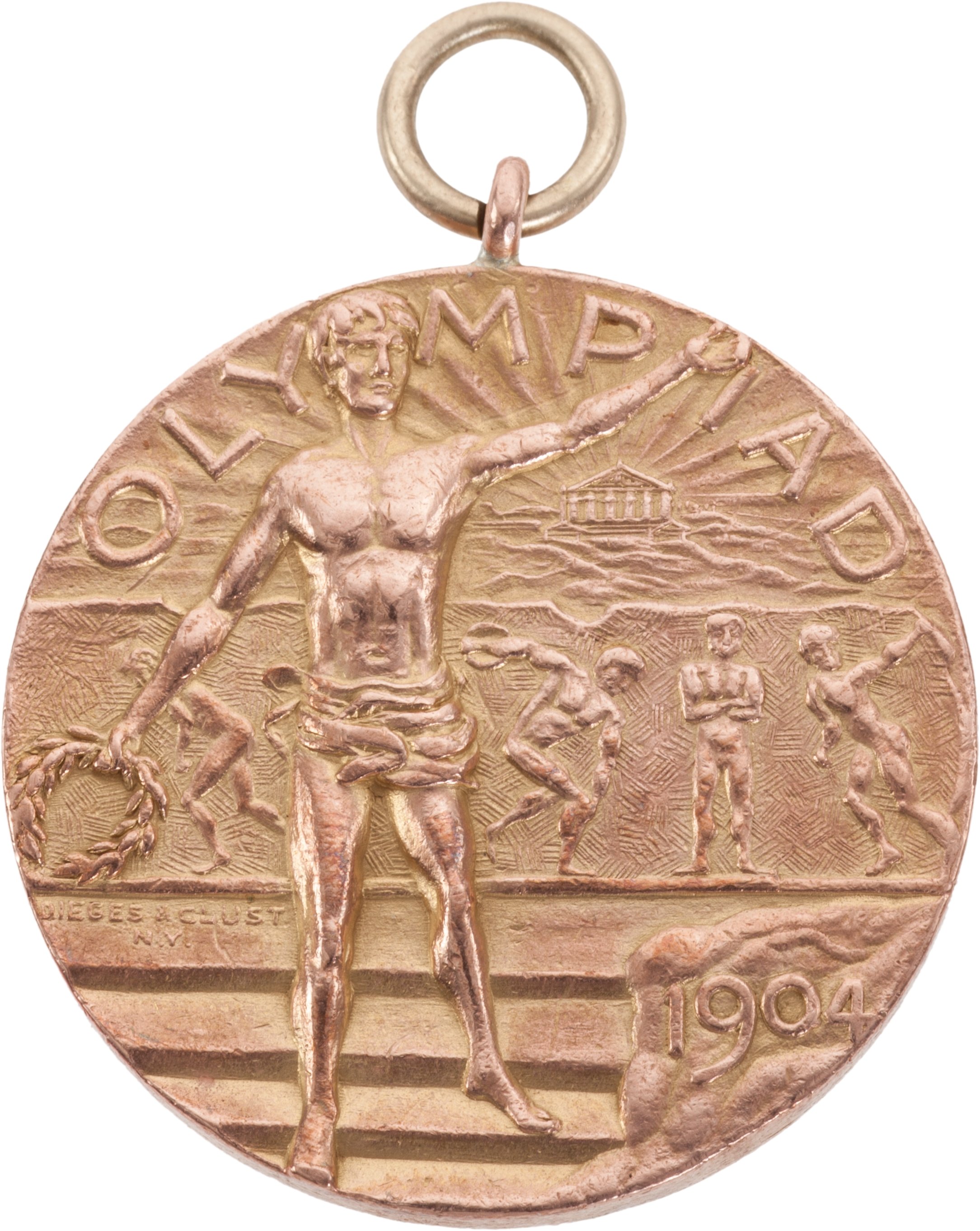
This 1904 St. Louis Summer Olympics gold medal, awarded to four-mile men’s relay winner George B. Underwood, sold for $38,837.50 at a May 2013 Heritage auction.

By Jim O’Neal

America in 1900 was a provincial society of 76 million citizens. It is hard to contemplate a place of such innocence … a nation of dirt roads and horse-drawn carriages, of tight corsets and Victorian pretensions, of kerosene lamps and outhouses, of top hats and bowlers, McGuffey Readers and The Ladies’ Home Journal.

Cities were crowded with smoke-filled men’s clubs and ornate-paneled bars, while country towns were still home to 60 percent of the population, villages of stark simplicity and virtue. The average American had but five years of schooling and the nation only recently had made dramatic strides in improving literacy. Yet even in the absence of sophistication, most people were convinced America and its people were God’s chosen few.

The St. Louis World’s Fair of 1904 (the Louisiana Purchase Exposition), commemorating the 100th anniversary of the Louisiana Purchase (a year late), was striking in its arrogance of America’s place in humanity. In addition to the ice cream cone, hamburger/hot dog, and iced tea – all introduced here – the fair featured an anthropology exhibition to explain human progress via the general increase in the size of the human cranium, the principle of “cephalization.”

Anthropologist W.J. McGee designed a display of pygmies from Africa, Patagonian giants from Argentina, and Native Americans in ethnological settings – purportedly to demonstrate the peak of upward human development from savagery to barbarism to civilization. The implicit message was the distinctive American alchemy that had transformed people to a higher state of being.

Throughout the 19th and early 20th centuries, there was a furious competition between scientists and pseudoscientists around the world to discover evolution’s “missing link.” All of them turned out to be bogus. The 1868 discovery in Albany, N.Y., of the Cardiff Giant turned out to be a gypsum statue aged with an acid bath. Then P.T. Barnum constructed his own Cardiff Giant, which he exhibited at his circus (a hoax of a hoax).

In perhaps the most celebrated of discoveries, Britain’s Piltdown Man, “unearthed in 1912,” established England as the cradle of civilization for 40 years. Then it was declared a phony, a mixture of orangutan bones assembled by an amateur paleontologist eager for fame.

Today, we still don’t know exactly how life began, but we do know, finally, how we got from there to here. One thing is certain: The path went through that 1904 fair in St. Louis – and I wish I had been there to attend the first Olympic Games held in the United States, eat a hot dog and end up in one of those bars with a mug of cold beer.
Intelligent Collector blogger JIM O’NEAL is an avid collector and history buff. He is president and CEO of Frito-Lay International [retired] and earlier served as chairman and CEO of PepsiCo Restaurants International [KFC Pizza Hut and Taco Bell].
Watergate Scandal Perhaps Permanently Eroded Public Trust in Government

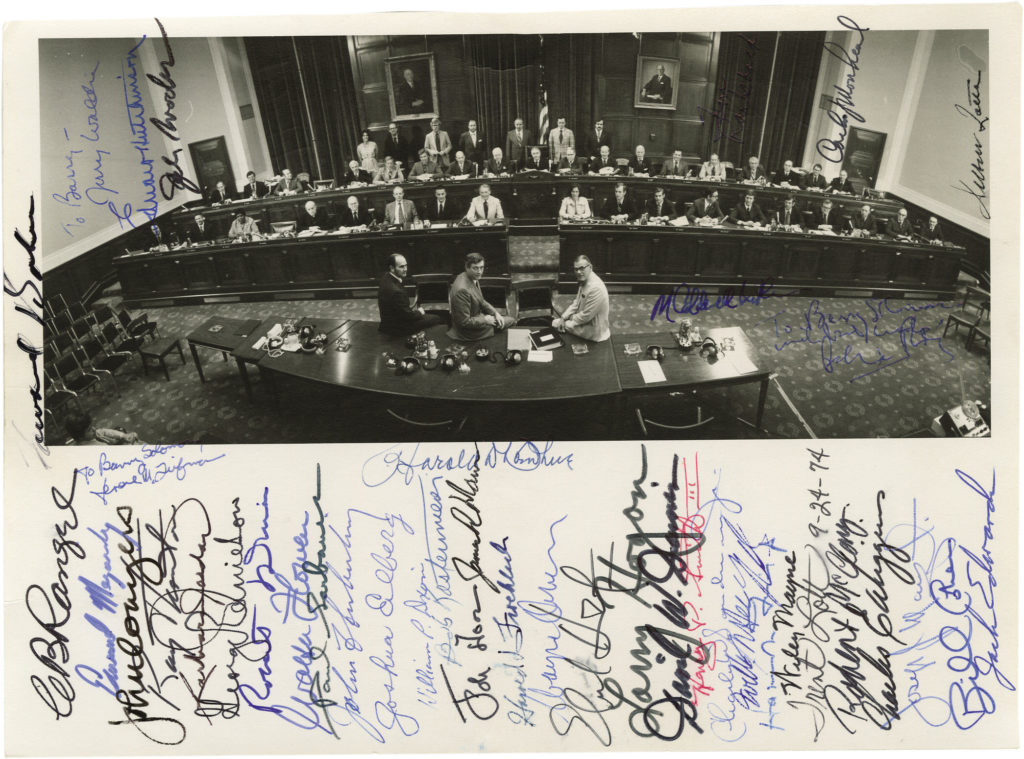
A photo signed by each member of the Congressional Watergate Committee, which investigated whether sufficient grounds existed to impeach Richard M. Nixon, realized $5,497 at an October 2006 Heritage auction.

By Jim O’Neal

The Washington Post account of the break-in appeared on the front page of its Sunday edition. The New York Times carried 13 inches (inside) with the headline “Five Charged with Burglary at Democratic Headquarters.” Most other editors played it down even more. Still, it captured the attention of high officers of the U.S. government and the Republican Party. Among them: H.R. Haldeman, John Mitchell, Maurice Stans, Jeb Magruder, John Dean and probably the president of the United States.

A year later during the hearings of the Senate Select Committee on Presidential Campaign Activities (chaired by Senator Sam Ervin of North Carolina), Magruder was asked when this glittering array of outlaws had decided to cover its tracks. He answered in a puzzled tone: “I don’t think there was ever any discussion that there would NOT be a cover-up.”

Among the other people who were in on the lies was Martha Mitchell, wife of Attorney General John Mitchell. She had tried to tell the truth, but a special bodyguard had yanked the phone wires out of the wall when she was telling a UPI reporter, “They don’t want me to talk.” She later said he held her down while another man injected a sedative into her buttocks. But there was no way to keep Martha Mitchell quiet and three days later she called the reporter again, saying, “I’m not going to stand for all these dirty things going on.” It made a good story, but Martha’s credibility was low and most Americans accepted the official line.

Ron Ziegler, the former ad man who served as President Nixon’s press secretary, spelled it out. In a scornful tone, he declined to even rebut Martha’s rants. “I am not going to comment from the White House on a third-rate burglary attempt,” Ziegler announced. However, when a few Post reporters continued to ask questions, Ziegler did comment from the WH: “I don’t respect the type of journalism, the shabby journalism, that is being practiced by The Washington Post.” (John Mitchell added, “[Washington Post publisher] Katie Graham is going to get her teat caught in a big fat wringer!”)

On Monday, July 16, via live TV, chief minority counsel Fred (Law & Order) Dalton Thompson got White House assistant Alexander Butterfield to disclose there was an automatic recording system in the White House. Apparently, all conversations in the Oval Office, the Cabinet Room and even President Nixon’s private office were taped.

Once this bombshell exploded, it was only a short trip to forcing the administration to turn over all recordings. This would inexorably lead to the indictment of 69 people (with 48 found guilty) and the first presidential resignation. When asked much later why he didn’t simply burn the tapes, Nixon calmly replied he wanted to preserve his legacy for posterity. (Mission accomplished!)

All of this was captured brilliantly 40 years ago in the film All the President’s Men with Robert Redford and Dustin Hoffman in the roles of Washington Post reporters Carl Bernstein and Bob Woodward. The movie won four Oscars, with Jason Robards snagging best supporting actor for his portrayal of editor Ben Bradlee. It is a must-see movie and the Bernstein-Woodward book is equally entertaining.

Coming on top of the Pentagon Papers and the Vietnam War, the entire Watergate scandal eroded public trust in government, perhaps permanently. Even today, the cover-up is generally worse than the crime.

Intelligent Collector blogger JIM O’NEAL is an avid collector and history buff. He is president and CEO of Frito-Lay International [retired] and earlier served as chairman and CEO of PepsiCo Restaurants International [KFC Pizza Hut and Taco Bell].
In Wartime, Leaders Made Sure Nation’s Treasures Remained Safe

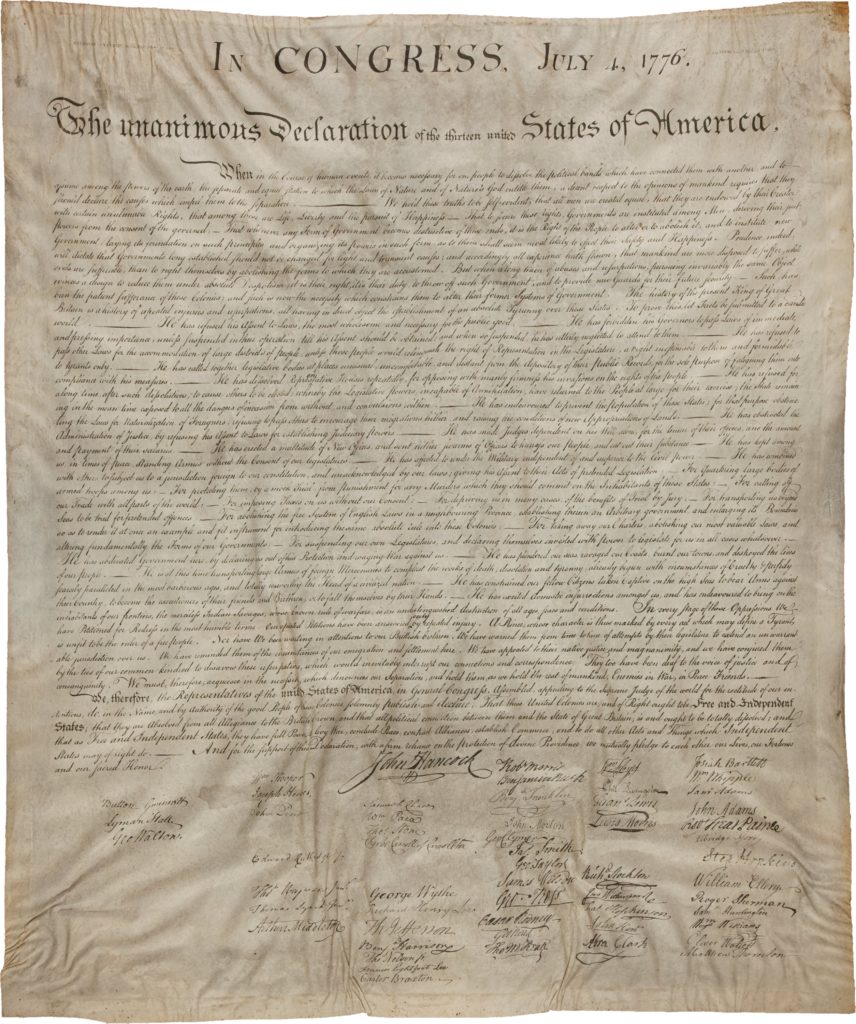
An exact copy of the Declaration of Independence, commissioned by Secretary of State John Quincy Adams in 1820, sold for $597,500 at an April 2012 Heritage auction.

By Jim O’Neal

Dwight Eisenhower was a five-star general in the U.S. Army and was appointed Supreme Commander of the Allied Expeditionary Forces in Europe by President Franklin D. Roosevelt. On June 6, 1944, he directed the largest amphibious invasion in history by establishing a beachhead on Normandy on the northern coast of France.

Operation Overlord started with overnight parachute and glider landings, massive naval bombardments and air attacks … followed by amphibious landings on five beaches. They were code named Omaha, Utah, Juno, Gold and Sword. Then, the remaining elements of the airborne divisions landed.

The successful operation is now commonly called D-Day.

There was an elaborate plan formulated to convince the Germans that Normandy was not the focal point of the invasion and, despite several unfortunate leaks, it was generally successful. The use of code names helped to disguise the actual location and even extended to officers who had knowledge of real D-Day plans. None of them were to be deployed to areas where there was the slightest chance of being captured. They were given the security classification code name of BIGOTs, and if any were unaccounted for or captured, the invasion was to be canceled. In a little-known incident on April 27, 10 BIGOTs were missing after German E-boats attacked several American LSTs. But all 10 bodies were recovered and no changes had to be made.

Three months later, on Sept. 19 at 3:35 p.m., the Provost Marshall of Fort Knox, Ky. – Major W.C. Hatfield – ordered a heavily armed convoy to “move out” from the U.S. Bullion Depository. As the vehicles started rolling, there was a large truck in the middle. Inside were containers holding the Declaration of Independence, the Constitution of the United States, and the Gettysburg Address. They were going home!

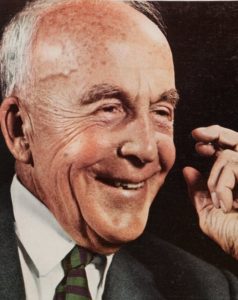
Archibald MacLeish

President Roosevelt, the Joint Chiefs and the War Department had decided that bombings or sabotage on the U.S. mainland were now unlikely. It was time for these most precious documents to return to Washington. The Librarian of Congress – Archibald MacLeish – wrote, “They see no need to keep materials of this kind in the woods and hills any longer.”

The convoy headed to Louisville, Ky., and agents placed the cases aboard a Pullman sleeper car – No. 42 – on the 5:30 p.m. B&O train to Washington, D.C. When they arrived at the Library of Congress via armored truck (with extra guards), MacLeish personally supervised their transfer to the vault. Safe at last!

MacLeish resigned shortly after an ailing President Roosevelt was elected to an unprecedented fourth term in 1944, defeating Republican Thomas E. Dewey, the governor of New York. However, FDR persuaded MacLeish to stay on as assistant Secretary of State for cultural and public affairs. His first assignment was to convince the American people that a United Nations was needed to ensure a lasting peace.

He did keep our most valuable treasures safe during the war, but lasting peace was more elusive. He died in 1982, just shy of his 90th birthday.

Intelligent Collector blogger JIM O’NEAL is an avid collector and history buff. He is president and CEO of Frito-Lay International [retired] and earlier served as chairman and CEO of PepsiCo Restaurants International [KFC Pizza Hut and Taco Bell].
Clash of Democracy and Oligarchy Dates to Ancient Times

persia-under-alexander-mazaeus-as-satrap-of-babylon
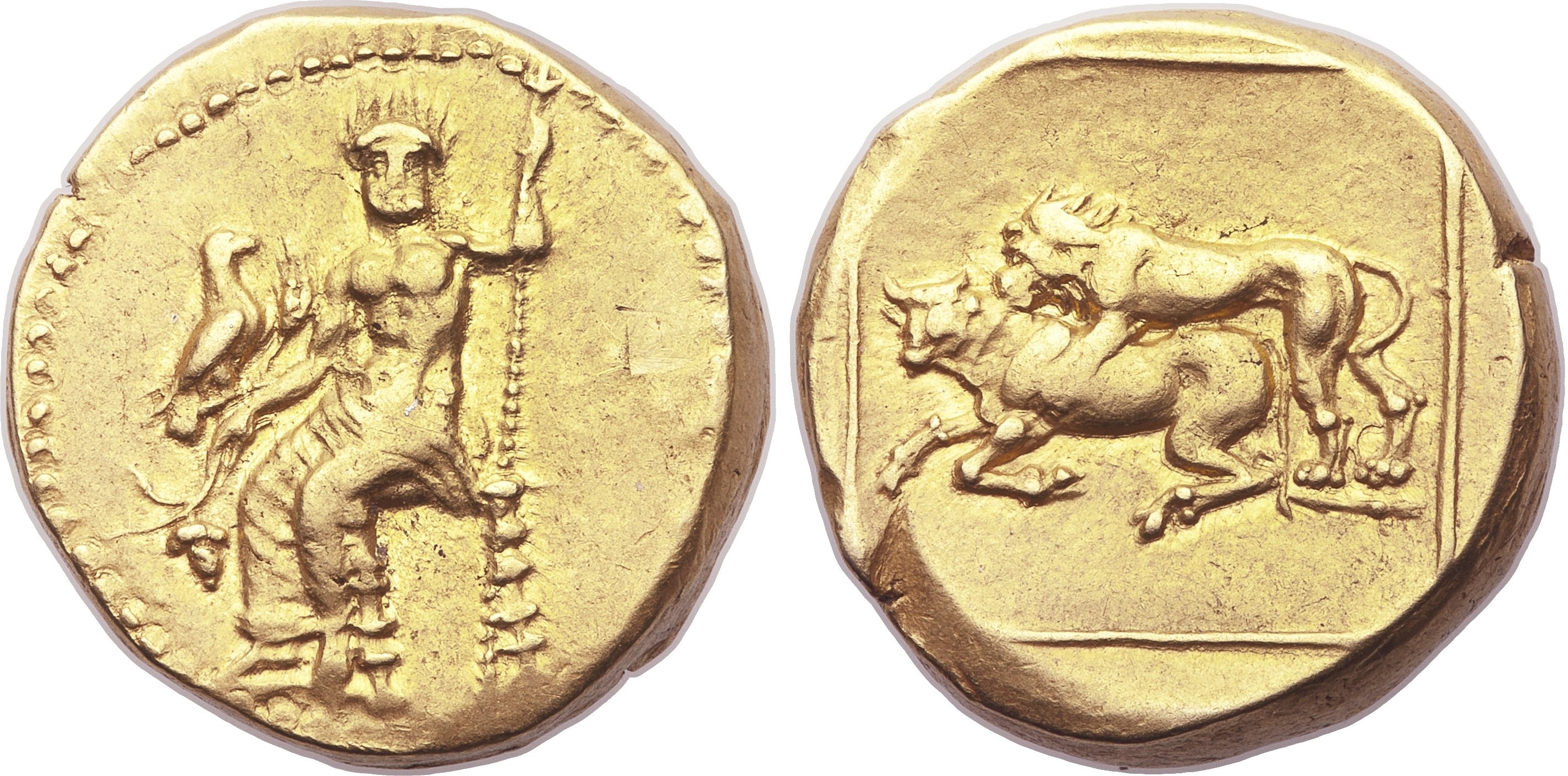
This double-daric gold coin, provisionally dated to the years Alexander the Great was King of Persia, sold for $70,500 at a September 2013 Heritage auction.

“Dictatorship naturally arises out of democracy and the most aggravated form of tyranny and slavery out of the most extreme liberty.” – Plato

By Jim O’Neal

During the Peloponnesian War (431-404 B.C.), Athens was ultimately defeated by the Spartans. Athenian democracy was twice suspended. In 411 and 404 B.C., Athenian oligarchs claimed that Athens’ weak position was due to democracy and led a counter-revolution to replace democratic rule with an extreme oligarchy. In both cases, democratic rule was restored within one year.

Democracy flourished for the next eight decades. However, after the Macedonian conquest of Athens under Phillip II and his son Alexander (later Alexander the Great) in 332 B.C., Athenian democracy was abolished. It was intermittently restored in the Hellenistic age in the 1st and 2nd centuries B.C., but the Roman conquest of Greece in 146 B.C. effectively killed it off.

Although democratic rule had been quashed, Athenian science and philosophy lived on. The renown and influence of Plato and Aristotle endured through the ages that followed and much of their work continues to influence Western thought to this day.

It is ironic that Aristotle tutored Alexander the Great at age 16 since throughout antiquity, Alexander was widely viewed as the most remarkable man who ever lived. When his father was assassinated in 336 B.C., he secured the Macedonian throne by destroying his rivals, forcing the Greek city/states to accept his authority in 334 B.C. and then marching into Asia Minor (modern-day Turkey) at the head of an army of 43,000 foot soldiers and a cavalry of 5,500. At its heart lay the Macedonian phalanx, a well-drilled corps of 15,000 men armed with the sarissa, a double-pointed 23-foot pike. They were simply invincible.

He then defeated the Persian emperors, subdued Greece, drove his troops across mountains, deserts and rivers into Afghanistan, Central Asia and on to the Indian Punjab, ruthlessly crushing all resistance. Alexander was now king of a vast and ethnically diverse empire that included 70 newly founded cities. It is said that he sat down and cried when he ran out of new places to conquer. He died in 323 B.C., having been history’s most successful military commander.

Not bad for a 32-year-old.

Jim O'NielIntelligent Collector blogger JIM O’NEAL is an avid collector and history buff. He is president and CEO of Frito-Lay International [retired] and earlier served as chairman and CEO of PepsiCo Restaurants International [KFC Pizza Hut and Taco Bell].
Hitler’s Seduction of German People was Sudden, Complete

lfqjctp798
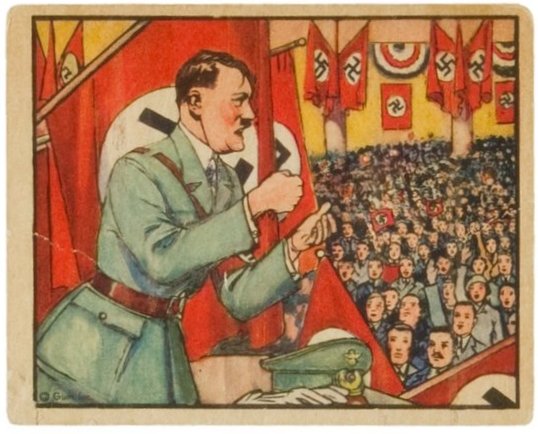
Adolf Hitler is among the figures featured in Gum Inc.’s 1938 “Horrors of War” trading card series. A complete set (288 cards) sold for $2,390 at a November 2011 Heritage auction.

By Jim O’Neal

The same winter President Roosevelt came to power in the United States, another leader in Europe assumed his country’s highest office. Over the next 12 years, until their deaths just two weeks apart in 1945, the lives of Franklin Delano Roosevelt and Adolf Hitler would grow increasingly intertwined … drawn together as archenemies in a conflict that was the 20th century’s most grotesque and widespread event.

Even all these years later, the rise of Hitler still baffles. His seduction of the German people was so sudden and complete, his assumption of power so total, that he defies comparison with history’s other evil conquerors. One German philosopher called him an “error” in history, as if the Fates had been distracted while a deadly mutant virus took hold.

Both FDR and Hitler’s journey to power was propelled by a world economic collapse.

Along with America and most of Europe, Germany suffered a Great Depression, with unemployment reaching 25 percent. If it had been hunger alone, the people may have followed a very different kind of leader. But Hitler’s enormous popularity was also a product of Germany’s lingering desire for revenge.

Despite Germany’s surrender in 1918 (an armistice arranged by the Reichstag, not the Army), few accepted the fact that they had been defeated in World War I. Hitler was from Bavaria, a haven for right-wing nationalists, and he railed against the forces of Judaism and Bolshevism, while mocking the fragile Weimar government as “November Criminals” for acceptance of the armistice.

After the complete breakdown of the economy in 1930, the passion of resentment and revenge gained momentum to include students, professors and businessmen. Hitler’s anti-Semitic message resonated with a deep suspicion of money cartels and the perceived unjust punishment from the Versailles agreement. The campaign moved with the speed of a plague.

The Nazi bible was Mein Kampf, a two-volume treatise started by Hitler while in prison for the 1923 Beer Hall Putsch, a bungled attempt to control Bavaria. As the movement gained in favor, Mein Kampf (My Struggle) became a best-seller and provided Hitler with a cloak of legitimacy. Still, it was Hitler’s voice, not his pen, that fueled the emotional appeal of the Nazi movement. In a brilliant insight, he grasped that the pain of the German people could be harnessed in a unique way. They had been victimized by the depression, humiliated by Versailles, robbed by chronic inflation and their spirit had devolved into despair, fear and resentment.

Hitler’s extraordinary oratory provided a powerful reassurance that they were a great people, their suffering unjust and he promised an improved life while those who were responsible for their pain would be punished. His two-hour speeches could hold a crowd of half-a-million people spellbound. It mattered not what he said, but how he said it. They were thrilled by the pageantry, the sense of historical inevitability and blind faith that Germany would rise again. It was only a short journey from here to another war of conflagration with even greater magnitude than the last.

The people were eager to get it started and so it came.

Jim O'NielIntelligent Collector blogger JIM O’NEAL is an avid collector and history buff. He is president and CEO of Frito-Lay International [retired] and earlier served as chairman and CEO of PepsiCo Restaurants International [KFC Pizza Hut and Taco Bell].
Even with United Nations, War and Terrorism Persist

charter-of-the-united-nations-and-statute-of-the-international-court-of-justice
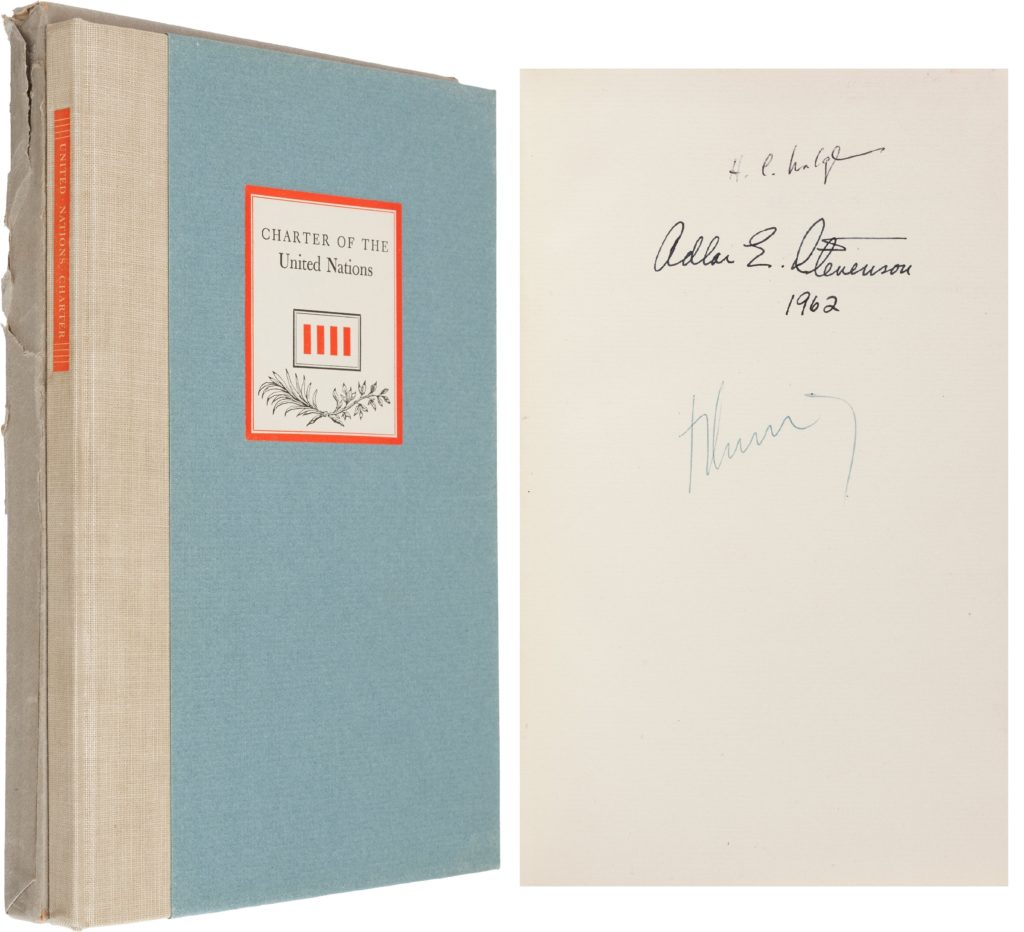
This 1945 copy of Charter of the United Nations and Statute of the International Court of Justice, signed by John F. Kennedy, Henry Cabot Lodge and Adlai E. Stevenson, sold for $2,375 at an April 2014 auction.

“… To save succeeding generations from the scourge of war …” — From the United Nations Charter

By Jim O’Neal

Edward Stettinius, chair of the U.S. delegation to the United Nations conference in San Francisco, signed the U.N. Charter in 1945. President Harry Truman was in attendance and later signed the document by which he ratified the charter of the United Nations.

The charter established the structure of the United Nations and outlined its guiding principles to prevent war, affirm fundamental human rights, facilitate international peace and security, promote improved living standards, and support social progress and economic advancements (whew!).

The United States, Britain and the USSR were the primary designers of the decision-making structure. The General Assembly consisted of all member countries. The Security Council, which was responsible for international peace and security, originally had 11 members, six of which were elected to two-year terms. Five – the United States, Britain, USSR, France and China – were permanent members, and each had veto power on Security Council resolutions.

Disagreements based on national interests plagued the discussions at the April conference, but they did not prevent the formal U.N. formation. There was also considerable debate about the voting process and veto provisions. Finally, on June 25, the delegates unanimously adopted the charter and the next day they all signed the document.

After the permanent members of the Security Council and most other members ratified the charter, the United Nations was officially established on Oct. 24, 1945. The world had entered a new period of international collaboration determined to avoid a repeat of the two wars that had caused so much devastation in the first half of the 20th century.

Alas, these lofty aims did not last long as the Cold War soon started, followed by major conflicts in Korea, Vietnam (twice), Afghanistan, etc. When we look around the world today, it’s estimated that the United States has Special Forces in over 70 countries (at least) and ad hoc terrorism is a routine, daily occurrence in many places. A new Cold War is gradually taking shape and even nuclear proliferation is back in the news.

Maybe conflict is in our DNA.

One thing is certain. Assuming the United Nations survives, they will have plenty to do for a long time.

Jim O'NielIntelligent Collector blogger JIM O’NEAL is an avid collector and history buff. He is president and CEO of Frito-Lay International [retired] and earlier served as chairman and CEO of PepsiCo Restaurants International [KFC Pizza Hut and Taco Bell].
President Harding’s Funeral Train Transfixed the World

president-harding
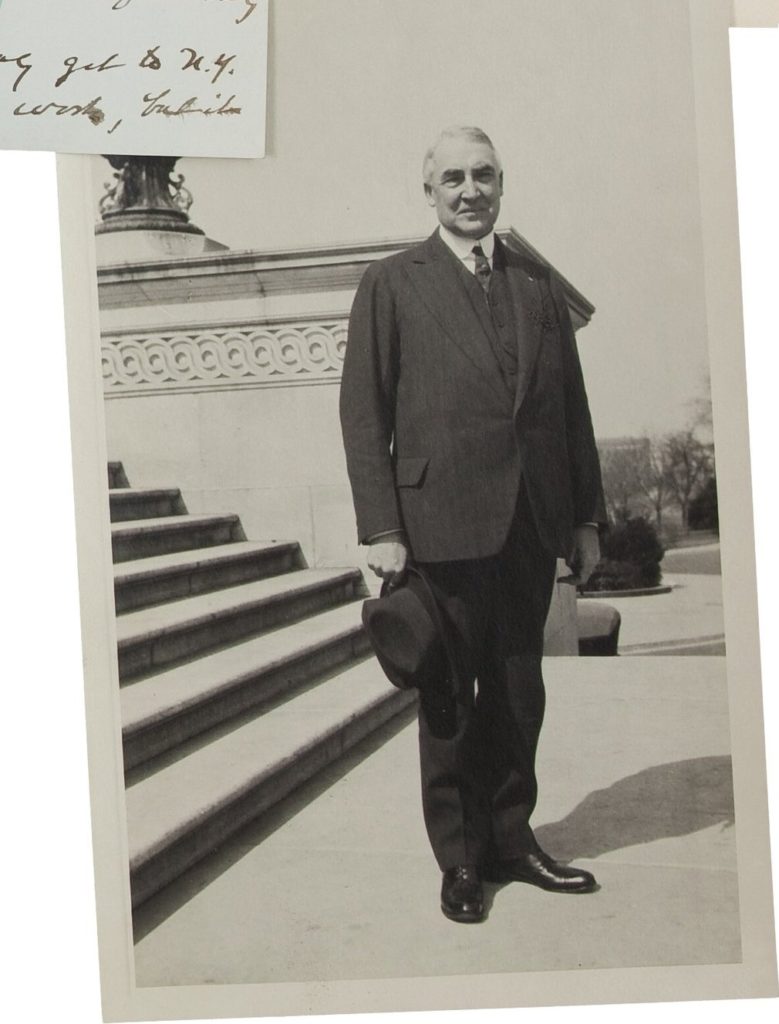
President Harding was popular with Americans, but the Harding Scandals later tainted his legacy.

By Jim O’Neal

The news of President Warren G. Harding’s death astonished the American people. Telephone and telegraph lines stayed busy between San Francisco and Washington. A special railroad car, “The Superb,” was outfitted as a hearse. Twenty-four hours after the president died, the train left San Francisco, pulling the lighted car with its flag-draped coffin, honor guard and banks of flowers.

“The spectacle of the funeral train traversing the entire breadth of the United States,” observed The Washington Post, “is not to be forgotten.”

News of Harding’s death arrived at the White House by telephone. Irwin “Ike” Hoover, the White House Chief Usher, had been trying to keep a diary, but he never seemed to make a record of important things. “President dies” was all he recorded that day. In fact, his book was merely a series of blank pages for all the early days of August 1923. Hoover’s job was to run the White House, not record history. He quickly set to work hanging crepe over the mirrors of the East Room. Then the shades were drawn and the house was closed to the public.

Later, the book 42 Years in the White House chronicled Hoover’s service, which started in 1891 (when he installed the first electrical wiring in the White House) and continued through nine presidents, starting with Benjamin Harrison and ending with Herbert Hoover. He died in 1933 and President Franklin D. Roosevelt offered the White House for his funeral. Oh, the tales that probably didn’t get recorded.

Harding’s funeral train pulled into Union Station on Aug. 7. It had held the world transfixed during its five-day trip across the nation. An honor guard transported the coffin from the train with great ceremony and Harding’s body was placed in the East Room. The funeral was held in the Capitol with his Cabinet, Congress and a large group of invited dignitaries.

Florence Harding had a quiet dinner with Calvin Coolidge and his family, and would remain in the White House for five busy days. She had a fire built in the fireplace in the Treaty Room and then methodically started burning the presidential papers she determined should not survive. Then she had all the remaining papers packed into boxes and removed to a nearby friend’s house. Then she resumed the burning more slowly in small fires on the lawn.

President Harding’s secretary, George Christian, stood by helplessly during this process, until he found some papers undisturbed in the Oval Office and hid them in the pantry on the first floor. They remained there, apparently forgotten, until after Mrs. Harding’s death. Then they were given to the Library of Congress. No other papers of President Harding are known to have survived the purge of his records.

Later, the “Harding Scandals” would offer one possible reason for this unusual situation.

Jim O'NielIntelligent Collector blogger JIM O’NEAL is an avid collector and history buff. He is President and CEO of Frito-Lay International [retired] and earlier served as Chairman and CEO of PepsiCo Restaurants International [KFC Pizza Hut and Taco Bell].
Ford Viewed his Legacy as Rebuilding Confidence in the Presidency

gerald-ford-presidential-seal-hooked-rug
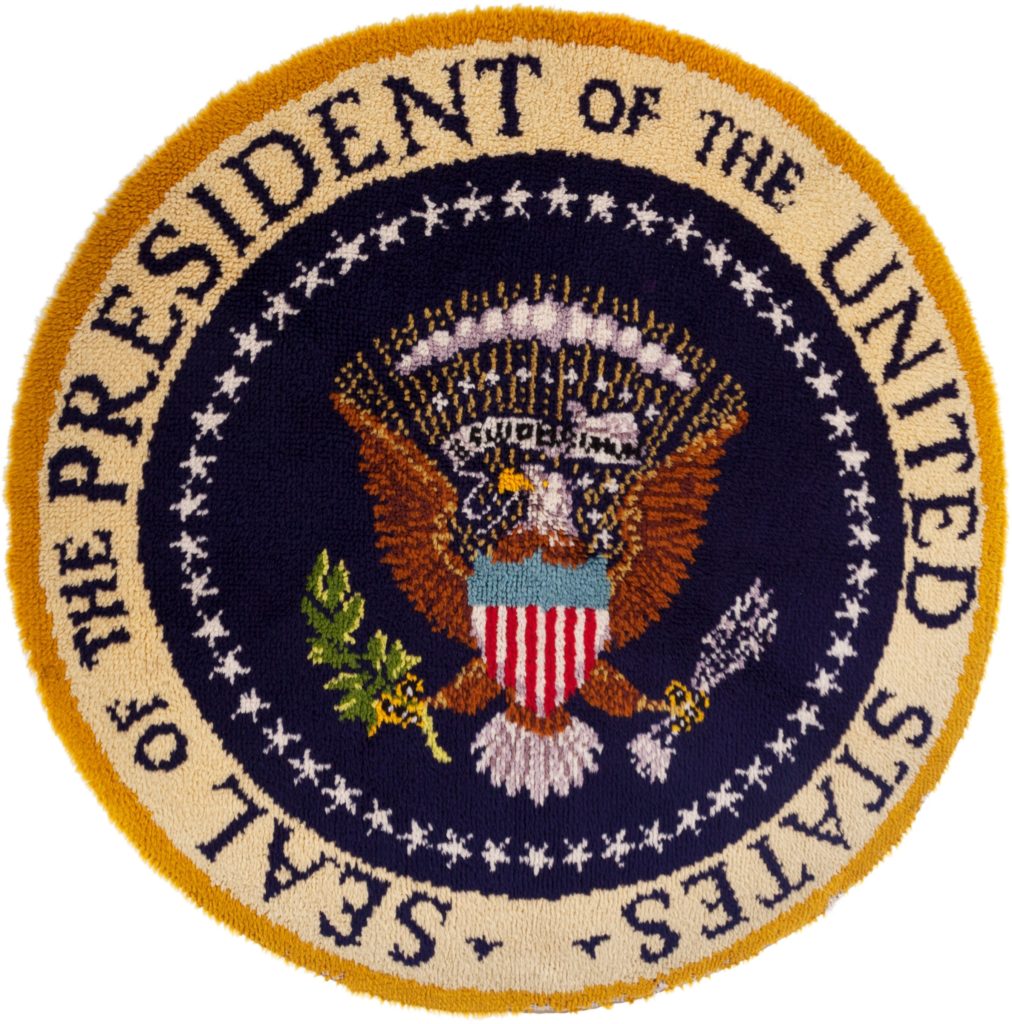
Gerald Ford’s Presidential Seal hooked rug, used in his home office in Rancho Mirage, Calif., sold for $13,145 at a December 2012 Heritage auction.

By Jim O’Neal

Public opinion polls as early as 1975 indicated that President Gerald Ford would be unlikely to win the Republican nomination for president in 1976. The main competition came from the conservative former governor of California, Ronald Reagan. However, Ford was determined to campaign hard and plunged into an aggressive schedule.

The mass demonstrations at the White House had finally started to wind down, although there was another incident in March 1975. Sixty-two protesters entered the grounds on the regular daily tour and then refused to leave, saying the U.S. should end involvement in the Indochina war and liberate the 200,000 political prisoners in South Vietnam. President Ford’s amnesty offer to those who had avoided the draft expired on March 1, and the protesters also demanded amnesty for “anyone who had resisted the war.” Most were booked and released from jail.

As the president started his campaign trip West, there were some nasty surprises lurking in Northern California. On Sept. 5, 27-year-old Lynette “Squeaky” Fromme, a cult follower of convicted mass murderer Charles Manson, pulled a partially loaded Colt-45 and fired it at Ford when he was two feet away. There was no bullet in the firing chamber and an alert Secret Service agent grabbed the gun before it could be fired again.

Three weeks later, as Ford left his San Francisco hotel (the St. Francis), 45-year-old Sara Jane Moore, a civil-rights activist, fired a 38-caliber revolver at him, but missed. A bystander prevented her from taking a second shot. Both women were convicted and given life sentences. Subsequently, both were released under a federal law that allows parole after 30 years, although “Squeaky” served two extra years for a prison escape/recapture.

gerald-ford
President Ford

At the GOP convention in Kansas City, Ford narrowly won the nomination on Aug. 19 with 1,187 votes to Reagan’s 1,070. He chose Bob Dole for his running mate. The Democrats picked Jimmy Carter and once again the opinion polls showed that the president was far less popular than the Georgia peanut farmer.

Ford challenged Carter to a series of televised debates – the first time an incumbent president debated an opponent. Ford also campaigned hard and nearly caught Carter, but in the November election he became the first sitting president to be defeated since Herbert Hoover in 1932.

In his final State of the Union address to Congress on Jan. 12, 1977, Ford said, “I am proud of the part I have played in rebuilding confidence in the presidency, confidence in our free system and confidence in our future. Once again, Americans believe in themselves, believe in their leaders, and in the promise that tomorrow holds for their children.”

Amen.

Jim O'NielIntelligent Collector blogger JIM O’NEAL is an avid collector and history buff. He is President and CEO of Frito-Lay International [retired] and earlier served as Chairman and CEO of PepsiCo Restaurants International [KFC Pizza Hut and Taco Bell].
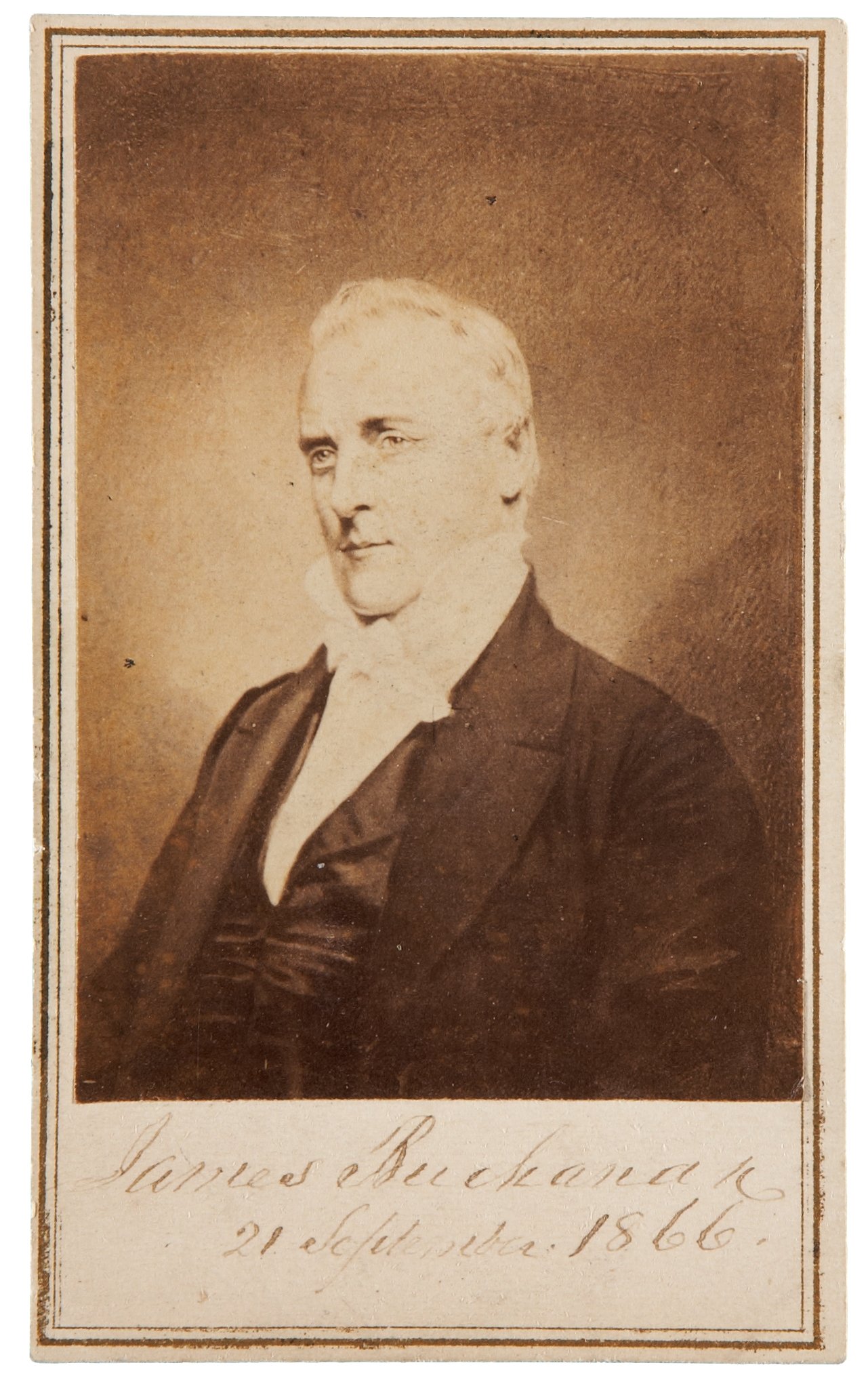
As Civil War Loomed, Buchanan Failed to Act, Assumed the Worst

James Buchanan Carte de Visite Signed
This James Buchanan carte de visite, signed and dated September 1866, sold for $6,572.50 at a February 2010 Heritage auction.

By Jim O’Neal

James Buchanan was elected to the U.S. Senate in 1834 and represented Pennsylvania for 11 years during the administrations of presidents Jackson, Van Buren, Harrison and Tyler. He turned down offers to serve as U.S. attorney general for Van Buren and an appointment to the Supreme Court by Tyler. After campaigning for Polk in the election of 1844, he finally accepted the position of secretary of state, since it seemed like a clear path to the presidency.

This was a bad decision and when he and President Polk could not agree on major issues, Buchanan would complain to a friend, “My life is that of a galley slave.”

Buchanan then failed to win the Democratic nomination in 1848 and 1852, but at the age of 62, was given the post of U.S. Minister to Great Britain. There, he gained unexpected notoriety when he secretly joined with other ministers (Pierre Soulé in Spain and John Mason in France) to draft the infamous “Ostend Manifesto,” which proposed to buy Cuba from Spain. If Spain refused, then “we shall be justified in wresting” the island from its owners … a strong inference of war.

Cuba was especially important to Southern Democrats since it was primarily a plantation-slave economy based on sugar and having it as a state would add two senators and nine members to the House of Representatives. However, anti-slave Northerners were not about to go to war with Spain to add more slave states to the Union and the effort was easily defeated.

At the Democratic National Convention in Cincinnati in June 1856, Buchanan bounced back, winning the nomination and then the election.

Two days after Buchanan was sworn in as president, the Supreme Court handed down the Dred Scott decision, which affirmed the right of slave owners to take their slaves into Western territories. This bolstered Buchanan’s belief that slavery was rooted in the Constitution and could not be legislated out of existence; it was an issue for each state to decide.

Then came the Panic of 1857, which was caused by the failure of Ohio Life Insurance Company of Cincinnati. The sudden demise of a once-solid institution touched off a wave of bank runs across the nation that plunged the nation into a deep economic depression. Many railroads failed due to over-expansion as did many state banks that were operating under flimsy regulations. The only areas that were unaffected were the cotton-growers exporting to England (and they needed more slaves to expand production).

It was clear that the slavery issue would lead directly to a civil war and James Buchanan was too inept or unwilling to provide leadership to avoid one. He just assumed the worst and declared that he “would be the last president of a United States.”

Fortunately, he was wrong, but it would take four long years and 620,000 dead Americans to prevent it.

Jim O'NielIntelligent Collector blogger JIM O’NEAL is an avid collector and history buff. He is President and CEO of Frito-Lay International [retired] and earlier served as Chairman and CEO of PepsiCo Restaurants International [KFC Pizza Hut and Taco Bell].
Van Buren’s ‘Palatial’ White House Not Popular with Voters

martin-van-buren-large-oval-sulfide-brooch
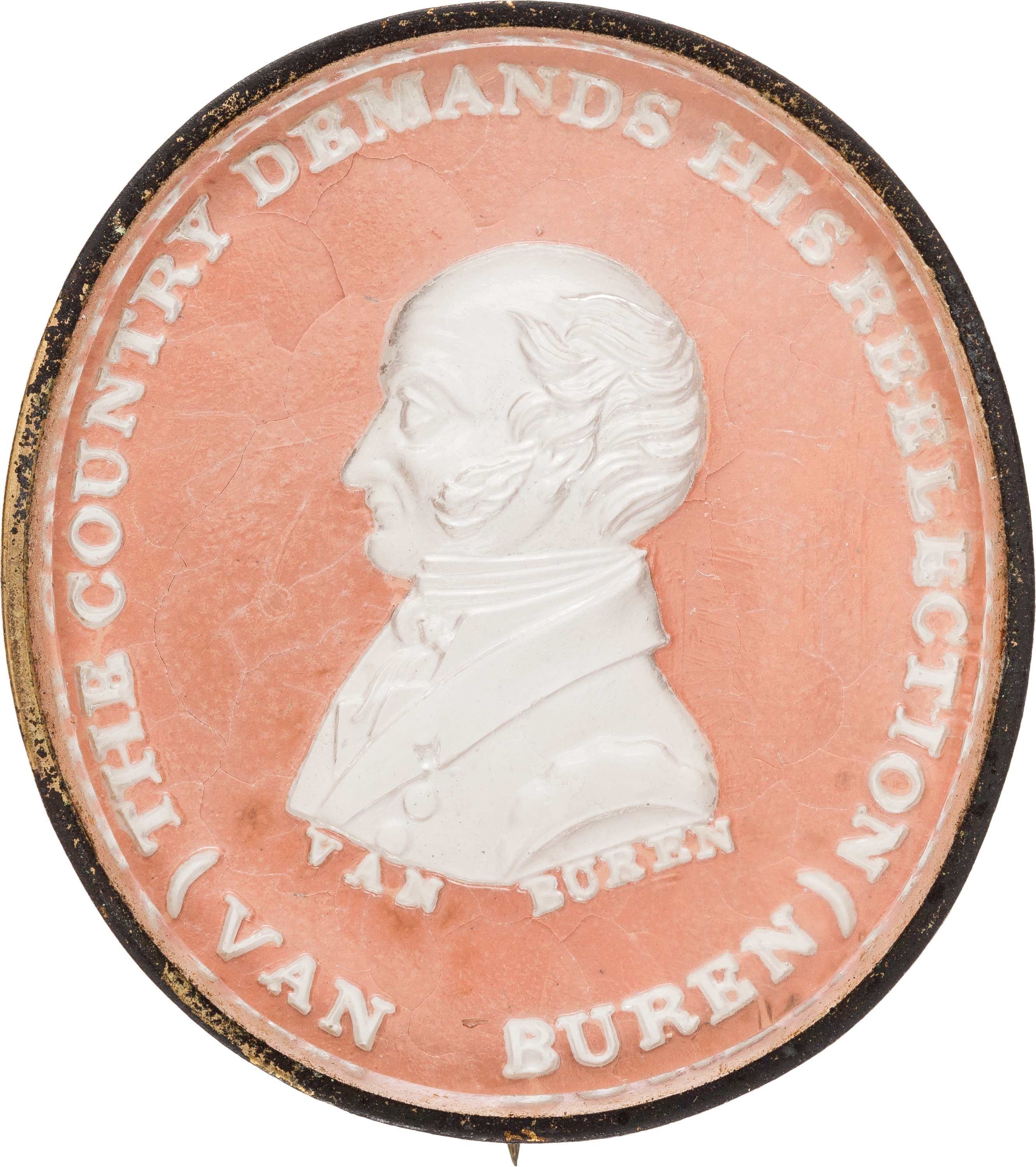
This Martin Van Buren oval sulfide brooch with the slogan “The Country Demands his Re-election,” sold for $12,500 at a September 2015 Heritage auction.

By Jim O’Neal

Martin Van Buren achieved the unique distinction of holding the offices of state senator and attorney general of New York, U.S. senator, governor of New York, U.S. secretary of state, vice president and then president.

However, he was never able to win popular support for himself or his policies at the national level.

The nation’s first major economic depression, the Panic of 1837, was undoubtedly the primary cause for undermining his popularity, although he was not responsible for the causation. Nearly a century later, another president, Herbert Hoover, would suffer nearly the same unfortunate fate.

Van Buren was the first president to be born an American citizen (1782) and he became adroit at behind-the-scenes political maneuvers. Yet, the general impression of him was that he was snobbish, autocratic and a conniver (“The Fox”). Van Buren became an obvious target for the poison darts of the Whigs as they characterized him as the antithesis of Andrew Jackson’s common-man philosophy.

Van Buren did little to combat criticism of this kind and in some respects even seemed to encourage it in his use of the White House. Adverse comments on the high style of living and aristocratic pretension in the WH increased each year of his presidency. By 1840, newspaper slurs on Van Buren as a princely pretender escalated and the continuing agony of the Panic made good copy in the Whig press.

On the afternoon of April 14, 1840, the House of Representatives sat as a committee to hear a prepared address by Charles Ogle, a Whig from Somerset, Pa., on the subject of President Van Buren and his “palatial” White House. One of the president’s supporters refuted the allegation, but then Ogle unleashed a dramatic rebuttal. This time he kept the house floor for three days and by the second day, the galleries were packed with spectators. This highly unusual attack made Ogle famous and printed copies of his remarks were circulated, first around the Capitol and then nationally by most newspapers. It was a devastating indictment of a president.

Martin Van Buren was too seasoned a politician to lose his temper, but his detachment from the storm of protest against him by the Whigs surprised even his closest friends.

When it came time for the 1840 election, the Whigs took a cue from the Jacksonians of 1828 and drafted a common-man hero – General William Henry Harrison. By then, sentiment had turned against Van Buren and he was defeated. A record number of citizens voted, 2.5 million, with Van Buren losing by 150,000. In the Electoral College, it was worse, with Harrison capturing 19 of the 26 states.

For all the bitterness of the campaign, Van Buren was determined not to be a poor loser. He not only witnessed Harrison’s oath-taking, but was among the first to shake his hand. The “Little Magician” offered every courtesy, gaining the admiration of a skeptical press. He left Washington by train. However, it was not his intention to be gone forever. He would try to regain the presidency in the next two elections.

Despite his efforts, he would never live in the White House again.

Jim O'NielIntelligent Collector blogger JIM O’NEAL is an avid collector and history buff. He is President and CEO of Frito-Lay International [retired] and earlier served as Chairman and CEO of PepsiCo Restaurants International [KFC Pizza Hut and Taco Bell].