America’s greatest contribution to humanity remains ‘freedom’

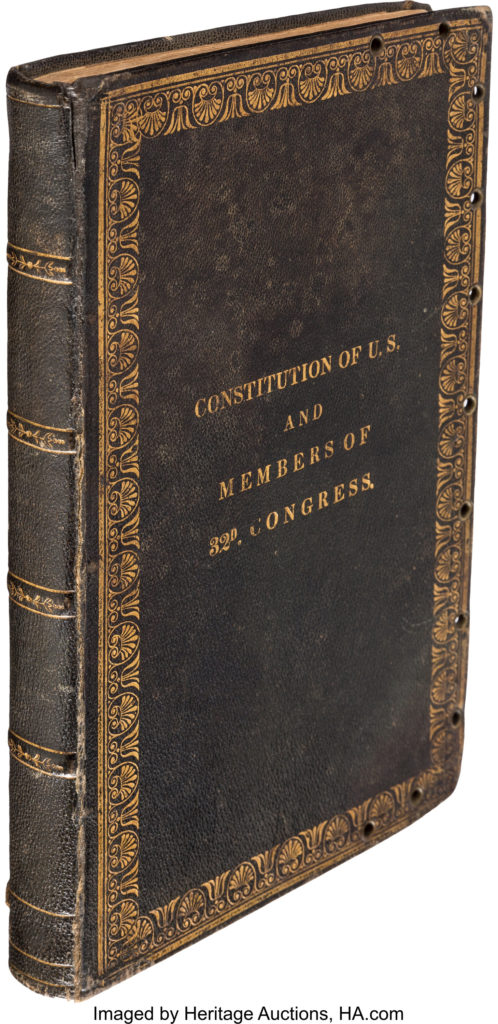
An 1852 presentation copy of the Constitution of the United States, signed by President Millard Fillmore, sold for $15,000 at an April 2016 Heritage auction.

By Jim O’Neal

Constitutional scholars are prone to claim there is a direct and historic link between the First Commandment of the Old Testament and the First Amendment of the U.S. Constitution … that one leads inexorably to the other. The First Commandment explains the origins of freedom and the First Amendment defines the scope of freedom in broad categories.

Both point unmistakably to freedom as America’s greatest contribution to humanity. Not the automobile, jazz or Hollywood. Not the word processor, the internet or the latest smartphones. All of these are often described as America’s unique assets, but it is the awesome concept of “freedom” that is America’s ultimate symbol, attraction … and even export!

The First Commandment reads, “I am the Lord thy God, who brought thee forth out of Egypt, out of the house of bondage, and thou shalt have no other gods before me.” In this way, God sanctions an escape from bondage and puts people on a path toward the “promised land,” toward freedom. This powerful message ricocheted through history until it finally found a permanent home in Colonial America.

In the early 18th century, the trustees of Yale, many of them scholars who read scripture in the original Hebrew, designed a coat of arms for the college in the shape of a book open to two words, Urim and Thummim, which have come to mean “Light” and “Truth” in English. The book depicted, of course, was the bible.

Not too far north, Harvard graduates had to master three languages … Latin, Greek and Hebrew. True gentlemen in those days had to have more than a passing familiarity with the Old Testament. It was not a mere coincidence that carved into the Liberty Bell in Philadelphia, relaying a brave message to a people overthrowing British rule, was an uplifting phrase selected from chapter 25 of Leviticus: “Proclaim liberty throughout the land, unto all inhabitants thereof.”

The Commandment that blessed an escape from oppression and embraced the pursuit of freedom led the Founding Fathers to pen the Bill of Rights. They had much on their minds, many interests to try and reconcile, but they agreed that the delineation of freedom was to be their primary responsibility. It was to become the First Amendment to the recently ratified Constitution, inspired in part by the First Commandment, and it read, “Congress shall make no law respecting an establishment of religion or prohibiting an establishment of religion, or prohibiting the free exercise thereof, or abridging the freedom or speech, or of the press, or the right of the people peaceably to assemble, and to petition the government for a redress of grievances.”

Throughout American history, these freedoms have become intertwined with American life, one indistinguishable from the other. Just consider that in one small grouping of words, into a single Amendment, resides more freedom for mankind than had ever existed in the history of the world. Somewhat remarkable, in my opinion, yet we take it for granted today and can only fine tune minor opinions on original intent in small insignificant instances.
Intelligent Collector blogger JIM O’NEAL is an avid collector and history buff. He is president and CEO of Frito-Lay International [retired] and earlier served as chair and CEO of PepsiCo Restaurants International [KFC Pizza Hut and Taco Bell].
Powerful images helped FDR advance his agenda

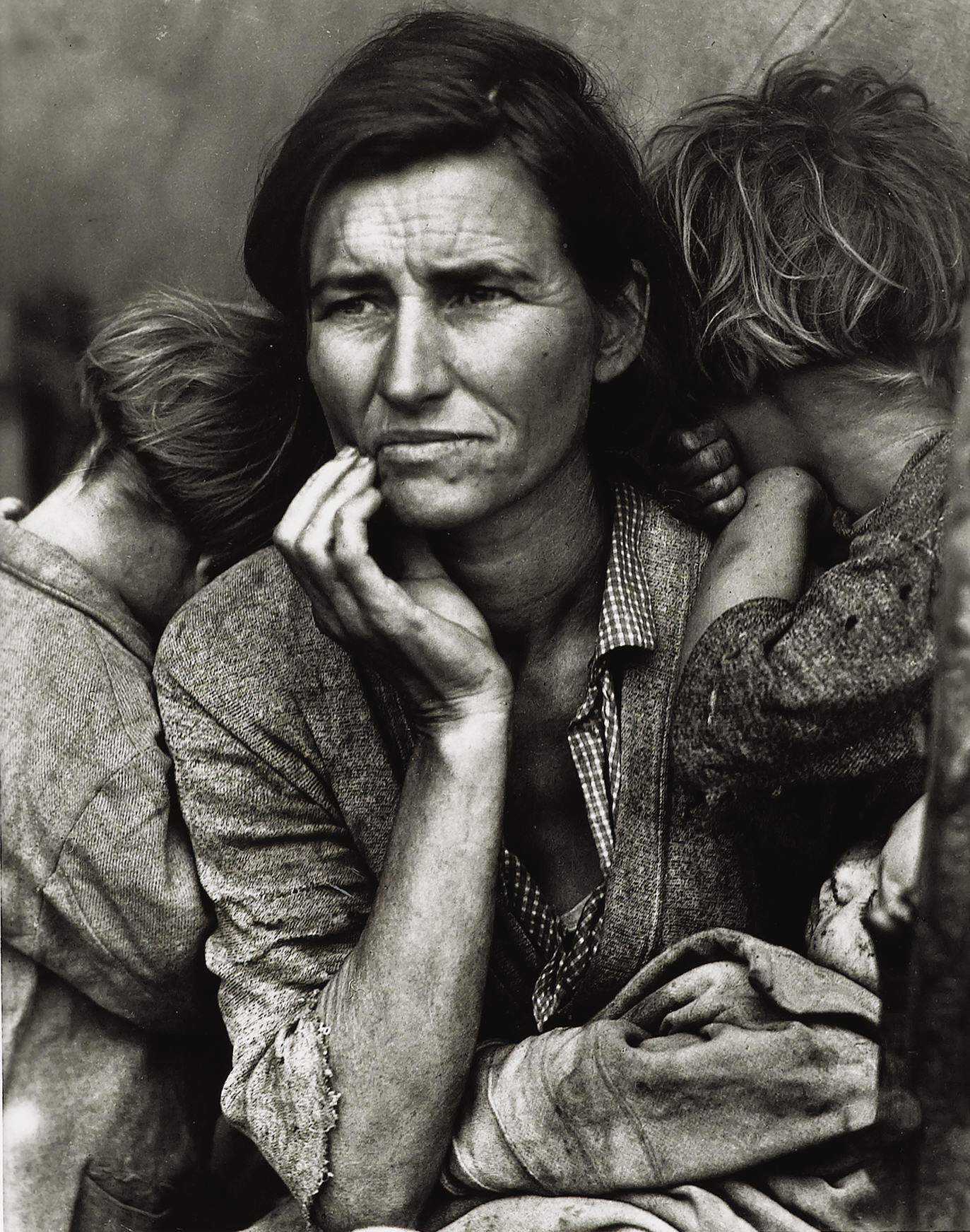
Dorothea Lange’s 1936 Migrant Mother was taken while she was employed by the U.S. government’s Farm Security Administration program.

By Jim O’Neal

President Franklin D. Roosevelt understood that it was not enough for only him to understand the Great Depression’s grip on the nation. The American people would have to see for themselves the faces of their fellow citizens, their backs against the wall, drained by the struggle to hold families and farms together.

The Depression was in its fourth year. In the neighborhoods and hamlets of a stricken nation, millions of men and women languished in sullen gloom and looked to Washington with guarded hope. Still they struggled to comprehend the nature of the calamity that had engulfed them. At the new Federal Emergency Relief Administration, headed up by Harry Hopkins, rivers of data flowed that measured the Depression’s impact in cold, hard numbers. Shareholders had seen the value of their assets decline by 75 percent since 1929, a colossal financial meltdown affecting the idle rich, struggling neighborhood banks, retirement nest eggs and even university endowments. Five thousand banks failed between the crash and the New Deal’s rescue operations in March 1933, wiping out $7 billion of depositors’ money.

Mortgage loan defaults accelerated – 150,000 homes lost in 1930; 200,000 in 1931; 250,000 in 1932. This stripped millions of people of both shelter and life savings in a single stroke, menacing the balance sheets of thousands of surviving banks. Shrinking real estate prices and tax revenues forced 1,300 municipalities to default, cutting services, payrolls and paychecks. Chicago reduced teacher pay and by 1932-33 cut their pay to zero.

Gross national product fell in 1933 to half of 1929, while capital spending on plant and equipment plummeted to $3 billion from $24 billion. Car production dropped 60 percent and steel was even worse. Mute bands of jobless men drifted through the streets of every American city on the prowl for jobs that didn’t exist.

Hardest hit was the countryside. Income for America’s farmers collapsed from $6 billion to $2 billion in three years. Unemployment and reduced wages were the most obvious and fell hardest on the most vulnerable: the young, the elderly, the least educated, the unskilled, and especially on rural Americans, with large numbers of immigrant workers.

But Hopkins knew that he needed more than sterile economic data to gain the necessary political power to make the structural government changes required. They needed to touch the human face of the catastrophe, taste the metallic smack of the fear and feel the hunger of the unemployed. He convinced Lorena Hickok of the Associated Press in July 1933 to travel the entire nation … talking to a broad swath of Americans and capturing their stories in their own words and in photographs. With FDR’s encouragement, a flood of documentary photographs would be converted into political power on a massive scale. In addition to Hickok, they contracted some of the nation’s finest photographers. Names like Dorothea Lange, Arthur Rothstein, Walker Evans and others would help create the consciousness necessary to mobilize the government’s resources. Their photographs helped create the absolute sense of urgency needed so desperately.

The small, nimble government agency that would support and encourage their photographic mission was the Resettlement Administration – later called the Farm Security Administration (FSA) – under the leadership of Rexford Tugwell, an original member of FDR’s brain trust, and still Assistant Secretary of Agriculture. Importantly, neither the Resettlement Administration nor the FSA had any Congressional oversight. These photographers had the freedom to tell the truth as they saw it. Their photographs are now housed in the Library of Congress and bear witness to what people were enduring, refuting what newspapers had been calling “moochers” or “an invading hoard of the idle.”

Looking at these portraits now, we can see the compassion of the photographers and the dignity of real Americans on the edge. They refuted the charges of those who thought the pictures were political propaganda. In discussions of the work of Dorothea Lange and her husband Paul Taylor, the photographer/curator Thomas Heyman summed it up: “They clung to the hope that what they were doing might be part of the solution.”

The strategy worked and FDR was given a mandate to introduce all aspects of the New Deal, the most expansive role of the federal government into America’s daily life. After the 1936 elections, newspaper editor William Allen White said, “He has all but been crowned by the people.” Still, it would take yet another war to get everybody back to work.

Intelligent Collector blogger JIM O’NEAL is an avid collector and history buff. He is president and CEO of Frito-Lay International [retired] and earlier served as chair and CEO of PepsiCo Restaurants International [KFC Pizza Hut and Taco Bell].
Believe it or not, electing presidents has never been a pleasant affair

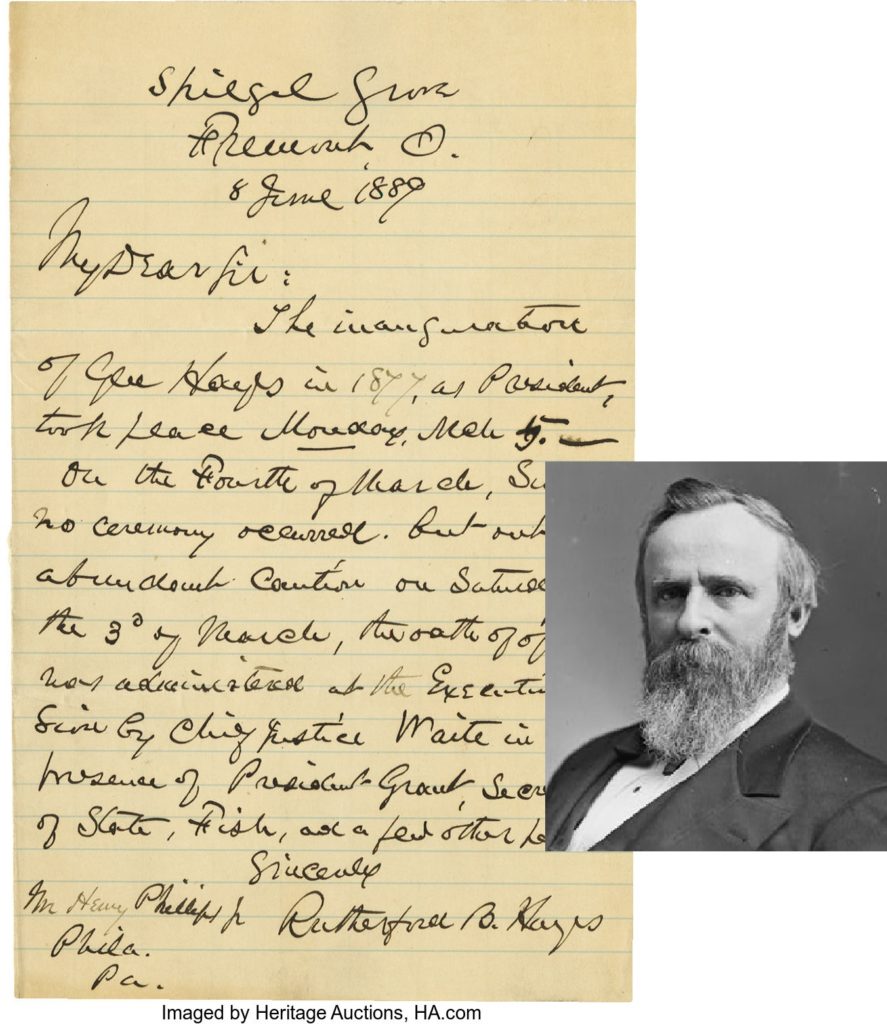
An 1889 letter in which Rutherford B. Hayes discusses his inauguration sold for $19,120 at an April 2007 Heritage auction.

By Jim O’Neal

One discouraging trend in American culture is treating everything from a partisan-political standpoint. I can recall not too long ago after an election, we’d simply forget about our disagreements about candidates and resume normal civility. Now it seems that nearly everything gets politicized, dividing the nation into continually warring tribes of Red and Blue. Some political pundits see the starting point as the 2000 Gore versus Bush election, with its hanging chads and the controversial Supreme Court decision to stop the vote recount in Florida. Others believe the feud between President Bill Clinton and Speaker Newt Gingrich exacerbated it.

However, to accept either theory requires ignoring the 1876 presidential election between Samuel Tilden and Rutherford B. Hayes.

Hayes, the Republican, was a lawyer from Ohio who distinguished himself during the Civil War as a brave soldier who was wounded five times and eventually promoted to a brevet major general. After the war, he served in Congress and was elected governor of Ohio three times.

Tilden also had a legal background and was the 25th governor of New York (1875-76). As the Democratic candidate for the presidency in 1876, he is still the only individual to win an outright majority (not just a plurality) of the popular vote, but lose the election … in a rather bizarre series of events. Four other candidates have lost the presidency despite having a plurality of the popular vote (Al Gore and Hillary Clinton are the most recent to suffer this fate).

It had generally been assumed that incumbent President Ulysses S. Grant would run for a third term, despite a troubled economy and numerous scandals that had been discovered during his two terms, which started in 1869. There was also the two-term precedent established by George Washington. In spite of these formidable barriers, Grant’s inner circle of advisors were eager to maintain political power. While Grant was on the verge of announcing his candidacy, the House of Representatives preempted him by passing a resolution by an overwhelming margin, 233-18, establishing a two-term limit to prevent a dictatorship. Grant reluctantly withdrew his name from consideration.

The Democrats proceeded with their National Convention in June 1876 in St. Louis (the first time a major political convention was held west of the Mississippi). They selected Tilden on the second ballot and added Thomas Hendricks for vice president, since he was the only one nominated. The Democrats were hungry for a win since they had been out of power since James Buchanan, who was elected a full 20 years earlier in 1856.

What followed was the most contentious presidential election in American history. On the first vote in the Electoral College, Tilden had 184 votes (only one short) while Hayes was stuck at 165. However, there were 20 votes being contested in four states (Florida, Louisiana, South Carolina and Oregon) and both parties were claiming victory. This impasse caused a Constitutional crisis and, finally, a beleaguered Congress passed a law on Jan. 29, 1877, to form a special 15-member Electoral Commission to settle the dispute. After a great debate, the commission awarded all 20 disputed votes to Hayes, who became president with 185 votes to Tilden’s 184.

In return, Republicans passed a resolution that required an end to Reconstruction and the removal of all federal troops from every Southern state. Over the next 20 years, the states passed all kinds of laws and regulations that effectively wiped out the provisions of the 14th and 15th Amendments to the Constitution that granted numerous rights to the black population. It would take another 60 years to regain them when LBJ was president and finally crack the “Solid South” grip on national politics.

Maybe we are doomed to be a divided nation, but I suspect that strong leaders will emerge, eventually, and help us remember the advantages of a group of united states … E pluribus unum.

Intelligent Collector blogger JIM O’NEAL is an avid collector and history buff. He is president and CEO of Frito-Lay International [retired] and earlier served as chair and CEO of PepsiCo Restaurants International [KFC Pizza Hut and Taco Bell].
Real Populist legacy lives on in a thousand different ways

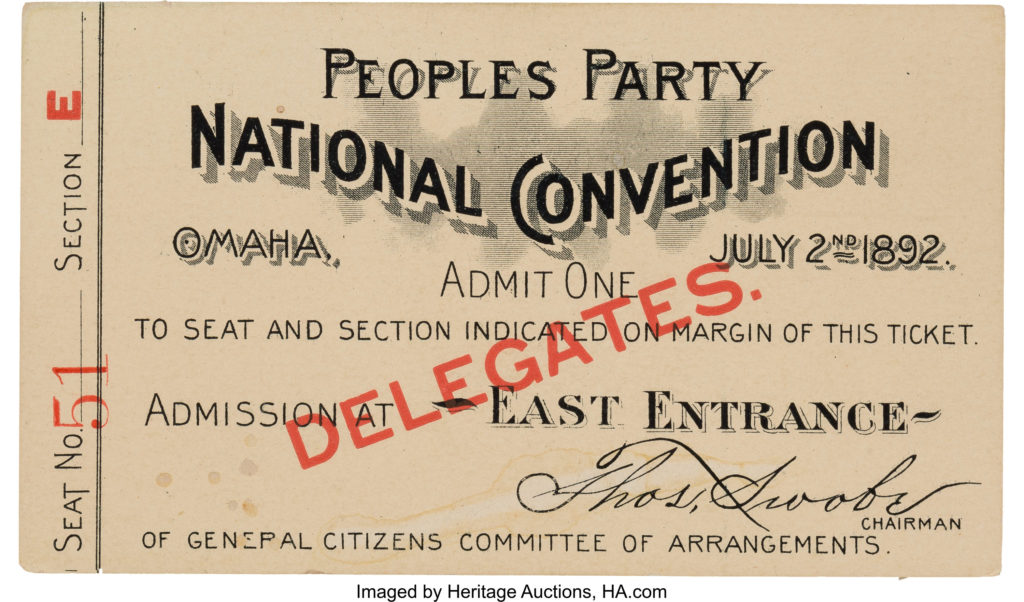
The People’s Party, also known as the Populist Party, met in Omaha, Neb., in 1892 and nominated James B. Weaver for its presidential ticket. A convention ticket went to auction in March 2018.

By Jim O’Neal

After the Civil War, thousands of farmers found themselves mired in a European style of serfdom. By 1883, they were trapped by the monopolistic pricing of both merchants and the railroads, which consumed virtually all their profits. To make their dilemma even worse, the federal government had returned to the gold standard after the war ended and demands of Wall Street drained money from rural banks to the point that entire regions were essentially broke.

The poor farmer was in the classic squeeze where the harder they worked and the more they produced the less they had. An early attempt to break the conundrum was to band together in what was called the Farmers’ Alliance, which began in Lampasas, Texas, in 1877. The Alliance quickly spread to Kansas, but within six years it was a failed effort since market forces were simply too strong for such an amateurish effort born out of desperation and lacking any real leverage or political power.

Voila! Enter the first in a long string of populists, a 36-year-old former tenant farmer from Mississippi: S.O. Daws. It was Daws’ goal to convert the Alliance into an overtly political organization, with its own Populist platform, formal candidates and party structure. However, his real genius lay in a dazzling oratory skill and grasp of political tactics. Daws persuaded the Alliance to appoint him “Traveling Lecturer” and he quickly started spreading the word and convincing his fellow farmers what to do.

One of his converts was a 34-year-old Tennessean named William Lamb, an undereducated (25 days of formal education) rail-splitter and farmer with an almost unsurpassed talent for organization. Together, Daws and Lamb provided the spark the Alliance had been missing. They used the sweeping executive power the farmers granted and soon had literally hundreds of thousands of new recruits in the organization. All told, they actually enlisted over 2 million people in 43 states. Populist historian Lawrence Goodwyn characterized it as the most massive organizing drive of any citizen institution in the entire 19th century in America.

But the Populists were never really about their leaders. They were about an idea, or actually many ideas … anything that might allow common men to make a living off the land while maintaining their human dignity. Generally, they were derided as nativist hicks, primarily because of later efforts. At the beginning, when they were at their best, they were staunchly anti-racist and injected a firestorm of ideas into a political system that tended to be moribund. Populist programs included a graduated income tax, the eight-hour workday, direct election of senators, citizen referendums, the secret ballot and, above all, regulation of agricultural markets to ensure farmers a decent return for their labor.

Time and fate worked against the Populists as America became increasingly industrialized with the lure of urbanization. After running their candidate for president in 1892, James B. Weaver of Iowa, the Populist Party (also known as the People’s Party or simply the Populists) folded themselves into William Jennings Bryan’s silver wing of the Democratic Party. Naturally, many of their ideas were also subsumed into other progressive political movements. One example is Sam Ealy Johnson (LBJ’s father), who served in the Texas House of Representatives from 1905-1924, and who said: “The job of government is to help people who are caught in the tentacles of circumstances.” Clearly a Populist inspiration.

Obviously, FDR incorporated many of the same concepts into his New Deal programs that helped during the Great Depression. The real Populist legacy lives on in a thousand other ways yet today, but these were people capable of standing in the hot sun for hours, and listening to speeches about obscure and esoteric subjects while working their way to a better life for all. This is how a democratic culture is created and we need to ensure it doesn’t get diluted by ruinous socialist beliefs that have failed every time well-intentioned people go too far.

Intelligent Collector blogger JIM O’NEAL is an avid collector and history buff. He is president and CEO of Frito-Lay International [retired] and earlier served as chair and CEO of PepsiCo Restaurants International [KFC Pizza Hut and Taco Bell].
Here’s why Foote, Faulkner are among our greatest writers

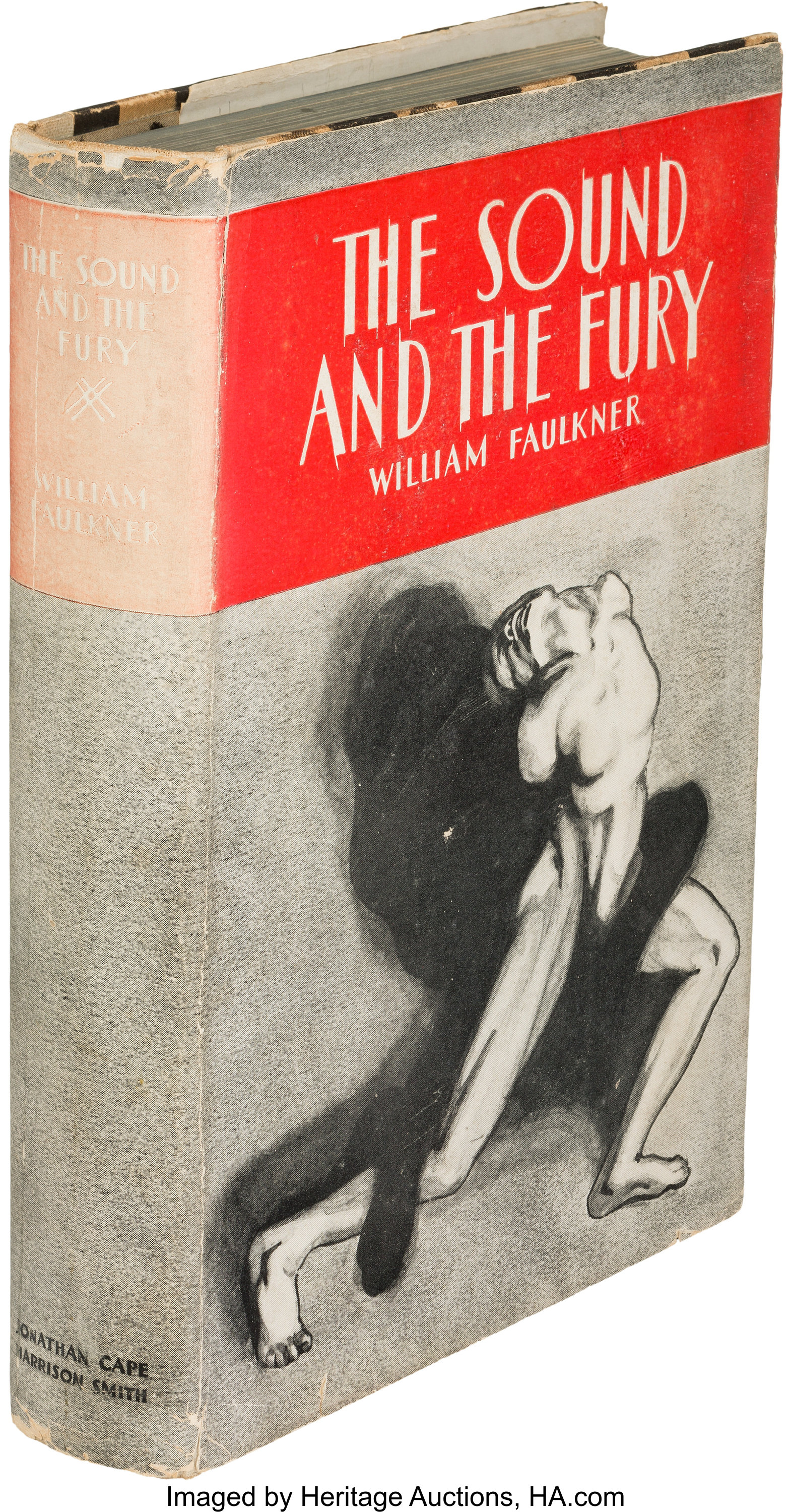
A 1929 first edition of William Faulkner’s The Sound and the Fury, in its original first state dust jacket, sold for $15,000 at a March 2018 Heritage auction.

By Jim O’Neal

Whenever the topic of “favorite author” is inevitably raised, I quickly steer the conversation to two categories. First is non-fiction, since it gives me an opportunity to nominate Shelby Foote for my all-time favorite subject of the Civil War. Secondly, I suggest that fiction favorites be limited to only writers born in the great state of Mississippi.

Shelby Dade Foote Jr. (1916-2005) spent over 20 years working on his masterpiece The Civil War: A Narrative, a three-volume, 3,000-page work that captivated me. However, like many others, it wasn’t until filmmaker Ken Burns aired his PBS documentary in 1990 that I became aware of just how much I truly appreciated it. In the first hour of the 12-hour series, Foote appeared in 90 segments. His sagacious comments and distinctive Southern drawl added a remarkable degree of authenticity to an otherwise only great production.

Legend has it that paperback sales of Foote’s book jumped to 1,000 per day and ended up selling over 400,000 mores copies – all as a result of his newfound celebrity. He reportedly remarked to Burns: “You have made me a millionaire.” A few critics complained that Foote had a Southern bias and cited a passage where he stated that Abraham Lincoln and Confederate Army general Nathan Bedford Forrest were the two smartest men in the entire war and tried to point out a few weaknesses of Forrest when they really objected to simply pairing him with the revered Lincoln.

As for fiction writers born in Mississippi, there are a lot more to choose from than you might expect. Consider Eudora Welty (The Optimist’s Daughter), Willie Morris (North Toward Home) and William Faulkner (As I Lay Dying), to name a few.

Of these, William Cuthbert Faulkner (1897-1962) didn’t give a damn about self-promotion. In fact, you could spell his name with or without the u. “Either way suits me,” he said quite often. As a boy, his parents took him to meet the great Confederate general (and Robert E. Lee’s right arm) James Longstreet (1821-1904). Little William had the temerity to ask, “What was the matter with you at Gettysburg? You should have won!” By reputation, Faulkner had a prickly side his whole life, but it didn’t seem to affect the quality of his writing.

When asked about grants for writers, Faulkner replied, “I’ve never known anything good in writing to come from having accepted any free gift of money. The good writers never apply to a foundation. They’re too busy writing something.” Faulkner would have been unaware that Foote (himself born in Greenville, Miss.) accepted Guggenheim Fellowships (1955-57) and Ford Foundation grants to get him through the 20 years of writing his Civil War narrative. However, as much as Faulkner’s work was admired by other writers, by 1945, all of his books, except for two, were out of print.

Yet just four years later, the unusually myopic Nobel Prize Committee made an unusually clear-sighted decision. In 1949, they awarded Faulkner the Nobel Prize for Literature, for which he became the only Mississippi-born Nobel winner. Two of his other works, A Fable (1954), and his last novel The Reivers (1962) won the Pulitzer for Fiction. Only two others have won the Pulitzer twice: Booth Tarkington 1919/1922 and John Updike 1982/1991.

Ernest Hemingway actually won in both 1941 and 1953, but the president of Columbia University, Nicholas Murray Butler, found Hemingway’s For Whom the Bell Tolls too offensive and convinced the committee to revere their decision and no prize was awarded in 1941. However, the movie version was nominated for nine Academy Awards and is a good piece of film.

In June 1943, Faulkner found an unopened letter that had been there for three months, since he didn’t recognize the return address. It was a proposal from writer and literary critic Malcolm Cowley to publish a “Portable Faulkner” to keep him from falling into literary obscurity. Faulkner was working as a Hollywood screenwriter (The Big Sleep) and was in danger of seeing all his books out of print. It was this effort that resuscitated Faulkner’s career and led directly to the 1949 Nobel Prize. Novelist and literary critic Robert Penn Warren called it the “great watershed moment,” for it saved Faulkner’s reputation and career.

True to style, when Cowley asked Faulkner to get Hemingway to write a preface, he refused. “It would be like asking one racehorse in the middle of the race to broadcast a blurb on another horse running in the same race.” He remained a prickly man to the end and I suspect it and all his wonderful writing came out of the same Southern Bourbon bottle.

Intelligent Collector blogger JIM O’NEAL is an avid collector and history buff. He is president and CEO of Frito-Lay International [retired] and earlier served as chair and CEO of PepsiCo Restaurants International [KFC Pizza Hut and Taco Bell].
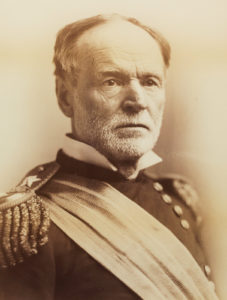
Union general had no patience with those who complained about war

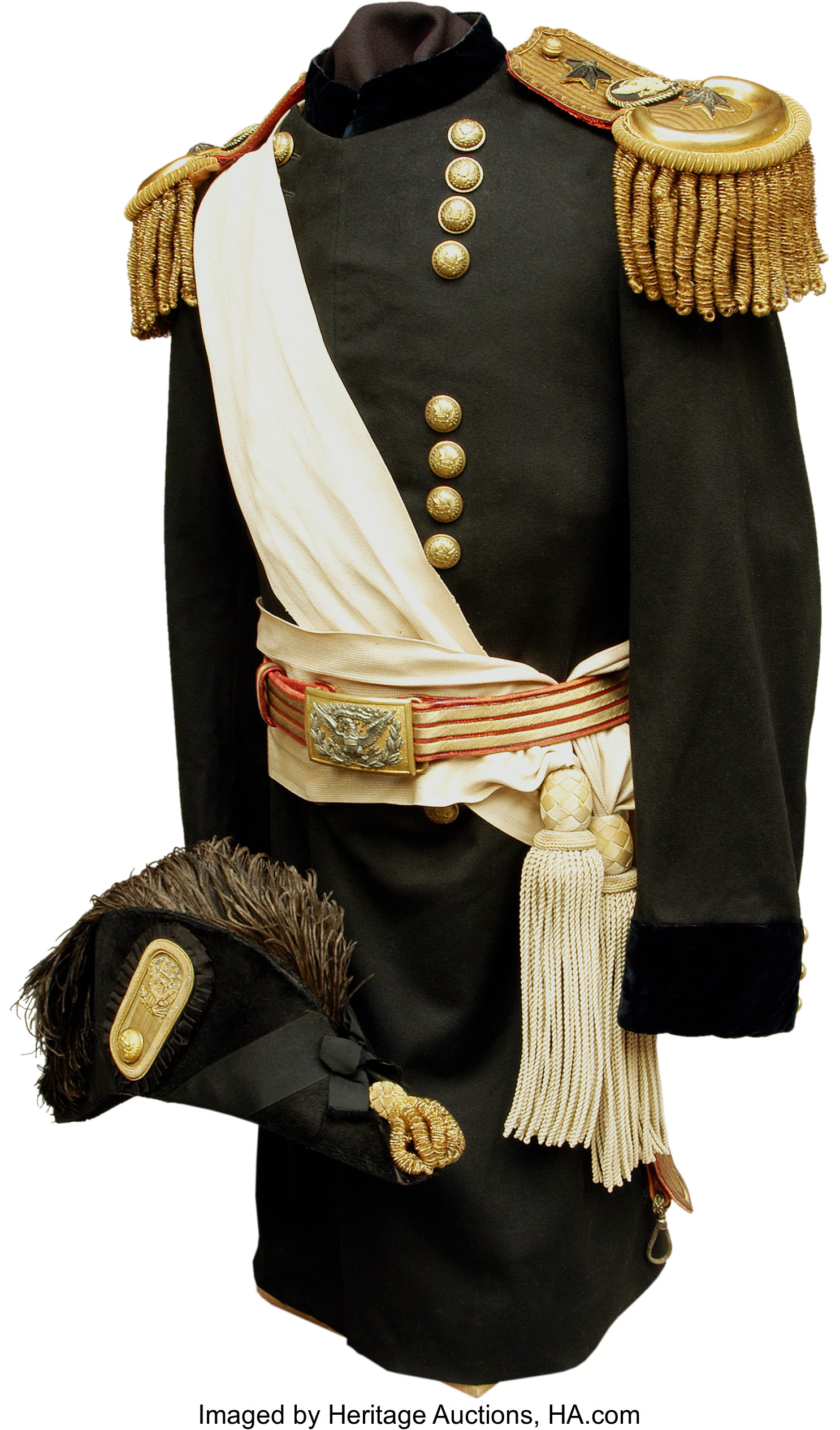
William Tecumseh Sherman’s dress uniform as general of the Union Army sold for $62,500 at a June 2018 Heritage auction.

“I beg to present you as a Christmas gift the city of Savannah with 150 heavy guns and plenty of ammunition and also about 25,000 bales of cotton.” – Maj. Gen. William Tecumseh Sherman, Dec. 22, 1864, telegram to President Lincoln

By Jim O’Neal

From mid-November 1864, there had been no word from William Tecumseh Sherman or his Union Army. President Lincoln, anxious about the fate of 60,000 soldiers, tried to conceal his concern, telling one crowd, “We all know where he went in, but I can’t tell where he will come out.”

Gen. Ulysses S. Grant was far less concerned as he followed his lieutenants’ progress in the Southern press and assembled supplies to send to Savannah, along with the Union Army’s mail. In early December, his reports indicated that Sherman had arrived in Savannah on Dec. 10. Eleven days later, Sherman occupied the mostly evacuated city, but once again, they had failed to cut off the retreat of the Rebel Garrison. With this communication, Sherman brought to a conclusion his famous March to the Sea.

Sherman

Arguments still flare up over the destruction that occurred during this critical episode of the Civil War, but Sherman’s primary target was property, not people, and his troops were not alone in terrorizing the countryside. The Confederate Cavalry, deserters from both sides, and bands of “bummers” both black and white contributed their share to the chaos. As Sherman observed, “Sweeping around generally through Georgia for the purpose of inflicting damage would not be good generalship.”

Rather, what he aimed to do was intimidate and terrorize Southerners to break their will to continue fighting. It was psychological warfare. “These people made war upon us, defied and dared us to come South to their country where they boasted they would kill us.” He had no patience with those who protested or complained. The strategy worked where there was total destruction and there was no means to fight on, but pride and ignorance kept the war alive in other places where leaders refused to accept the inevitable.

Critics of Sherman’s March that complain about his scorched-earth policy typically overlook his occupation of Savannah. He basically left it alone after the inhabitants accepted defeat, except when merchants tried to reclaim the cotton he had captured. Sherman was far more interested in their return to the Union than continual martial law that would only result in further alienation.

By conventional strategy, Sherman’s next move should have been the immediate transfer of his Army by water to Virginia, where Grant had Gen. Robert E. Lee’s Army of Northern Virginia bottled up behind fortifications at Petersburg. The Federal Navy had the ships available. Both Lincoln and Grant supported this plan, but Sherman disagreed. Instead, he wanted to apply total war – as he had in Georgia – to the Carolinas.

He especially wanted to punish South Carolina, “the Palmetto State,” for its role in starting the war. He was convinced that by bringing the war to the Carolinas’ home front, his operations would have a direct bearing on the struggle in Virginia. Even the people in Georgia prodded him to pay their neighbors a visit. As Sherman later observed, “My aim then was to whip the rebels, humble their pride, to follow them to their innermost recesses and make them fear and dread us.”

By late January 1865, Sherman’s 60,000 veterans commenced the march into South Carolina and he stopped his communications. It would be late March before he commented on the most controversial issue of the campaign – the burning of Columbia, the state capital. His instructions to the commander of the Army of Georgia, Maj. Gen. Henry Warner Slocum, were direct: “The more of it you destroy, the better it will be. The people of South Carolina should be made to feel the war, for they brought it on and are responsible for our presence here. Now it is time to punish them.”

By the end of the month, he was on his way to North Carolina, with the end of the war coming into sight. “It is only those who have never fired a shot nor heard the shrieks of the wounded,” Sherman said, “who cry aloud for blood, more vengeance, more desolation.”

Intelligent Collector blogger JIM O’NEAL is an avid collector and history buff. He is president and CEO of Frito-Lay International [retired] and earlier served as chair and CEO of PepsiCo Restaurants International [KFC Pizza Hut and Taco Bell].
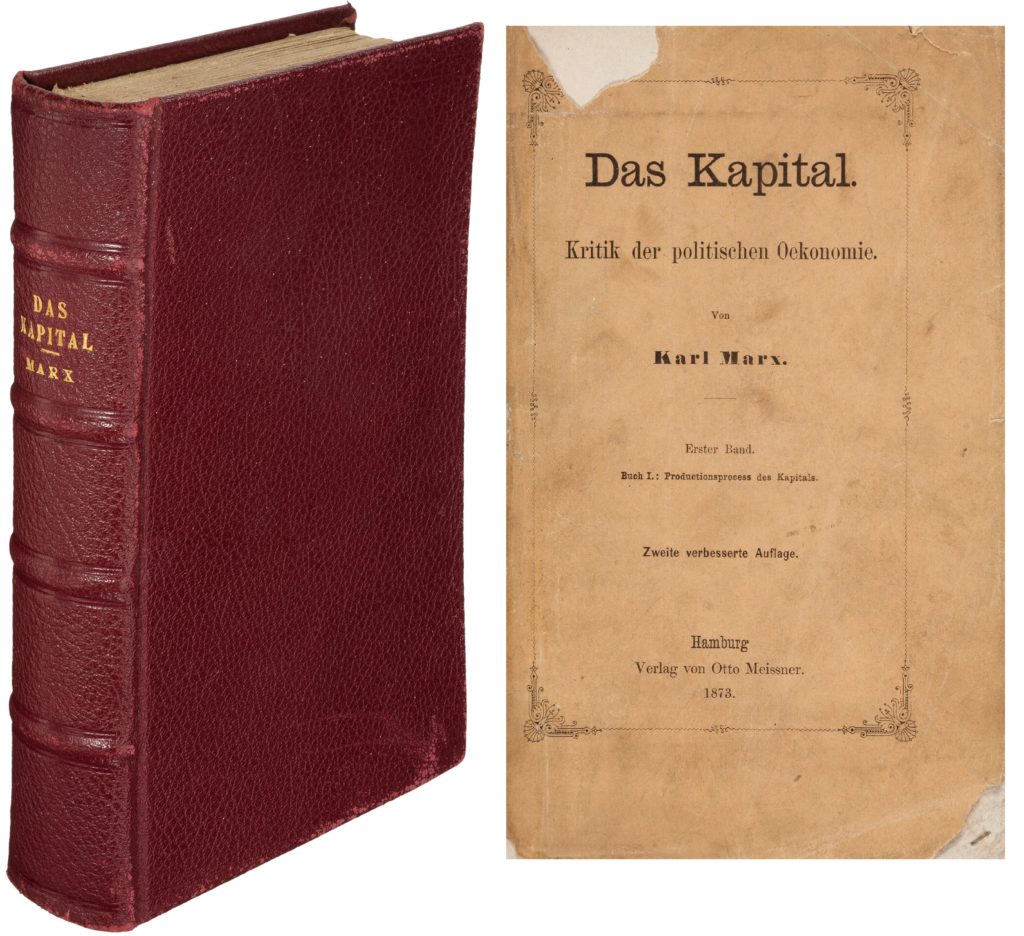
As a ‘champion’ of the working man, Marx lived the high life

A second edition of the first volume of Karl Marx’s Das Kapital (Hamburg: Otto Meissner, 1872) sold for $3,500 at a March 2018 Heritage auction.

By Jim O’Neal

When Ho Chi Minh lived in London, training as a pastry chef under Auguste Escoffier at the Carlson House, he used it as a pillow. Fidel Castro claimed he read 370 pages (about half) in 1953 while he was in prison after a failed revolutionary attack of the barracks of Moncada in Santiago de Cuba. President Xi Jinping of China hailed its author as “the greatest thinker of modern times.”

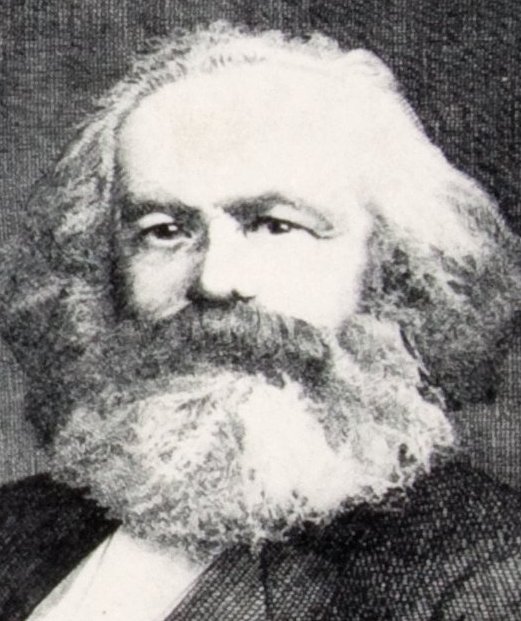
It’s been 200 years since Karl Marx was born on May 5, 1818, in Trier, Germany. His book Das Kapital was published in 1867, or at least that was when Volume 1 made its way into print. His friend and benefactor Friedrich Engels edited Volumes 2 and 3 after Marx’s death.

Karl Marx

Engels (1820-1895) was born in Prussia, dropped out of high school and finally made it to England to help run his father’s textile factory in Manchester. On his trip, he met Marx for the first time, but it would be later before their friendship blossomed. Perhaps it was due to Engels’ 1845 book The Condition of the Working Class in England.

He had observed the slums of Manchester, the horrors of child labor, and the utter impoverishment of laborers in general and the environmental squalor that was so pervasive. This was not a new indictment since Thomas Robert Malthus (1766-1834) had written, albeit anonymously, about these abysmal conditions. However, he had blamed the poor for their plight and opposed the concept of relief “since it simply increases their tendency to idleness.” He was particularly harsh on the Irish, writing that a “great part of the population should be swept from the soil.”

Not surprisingly, mortality rates soared, especially for the poor, and the average life expectancy fell to an astonishing 18.5 years. These lifespan levels had not existed since the Bronze Age and even in the healthiest areas, life expectancy was in the mid-20s, and nowhere in Britain exceeded 30 years.

Life expectancy had largely been uncertain until Edmond (the Comet) Halley obtained a cache of records from an area in Poland in 1693. Ever the tireless investigator of any and all scientific data, he suddenly realized he could calculate the life expectancy of any person still alive. From these unusually complete data charts, he created the very first actuarial tables. In addition to all the many other uses, this is what enabled the creation of the life insurance industry as a viable service.

One of the few who sympathized with the poor was the aforementioned Friedrich Engels, who spent his time embezzling funds from the family business to support his collaborator Karl Marx. They both passionately blamed the industrial revolution and capitalism for the miserable conditions of the working class. While diligently writing about the evils of capitalism, both men lived comfortably from the benefits it provided them personally. To label them as hypocrites would be far too mild a rebuke.

There was a stable of fine horses, weekends spent fox hunting, slurping the finest wines, a handy mistress, and membership in the elite Albert Club. Marx was an unabashed fraud, denouncing the bourgeoisie while living in excess with his aristocratic wife and his two daughters in private schools. In a supreme act of deception, he accepted a job in 1851 as a foreign correspondent for Horace Greeley’s New-York Tribune. Due to his poor English, he had Engles write the articles and he cashed the checks.

Even then, Marx’s extravagant lifestyle couldn’t be maintained and he convinced Engels to pilfer money from his father’s business. They were partners in crime while denouncing capitalism at every opportunity.

In the 20th century, Eugene Victor Debs ran for U.S. president five consecutive times as the candidate of the Socialist Party of America, the last time (1920) from a prison cell in Atlanta while serving time after being found guilty of 10 counts of sedition. His 1926 obituary told of him having a copy of Das Kapital and “the prisoner Debs read it slowly, eagerly, ravenously.”

In the 21st century, Senator Bernie Sanders of Vermont ran for president in 2016, despite the overwhelming odds at a Democratic National Convention that used superdelegates to select his Democratic opponent. In a series of televised debates, he predictably promised free healthcare for all, a living wage for underpaid workers, college tuition and other “free stuff.” I suspect he will be back in 2020 due to overwhelming support from Millennials, who seem to like the idea of “free stuff,” but he may have 10 to 20 other presidential hopefuls who’ve noticed that energy and enthusiasm.

One thing: You cannot call Senator Sanders a hypocrite like Karl Marx. In 1979, Sanders produced a documentary about Eugene Debs and hung his portrait in the Burlington, Vt., City Hall, when he became its mayor after running as a Socialist.

As British Prime Minister Margaret Thatcher once said: “The problem with Socialism is that eventually you run out of other people’s money.”

JIM O’NEAL is an avid collector and history buff. He is president and CEO of Frito-Lay International [retired] and earlier served as chair and CEO of PepsiCo Restaurants International [KFC Pizza Hut and Taco Bell].
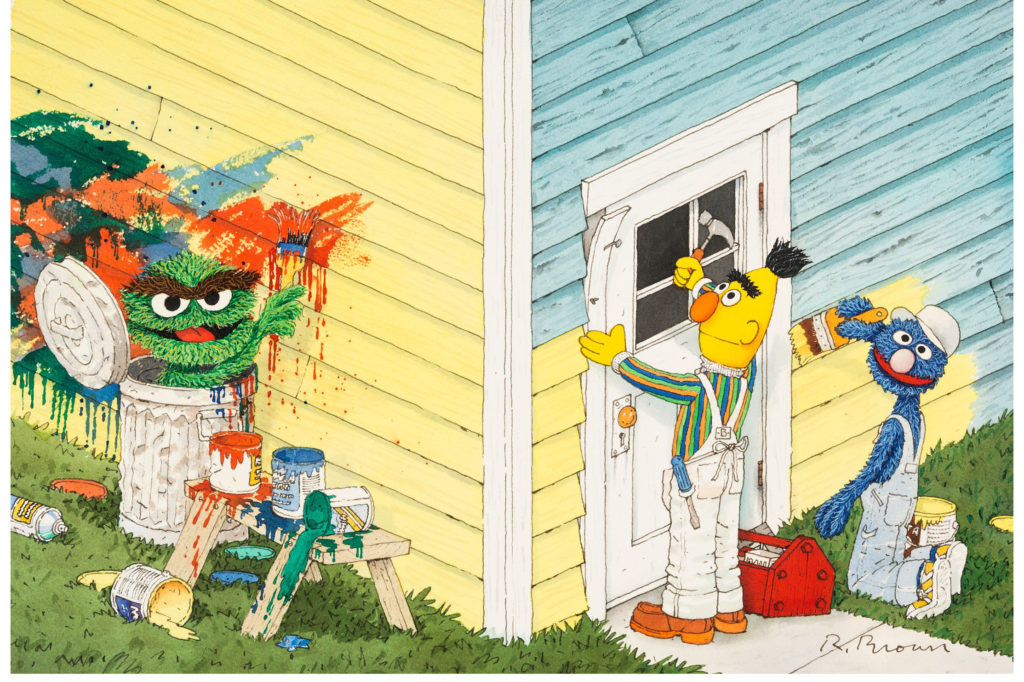
‘Sesame Street’ inspired by the simple idea of making the world a better place

The original illustration for the July/August 1980 cover of Sesame Street Magazine, by Rick Brown, sold for $2,390 at a December 2017 Heritage auction.

By Jim O’Neal

Can you tell me how to get to Sesame Street?

It’s a question millions of children have been asking every day for the past 50 years. In a single television season, 1969, Sesame Street became the most famous street in America, eclipsing Wall Street, Madison Avenue and even (every town has one) Main Street. So how did we get here in the first place?

Television producer Joan Ganz Cooney recalls a “little dinner party” in 1966 with her husband, Tim Cooney, and Lloyd Morrisett – an executive as the Carnegie Corporation – who asked an innocent but sincere question: “Do you think television can be used to teach young children?” In his book Street Gang: The Complete History of Sesame Street, author Michael Davis writes about Morrisett watching his young daughter sitting in front of their TV watching a test pattern, but who also knew popular TV ad jingles from memory. That sparked a lightbulb question: “What else could she learn and remember?”

Joan Ganz Cooney (b.1929) had already become interested in working for educational television through her work as a documentary producer for WNET, New York’s first educational TV station. She thought about Morrisett’s dinner-party question and answered, “I don’t know, but I’d like to talk about it.” As it turned out, they did a lot more than simply talk.

She claims none of them had any idea when they started that Sesame Street and the Children’s Television Workshop (CTW) would grow into the international institutions they are today. Or that Sesame Street, winner of more Emmys than any other show (167 Emmys and eight Grammys), would also become the longest street in the world, benefiting more children in more countries than any program in history. None of them had any idea that the characters – wonderful, zany and vulnerable Muppets that taught children about letters, numbers and getting along – would become an integral part of American culture, or that they were creating a family that every child watching would feel a part of.

They only knew for sure that they wanted to make a difference in the lives of children and families, particularly low-income children. When they began their work in the late 1960s, this seemed imminently possible. It was a time when many believed they had the responsibility and power to make the world a better place, even if only just a little better. Note: Some of us are still absolutely certain this will happen. For any doubters, just be aware that for the first time in recorded history, more than 50 percent of the world’s population is now living above the poverty line!

Sesame Street’s goal was more modest (and only in retrospect, revolutionary): to use television to help children learn (full stop)!

They knew children watched a great deal of television in the years before pre-school. They were well aware that they loved cartoons, game shows and situation comedies; that they responded to slapstick humor, music with a beat and, above all (sadly), fast-paced, oft-repeated commercials. If they could create an educational show that capitalized on some of commercial television’s most engaging traits – high production values, sophisticated writing – they could attract a sizeable audience that included, most importantly, low-income children.

There was a lot of betting against them because of the number of UHF stations in the public television system, especially in pre-cable days. But their basic instincts were almost impeccable. The wasteland was too vast and the yearning for something better too great. Sesame Street was an instant hit and remains so yet today.

On a personal note, I don’t recall ever watching it (I was 32 when it debuted), but I recall that Big Bird is 8-foot-2 and I knew Joan Ganz’s second husband, Peter G. Peterson, who she married in 1980. He was an absolutely remarkable man who was CEO of Bell & Howell and co-founder of the Blackstone Group with Stephen Schwarzman in 1985 when I was heavily involved in minority business development for Frito-Lay. He was the one who first made me aware of the implications of the national debt and the cruel burden we are passing to the next generation. Peterson’s book, Running on Empty, is still a classic, even as the situation has only gotten worse. The only one who doesn’t seem to get it is New York Times columnist and Noble Prize-winner Paul Krugman, who could easily be a character on Sesame Street if he ever learns his multiplication tables.

JIM O’NEAL is an avid collector and history buff. He is president and CEO of Frito-Lay International [retired] and earlier served as chair and CEO of PepsiCo Restaurants International [KFC Pizza Hut and Taco Bell].
Childhood has always been tough, but let’s not go too far

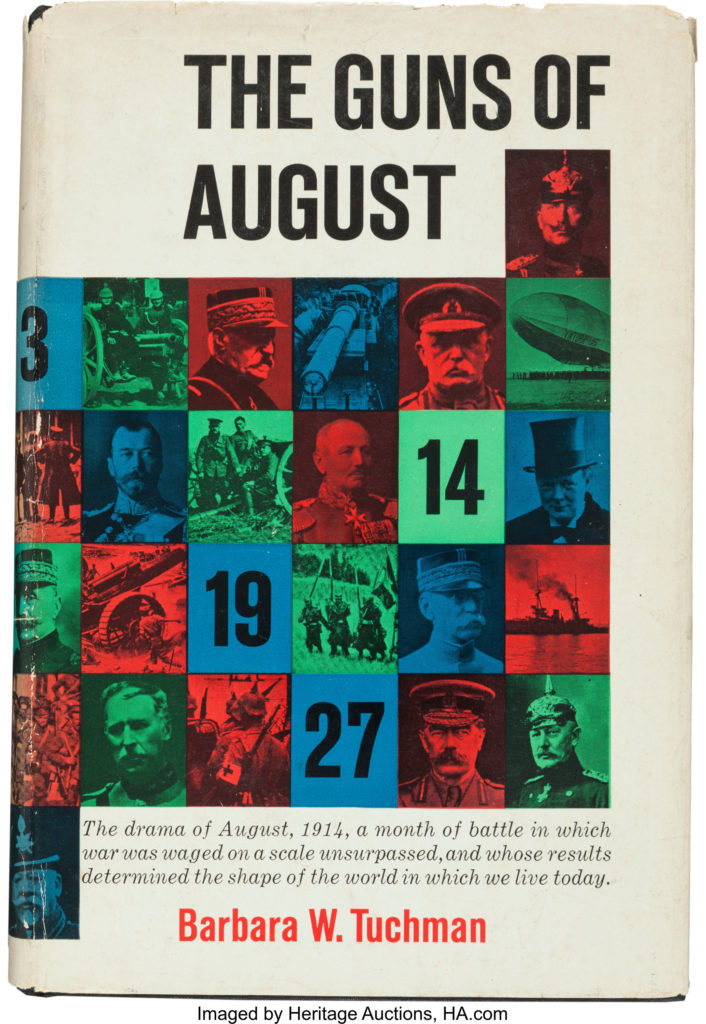
A 1962 first edition, first printing of The Guns of August, signed by author Barbara Tuchman, sold for $625 at an April 2013 Heritage auction.

By Jim O’Neal

Simply mention the name of Barbara Tuchman and it brings back fond memories of her wonderful book The Guns of August, which won the Pulitzer in 1963. It brilliantly explains the complicated political intrigue that started innocuously in the summer of 1914 and then erupted into the horrors of the First World War. It is always a good reminder of how easily our foreign entanglements can innocently provoke another, except survivors today would call it the Last World War.

Tuchman (1912-89) won a second Pulitzer for her biography of General “Vinegar Joe” Stilwell and his travails in China-Burma-India during World War II. He was faced with trying to manage/control aviator Claire “Old Leatherface” Chennault and his famous Flying Tigers. He also had to contend with Chiang Kai-shek, who eventually became the first president of the Republic of China (1950-75). This dynamic duo conspired to have General Stilwell removed and were finally successful by badgering a tired and sick FDR.

However, it was a totally different award-winning book Tuchman published in 1978 that was much more provocative and controversial (at least to me). In A Distant Mirror: The Calamitous 14th Century, she writes, “Of all the characteristics in which the medieval age differs from the modern, none is so striking as the comparative absence of interest in children.” She concluded, chillingly, that “a child was born and died and another took its place.”

Tuchman asserted that investing love in young children was so risky, so unrewarding, that everywhere it was seen as a pointless waste of energy. I politely refuse to accept that our ancestors were ever so jaded and callous. Surely, there was at least a twinge of sorrow, guilt or emotion.

Yet earlier, French author Philippe Ariès in his Centuries of Childhood made a remarkable claim that until the Victorian Age “the concept of childhood did not exist.” There is no doubt that children once died in great numbers. One-third died in their first year and 50 percent before their 5th birthday. Life was full of perils from the moment of conception and the most dangerous milestone was birth itself, when both child and mother were at risk due to a veritable catalog of dangerous practices and harmful substances.

And it was not just happening to poor or needy families. As Stephen Inwood notes in A History of London, death was a visitor in the best of homes and cities. English historian Edward Gibbon (The History of the Decline and Fall of the Roman Empire) lost all six of his siblings while growing up in the 1700s in Putney, a rich, healthy suburb of London. In his autobiography, Gibbon describes his childhood as “a puny child, neglected by my mother, starved by my nurse.” So death was apparently totally indifferent in choosing between rich and poor; but that is a far cry from not having a childhood per se.

To extend this into a situation where mothers became totally indifferent to young children because of high rates on infant mortality and thus it made little sense to invest emotionally in infants defies logic. Obviously, parents adjusted and had many children in order to guarantee that a few would survive … just as a sea turtle lays 1,000 eggs to have a few survive. To do otherwise is to invite extinction.

The world these respected people write so persuasively about would have been a sad, almost morbid place, with a landscape of tiny coffins. I say where is the proof?

JIM O’NEAL is an avid collector and history buff. He is president and CEO of Frito-Lay International [retired] and earlier served as chair and CEO of PepsiCo Restaurants International [KFC Pizza Hut and Taco Bell].
President Lincoln can teach us a little about working together

A scarce copy of The Photographs of Abraham Lincoln featuring nearly 150 images relating to the president sold for $5,250 at a June 2015 Heritage auction.

By Jim O’Neal

No matter where you stand on the current controversy over the Supreme Court nomination process, it’s almost a certainty that irrespective of the outcome, you haven’t changed your opinion (much). There are just too many places to find others who totally agree with you and who validate your position. Technically, it’s called an “echo chamber” and we are surrounded by it.

Never fear, someone will share your viewpoint and increase your confidence level in believing that you are right … irrespective of what others think.

The 24/7 cable news business model was built on this premise and increased eyeballs, resulting in higher ratings, which drive higher advertising rates. They probably caught on from analyzing newspapers, who learned early that good news doesn’t sell as well, just as their street vendors learned that shouting “Read all about it (fill in the blank)” sold newspapers. Living in the U.K. for five years finally broke my habit, but it was mostly sensory overload from all the tabloids rather than my preference for a juicy story, regardless of the topic.

People who study the echo chamber have been writing about the increase in “tribalism,” in the sense that people are actually moving to communities, joining clubs and sharing social media with like-minded people at an accelerating rate. I suppose this will continue, but I haven’t found a tribe that will have me. In fact, quite the opposite, since I much prefer hearing a broadly diverse spectrum of ideas.

I relish hearing opinions about climate change, gun control, border security, health care, policing our cities, the Electoral College, the Iraq War, media bias and so on … especially from smart people who have fresh ideas … instead of stale recycled talking points borrowed from others. I regularly read both The New York Times and The Wall Street Journal to get basic balance. The only line I draw is at wild conspiracies, unless they’re packaged by people who are also highly entertaining (e.g. Oliver Stone and his JFK or Platoon).

Doris Kearns Godwin’s Team of Rivals does a terrific job of explaining this concept, using the election of 1860 and how Abraham Lincoln leveraged his administration by filling three of his top Cabinet posts with his main election rivals. They became part of the solution rather than critics. In my opinion, the U.S. Congress should practice this to gain consensus rather than relying on an appellate system and the Supreme Court to shape our legal landscape.

JIM O’NEAL is an avid collector and history buff. He is president and CEO of Frito-Lay International [retired] and earlier served as chair and CEO of PepsiCo Restaurants International [KFC Pizza Hut and Taco Bell].